
Advice needed on leaky cap cleanup!

  • Thread starter Thread starter WhyreByter
  • Start date Start date
  • Replies Replies 10
  • Views Views 2971

WhyreByter

Member
AmiBayer
Joined
Oct 18, 2010
Posts
176
Country
USA
Region
Washington State
Hi folks!

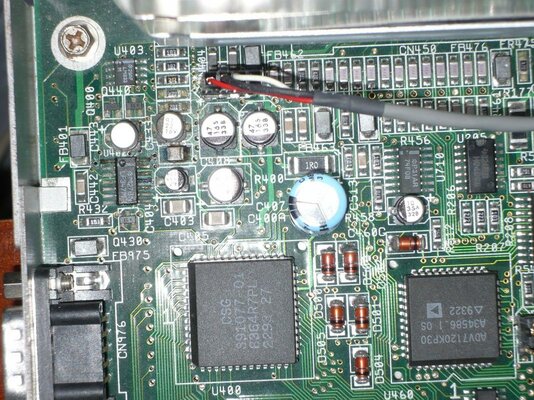
So, I'm the happy new owner of an a4000D, but have a problem. The machine boots up, displays, mouse works, etc. (didn't test audio). But, upon opening her up, I found a number of leaky caps. I've attached a snap shot of the audio circuit area, which is one of the worst areas.

I'm looking for some advice on how far to go in fixing this. I ordered a cap kit from Cosmos right away, but it will take a week or so for it to get here. In the meantime, my gut tells me to take a ton of pictures to document where everything goes, and to pull the old caps as soon as possible. Followed by liberal application of lemon juice, IPA, and gentle scrubbing to prevent further damage.

My question is around how much proactive cleanup I should do. Take, for instance, the cap just below C433, which has green fuzz on the solder joints. Is that just a scrub and neutralize? Or should that get a wicking of old solder, and application of new? Or a complete removal/cleanup/replacement? Likewise the resistors above C433.

Likewise the IC (LF347M) below C443, which really scares me. It looks like leads 1 and 11 are really bad off. Is that just a cleanup, or a remove/replace? Ditto Q400/Q440 above C443.

This area is, by far, the worst. The RTC doesn't work after some light battery leakage, but that area is nothing compared to this.

Thanks!
WhyreByter
 

Attachments
  • P1000945.jpg
    P1000945.jpg
    210.5 KB · Views: 8
Last edited:
Just tested out the audio, and at least the right channel works. Can't get a plug on the left due to my a520 adapter being plugged in (haven't set up my monitor yet). So, that's something, at least! :)

--WhyreByter
 
I would say, that once the source of the contamination is removed, ie the caps, the rest of the area should be just cleaned and neutralised.
Once clean it will be easier to assess if there is any actual damage.
 
Capacitors leaks base chemicals on the board, the same as battery leakage, only not that corrosive. But still corrosive.

Use lemon juice or spirit vinegar on the area for a few minutes to up half an hour, then wash the entire board with tap water and let it dry for a couple of days on a vented cupboard.

Do not expose the motherboard to direct sunlight in Summer times!

If you are in a hurry, after washing the board with water, pour copious amount of IPA (isopropyl alcohol) over it, let it dry a bit on a well vented area then use a hair dryer to finish the job.

No, paint stripper guns are not good to dry a board!
 
Acid vs. base...

Acid vs. base...

Thanks for the info; the caps will be coming off this weekend, and an initial cleanup done.

But, this has always confused me...

According to some references (such as wikipedia), electrolytic caps insides are an acid, not a base.

Which means that we should use something that's base to counter it. Lemon juice and vinegar are acids.

What am I missing?

Thanks!
WhyreByter
 
@WhyreByter

the electrolyte is an Alkaline solution of sodium hydroxide =)

Now when they leak, like a battery can form both sodium hydroxide and sodium peroxide. In the picture you have taken there is a leak that has a lot of reaction with the pads and tracks in the local circuit.

Its not that bad and should easily be repaired with a little effort.

firstly you need to neutralize the Alkaline, to do this you need a mild acid... like acetic acid... spirit vinegar or lemon juice is the way to go here.

I did an explanation in this post as to how, why and to repair -

remember a capacitor is very much like a battery.

Zetr0 said:
okay here goes - heres the science bit - I tried to keep it from A level chemistry as possible without going into full mind-numbing and tongue swallowing reaction equations.

There would be better ways to say this but this is the laymen expression, if anyone feels a better expression or more detail is require please add to or post on =D

It is a bit winded this post so jump to the end of it to catch the highlights.


Still here? then Lets Begin =)


Whats is the NiCad Battery?


Rechargeable battery on the A500 is the same on the A2000 - it is a NiCad (Nickle Cadmium) Accumulator.

A NiCad Battery consists of nickel oxide hydroxide, and metallic cadmium as electrodes - this is then immersed in (potassium hydroxide [KOH]) an alkaline electrolyte.


When it leaks: Reaction Time

Initially what happens is the reaction process here starts off with with the battery leak - this causes the Potassium Hydroxide to react with the air.... this over a time and room temperature will create Potassium Perxoide. Both of these chemicals react quite strongly with Copper.

Peroxide is a VERY strong oxidizer, when you have this combined with Copper (an oxidizing metal) you have a very compound problem, as you can imagine what starts off small will crescendo to a larger problem in a short space of time.

Environmental factors do play a part in this, from temperature to air humidity - all effect this copper - potassium hydroxide / peroxide reaction.

Now potassium peroxide is an inorganic compound with the molecular formula K2O2, it is also a mild alkaline to a base pending on its strength.


How do we fix it?

To neutralize an alkaline we must use an acid: of course acid will also react with Copper, in fact there are very few things copper wont react with, so we need something safe and controllable - Acetic acid (i.e. spirit vinegar) - although this would react with copper - its relatively insignificant when compared to the peroxide base that has built up in concentrations on the PCB.

The acetic acid neutralizes the base and provides an alternative for oxidization with the peroxide being that its an organic compound. As a plus point it also breaks down the concentrated Copper Hydroxide (those blue/green fuzzy bunnies) left over from previous reactions.


But why?!?!?

Copper Hydroxide is mildly amphoteric, This is the double whammy for the copper tracks as the more that reacts the more alkaline is produced thus the more it reacts until it runs out of oxygen/copper..

There are four driving factors for this reaction

1. The amount of potassium hydroxide that leaks
2. The amount of potassium hydroxide that reacts to form potassium peroxide
3. The air humidity
4. The temperature of the PCB and environment.

I could go on with the forming of crystal and copper dendrites and electrical impedance - but that's only going to bore the pants off every one lol


In short (for those that skipped)

1. A NiCad battery has an alkaline electrolyte.
2. Electrolyte leaks and reacts with air to form a strong oxidizer
3. Copper is an verilent Oxidizing metal
4. Electrolyte is an Alkaline and will concentrate to a Base
5. Copper reacts with Oxidizer causing more Alkaline
6. Alkaline reacts with Copper and Air creating more Alkaline

Once the battery leaks its like lighting a fuse to a firework and running away.


There that just about sums it up... where as the wet capacitors use sodium hydroxide - thus not being as strong as potassium hydroxide - they still can cause some serious damage when they do leak and are not cleaned up.

Heat is the biggest fail point of capacitors, and this is a triple whammy as temperature will increase the rate and concentration of the damage.


hope that ramble post
 
@Zetr0 - Thanks, as always, for your detailed response! I'm still a bit confused, based on the available info on the internet, but based on seeing the reaction of lemon juice on battery stuff, I'm convinced that way. <shrug>

Looks like my weekend fun is planned out! :)

Cheers!
WhyreByter
 
Zetr0 is spot on....

Lemon juice (or more correctly, citric acid) is used extensively in the metal finishing industry as a metal brightener, as it's not acidic enough to etch the metal surface.

I saw it used at BNFL Springfields on the magnesium / aluminium alloy fuel cans for the Magnox reactors, and they came out super shiny!! :cool:

We're getting the whole retro restoration thing sussed out totally on here....
 
Well snap. I didn't even know it had leaking caps. I tested it and it was working fine. Audio was working too. That is discouraging to me as I have a A4000's, a A1200 and two A600's (which one is dead, probably due to caps!) and I am sure I will have lots of leaking caps to deal with. Just great. Unfortunately I am not good enough to do SMD soldering so I guess when they go I will be in trouble. I'm sure once you get the new caps on she will be good as new...
 
Back
Top Bottom