

For those of you with deep pockets and the desire to buy something in the realms of the C65 or Amiga walker / A1400 / nyix etc etc
on Ebay ( no link here) there is a
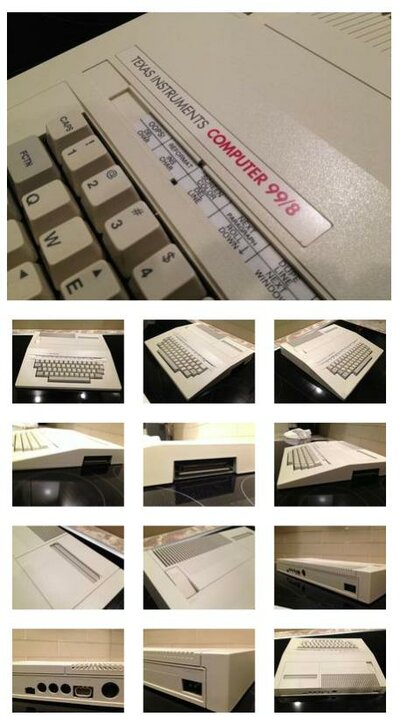
TI-99/8 COMPUTER - Texas Instruments Holy Grail
obviously we cannot link or discuss PRICE! but its an interesting machine and worth a nosey if nothing else...
an engineering sample and full working computer, which in its self is extremely rare. (and yes RARE on this occasion means rare as most ti99/8 didn't work or were incomplete in some way.)
estimates are that 50 to 100 machines were built before TI pulled out of the market and closed the computer division 1984 - with losses of over $300 million.
PS.
nope im not selling it nor am i related to the owner...
mike.
Wiki details:
The TI-99/8 was intended to be a major improvement over the TI-99/4A. It met that mark in all but one respect: the TMS-9118 video processor used on both versions of the TI-99/8 has a feature set almost identical to that of the TMS-9918A used in its predecessor.
Memory
There is 64KB of random access memory standard on both versions of the TI-99/8 motherboard, with the possibility of extending that to 15MB using memory cards in the Peripheral Expansion Box (PEB). 220 KB of System ROMs contains the code for the operating system, the HexBus I/O interface, TI Extended BASIC II, and the core support routines for the UCSD p-System. Most of the ROMs were actually GROMs, a specialized medium-speed memory chip developed by TI with its own 13-bit address bus. GROMs are treated as devices by the operating system. The majority of surviving machines do not have fully-functional versions of the UCSD p-System GROMs (or don't have them at all).
Speech Synthesis
There is no need for an external speech synthesizer for the TI-99/8, as it is included on both versions of the motherboard.
Speed
The TI-99/8 uses a TMS-9995 microprocessor clocked at 10 MHz. The main screen has an option to slow this down to the same speed as a TI-99/4A so that arcade game software written for the older machine remains playable.
Operating System
The source code for the TI-99/8 is available and has been assembled to create an emulated version of the computer operating under MESS. The commented code is located on the WHTech FTP site, along with documents containing the specifications for interfacing with the Hex-Bus peripherals and the source code for the TI-99/8 implementation of the Hex-Bus Interface. The website for the Amarillo User's Group also has documents outlining the known bugs in the code available to us. Most of these bugs are within Extended BASIC II.
Peripherals
Two different avenues to peripheral expansion exist: cards for the PEB and/or HexBus peripherals. Bus speed dictates that memory expansion devices must connect through the PEB, as the HexBus does not have sufficient throughput to support it. Note that many of the peripheral expansion cards designed for the TI-99/4A will also work with the TI-99/8. Follow the link for descriptions of the various TI-99/8 Peripherals.
However, some more test with the emulation in MESS showed that most peripheral cards will not work in Extended Basic II which is built into the TI-99/8 console. Still, cartridges like Editor/Assembler may work with the PEB cards.
Software
Very little software designed specifically for the TI-99/8 was produced. Most of the cartridge software for the TI-99/4A works, with some notable exceptions. The Extended BASIC cartridge does not work at all, because it conflicts with the built-in Extended BASIC II. The Editor Assembler cartridge fails when it checks for the 32K Memory Expansion card as part of its startup routine. There are problems with the Terminal Emulator II cartridge, in that only the terminal emulation functions of the cartridge work. Third-party cartridges also have problems, as the V3.0 Operating System installed in the TI-99/8 expects at least one GROM in the cartridge and won't execute those that don't have one present.
Extended BASIC II adds many useful functions and commands to the Extended BASIC programmer's tool set. It also recognizes a much larger memory space. A standard TI-99/8 console shows approximately 60K of free space for programs, and the addition of a 128K Memory Expansion increases that to over 170K.
UCSD Pascal V4.11
The version of the p-System delivered with the TI-99/8 is an incremental improvement over Version 4.0 (the version installed on the p-Code card for the TI-99/4A). The system allows programs up to approximately 62K in size, and it is designed to utilize the 128K Memory expansion space for program variable storage and stack space when present (64K each).
on Ebay ( no link here) there is a
TI-99/8 COMPUTER - Texas Instruments Holy Grail
obviously we cannot link or discuss PRICE! but its an interesting machine and worth a nosey if nothing else...
an engineering sample and full working computer, which in its self is extremely rare. (and yes RARE on this occasion means rare as most ti99/8 didn't work or were incomplete in some way.)
estimates are that 50 to 100 machines were built before TI pulled out of the market and closed the computer division 1984 - with losses of over $300 million.
PS.
nope im not selling it nor am i related to the owner...
mike.
Wiki details:
The TI-99/8 was intended to be a major improvement over the TI-99/4A. It met that mark in all but one respect: the TMS-9118 video processor used on both versions of the TI-99/8 has a feature set almost identical to that of the TMS-9918A used in its predecessor.
Memory
There is 64KB of random access memory standard on both versions of the TI-99/8 motherboard, with the possibility of extending that to 15MB using memory cards in the Peripheral Expansion Box (PEB). 220 KB of System ROMs contains the code for the operating system, the HexBus I/O interface, TI Extended BASIC II, and the core support routines for the UCSD p-System. Most of the ROMs were actually GROMs, a specialized medium-speed memory chip developed by TI with its own 13-bit address bus. GROMs are treated as devices by the operating system. The majority of surviving machines do not have fully-functional versions of the UCSD p-System GROMs (or don't have them at all).
Speech Synthesis
There is no need for an external speech synthesizer for the TI-99/8, as it is included on both versions of the motherboard.
Speed
The TI-99/8 uses a TMS-9995 microprocessor clocked at 10 MHz. The main screen has an option to slow this down to the same speed as a TI-99/4A so that arcade game software written for the older machine remains playable.
Operating System
The source code for the TI-99/8 is available and has been assembled to create an emulated version of the computer operating under MESS. The commented code is located on the WHTech FTP site, along with documents containing the specifications for interfacing with the Hex-Bus peripherals and the source code for the TI-99/8 implementation of the Hex-Bus Interface. The website for the Amarillo User's Group also has documents outlining the known bugs in the code available to us. Most of these bugs are within Extended BASIC II.
Peripherals
Two different avenues to peripheral expansion exist: cards for the PEB and/or HexBus peripherals. Bus speed dictates that memory expansion devices must connect through the PEB, as the HexBus does not have sufficient throughput to support it. Note that many of the peripheral expansion cards designed for the TI-99/4A will also work with the TI-99/8. Follow the link for descriptions of the various TI-99/8 Peripherals.
However, some more test with the emulation in MESS showed that most peripheral cards will not work in Extended Basic II which is built into the TI-99/8 console. Still, cartridges like Editor/Assembler may work with the PEB cards.
Software
Very little software designed specifically for the TI-99/8 was produced. Most of the cartridge software for the TI-99/4A works, with some notable exceptions. The Extended BASIC cartridge does not work at all, because it conflicts with the built-in Extended BASIC II. The Editor Assembler cartridge fails when it checks for the 32K Memory Expansion card as part of its startup routine. There are problems with the Terminal Emulator II cartridge, in that only the terminal emulation functions of the cartridge work. Third-party cartridges also have problems, as the V3.0 Operating System installed in the TI-99/8 expects at least one GROM in the cartridge and won't execute those that don't have one present.
Extended BASIC II adds many useful functions and commands to the Extended BASIC programmer's tool set. It also recognizes a much larger memory space. A standard TI-99/8 console shows approximately 60K of free space for programs, and the addition of a 128K Memory Expansion increases that to over 170K.
UCSD Pascal V4.11
The version of the p-System delivered with the TI-99/8 is an incremental improvement over Version 4.0 (the version installed on the p-Code card for the TI-99/4A). The system allows programs up to approximately 62K in size, and it is designed to utilize the 128K Memory expansion space for program variable storage and stack space when present (64K each).
Attachments
Last edited:


