
You are using an out of date browser. It may not display this or other websites correctly.
You should upgrade or use an alternative browser.
You should upgrade or use an alternative browser.
GoldenGate vortex 386
- Thread starter cugar124
- Start date
- Replies 99
- Views 12725


Hi.
Latest news from my GG386 experiments.
- i have tried to update the RAM to 16 MB and i have bought some nice 4 MB simms with 2 chips here https://www.ebay.fr/itm/115420643997 . Unfortunately the GG386 does not boot with them with just a very faint beep from the onboard speaker. I have read somewhere from a 90's source that the board wants simms with 9 chips and not the so-called "new simms with 3 chips" (new in the early 90's of course). Seems it doen't like either my post-modern 2 chips simms. However, as my clips are broken there is always a doubt about the simms making bad contact as they are smaller than the one of 1 MB i have with 9 chips. Need to find 4 * 4 MB SIMMs with 9 chips @60 ns for a nice price.
- i have noticed the original simms were 70 ns and not 60, so i removed the setup for the O wait state. With 1 wait state, the init driver from the MK8330 does launch but games still don't find the card themselves. So, i have removed completely and returned to a SB16 Vibra 16 CT4170 with no OPL2/3 but CQM emulation and this one works perfect. Not a bad thing as i am amongst those who actually like a bit the CQM sound and this board has clean output with no noise and no hanging note MIDI bug for the MT32/SC55.
No need for the CTCM TSR, Unisound works pefect with the board with everything working ok. No PnP IRQ problem.
I will use the very good MK8330 again with the Commodore A2386 later, in this computer or another. It seems the GG386 does not like the MK8330 no matter what i do.
- i have tried to install a CF Microdrive in the 40 pins female IDE adapter plugged directly into the IDE port of the GG with power via a floppy connector. The board don't like it either, boots with crazy beeps and then the output from my VGA board is scrambled so i can't access bios setup. Had to remove it and return to my hardfile.
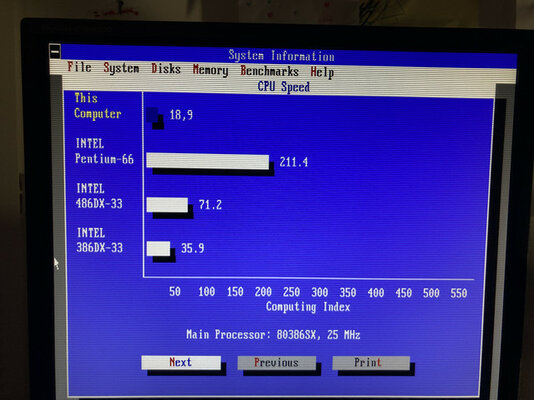
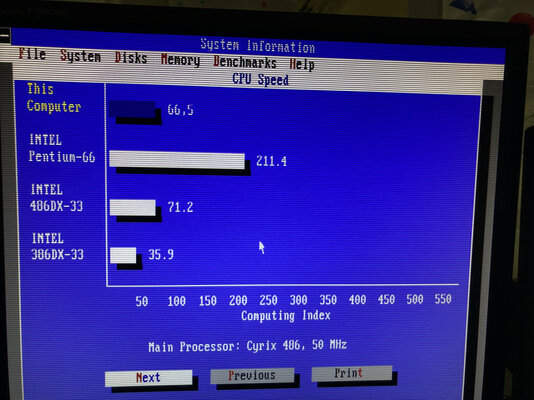
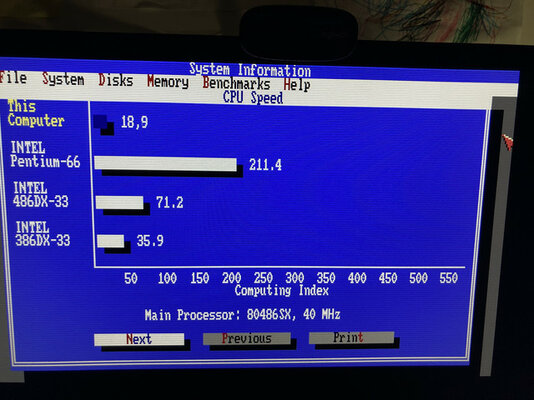
- Finally, for reference here are some benchmark results of Norton Sysinfo:
* the GG386 AMD 386sx @25MHz
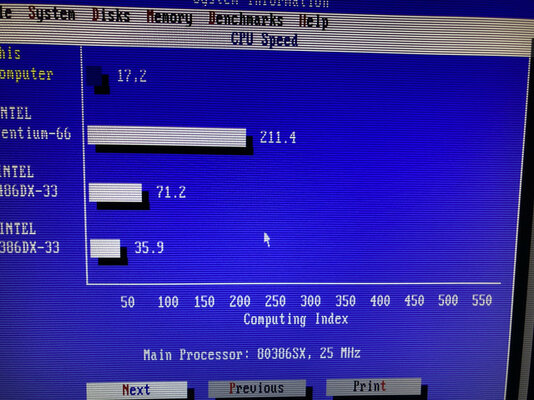
* The Commodore A2386 with Intel 386sx @ 25MHz - faster than GG386
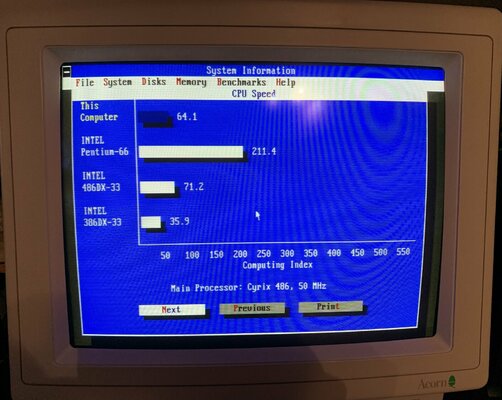
* The Commodre A2386 with Cyrix 486SRX2@50 MHz - almost a 486 DX33
* PCTask with 68060@50 MHz pretending to be a 486sx cpu, roughly equivalent to a 386sx@25 (but the video emulation is slow even with a lot of RAM and Z3 RTG board so it is nowhere as smooth as any 386 bridgboard)
Latest news from my GG386 experiments.
- i have tried to update the RAM to 16 MB and i have bought some nice 4 MB simms with 2 chips here https://www.ebay.fr/itm/115420643997 . Unfortunately the GG386 does not boot with them with just a very faint beep from the onboard speaker. I have read somewhere from a 90's source that the board wants simms with 9 chips and not the so-called "new simms with 3 chips" (new in the early 90's of course). Seems it doen't like either my post-modern 2 chips simms. However, as my clips are broken there is always a doubt about the simms making bad contact as they are smaller than the one of 1 MB i have with 9 chips. Need to find 4 * 4 MB SIMMs with 9 chips @60 ns for a nice price.
- i have noticed the original simms were 70 ns and not 60, so i removed the setup for the O wait state. With 1 wait state, the init driver from the MK8330 does launch but games still don't find the card themselves. So, i have removed completely and returned to a SB16 Vibra 16 CT4170 with no OPL2/3 but CQM emulation and this one works perfect. Not a bad thing as i am amongst those who actually like a bit the CQM sound and this board has clean output with no noise and no hanging note MIDI bug for the MT32/SC55.
No need for the CTCM TSR, Unisound works pefect with the board with everything working ok. No PnP IRQ problem.
I will use the very good MK8330 again with the Commodore A2386 later, in this computer or another. It seems the GG386 does not like the MK8330 no matter what i do.
- i have tried to install a CF Microdrive in the 40 pins female IDE adapter plugged directly into the IDE port of the GG with power via a floppy connector. The board don't like it either, boots with crazy beeps and then the output from my VGA board is scrambled so i can't access bios setup. Had to remove it and return to my hardfile.
- Finally, for reference here are some benchmark results of Norton Sysinfo:
* the GG386 AMD 386sx @25MHz
* The Commodore A2386 with Intel 386sx @ 25MHz - faster than GG386
* The Commodre A2386 with Cyrix 486SRX2@50 MHz - almost a 486 DX33
* PCTask with 68060@50 MHz pretending to be a 486sx cpu, roughly equivalent to a 386sx@25 (but the video emulation is slow even with a lot of RAM and Z3 RTG board so it is nowhere as smooth as any 386 bridgboard)
Last edited:
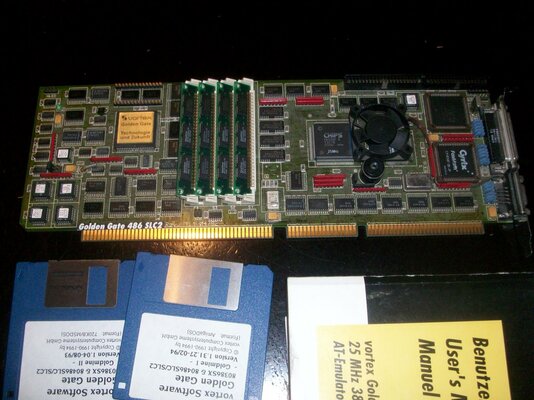
Indeed. Care to share a closer picture with the ref of that RAM?
They say here than we need 9 chip RAM http://obligement.free.fr/articles/goldengate_configuration.php
I have confirmation from the maker of my new SIMMs that " IBM PC compatible may need parity RAM, older 386 and 486 systems may only work with 4MB modules with 8 or 9 chips (11 address lines A0-A10 available)"
Maybe it is different for the SLC2 board which came later with newer program in the GALS?
I think i also should have my SIMM sockets replaced to rule out contact problems with those small SIMMs.
Funny that even with the 8kb cache the board is still a bit slower than the A2386 with the Cyrix 486SLC2 chip and 1 kb of cache. What is the difference? Board chipset maybe?
They say here than we need 9 chip RAM http://obligement.free.fr/articles/goldengate_configuration.php
I have confirmation from the maker of my new SIMMs that " IBM PC compatible may need parity RAM, older 386 and 486 systems may only work with 4MB modules with 8 or 9 chips (11 address lines A0-A10 available)"
Maybe it is different for the SLC2 board which came later with newer program in the GALS?
I think i also should have my SIMM sockets replaced to rule out contact problems with those small SIMMs.
Funny that even with the 8kb cache the board is still a bit slower than the A2386 with the Cyrix 486SLC2 chip and 1 kb of cache. What is the difference? Board chipset maybe?
Not sure, but in practice the 8k chip is significantly faster than the 1k cyrix chips. i had a 50mhz cyrix on this board until the TI was used to replace it, and the upgrade is well worth it. Games like Doom will run at 16fps with 8k cache, so as fast if not faster than a 25mhz 486SX
Well, they do not fry in seconds, there is evidence on here and on vogons forum of people using these chips for many years without problem, me includedThose TI486SLC2 chips with 8kb seem hard to come by now in 5V version. Only 3,3V ones are widely available and would fry in seconds if soldered on the bridgeboards.
Do you have a picture of the chip underneath your fan? As it is a GG486SLC2 i guess it is the original cpu or did you solder anything else?
If ou are refering to those chips available on Ebay https://www.ebay.fr/itm/39436245893...Q9xiYOYPXWtS3DAQ1MDFSN6ImMs=|tkp:BFBMipre3s1h
-G50 part are confirmed to be 3,3V and so-called 5V tolerant, which means 5V for I/O not core according to the reference guide from Texas Instrument i have read and according to several Vogons threads on this matter.
Member @Spirantho has also proven this voltage issue before.
There are similar cpu in 5V core and I/O which should be ***---050 instead of G50.
If someone managed to use a G50 one without killing it, he must have used some kind of voltage adapter.
If ou are refering to those chips available on Ebay https://www.ebay.fr/itm/39436245893...Q9xiYOYPXWtS3DAQ1MDFSN6ImMs=|tkp:BFBMipre3s1h
-G50 part are confirmed to be 3,3V and so-called 5V tolerant, which means 5V for I/O not core according to the reference guide from Texas Instrument i have read and according to several Vogons threads on this matter.
Member @Spirantho has also proven this voltage issue before.
There are similar cpu in 5V core and I/O which should be ***---050 instead of G50.
If someone managed to use a G50 one without killing it, he must have used some kind of voltage adapter.
The one I use is one of the purported 5v I/O tolerant parts. It’s been fine for nearly 5 years. If it were going to fry it would have done so already. I use a slim heatsink and fan.
Post #6 here is interesting
 forum.vcfed.org
Post #6 here is interesting
IBM PS/1 Model 2121 CPU Upgrade (386 to 486)
Hey all! I recently attempted to follow the example set forth on this blog: http://www.zonadepruebas.com/viewtopic.php?t=6184 and upgrade my IBM PS/1's CPU from an Intel 386SX to a Ti 486. See attached photos of my solder-in replacement. However, when I turn the computer on, I do not seem to be...
forum.vcfed.org
Amazing. Spirantho did not suceed in doing so.
The thread you mention links to another thread where the guy is using some kind of voltage regulator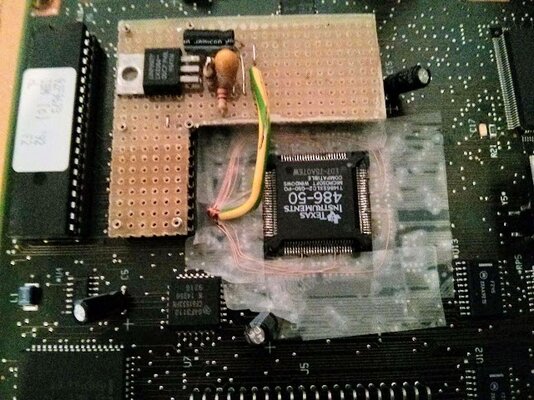
I might buy one and see what can be done the, but if the step from 3,3V to 5V generates a lot of heat it would be an issue in my computers which sacrify airflow for silence.
The thread you mention links to another thread where the guy is using some kind of voltage regulator
I might buy one and see what can be done the, but if the step from 3,3V to 5V generates a lot of heat it would be an issue in my computers which sacrify airflow for silence.
Yeah, I admit I’m surprised that these TI chips seem to work ok and so far without issue. Perhaps I am simply lucky with the one I have, and I appreciate that a sample size of me isn’t particularly representative, but I do know that others have also used these chips and so far they’ve been ok.
Worth a try perhaps, if the risk of desoldering the Cyrix chip isn’t deemed too high.
Worth a try perhaps, if the risk of desoldering the Cyrix chip isn’t deemed too high.

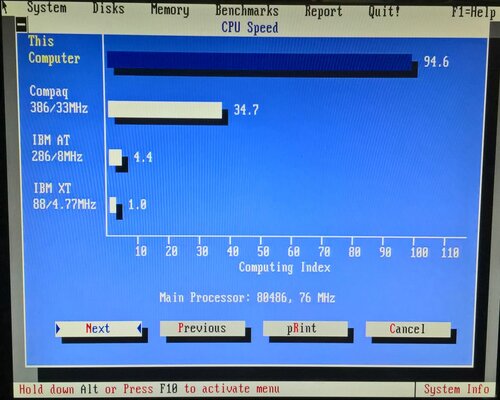
I can do so tomorrow!
Here another picture with the Commodore Bridgeboards tested...

Impressive result with the TI chip overclocked. How does it sustain the heat? When i wanted to add a fan on the CX486SLC2@50, i didn't find a proper fan of the right size (and Noctua don't make that small), then i wanted to use an adapter to use 40 mm over 25 mm but there was not enough room in the computer for so much bulk.
On the other hand, for actual games i wanted to play with the A2386 (1990 to 1994 era), there was no real differences compared to the A2386 for my kind of games (Dune, adventure games, RPG, etc) and finally no interest to have so much speed. Then come Doom and the like. Doom is fine to play on the Cyrix@50 and is not at all on the 386sx@25, but problem is it is much better and faster on the Amiga with 68060 (even with General Midi music). There is also a competition with Mac emulation (Dark Forces ok with Shapeshifter 68060, tough on the bridgeboards).
On the other hand, for actual games i wanted to play with the A2386 (1990 to 1994 era), there was no real differences compared to the A2386 for my kind of games (Dune, adventure games, RPG, etc) and finally no interest to have so much speed. Then come Doom and the like. Doom is fine to play on the Cyrix@50 and is not at all on the 386sx@25, but problem is it is much better and faster on the Amiga with 68060 (even with General Midi music). There is also a competition with Mac emulation (Dark Forces ok with Shapeshifter 68060, tough on the bridgeboards).
Last edited:
Now, i have found two 4 MB 30 pin SIMM with 9 Toshiba chips at 60 ns.
I have tried to use them in S1 and S2 banks as per manual, but the card did not boot.
However, with two of my old 1 MB SIMM in banks S1 and S2 and the 4 MB SIMM in S3 and S4 the card does boot with 10 MB of RAM. I am mixing here 60 and 70 ns chips though. The board still works at 0WS.
I need to find two other 30 pins SIMM, preferably the same as the two others to have 16 MB and 60 ns.
I have also taken the opportunity to try another audio board, with the clean and reliable Yamaha Audician 32 Plus. It happens that the board does have a lot of noise at bus HIGH setting, and is ok at bus LOW. I am surprised, it is a board from late 90's.
I have tried to use them in S1 and S2 banks as per manual, but the card did not boot.
However, with two of my old 1 MB SIMM in banks S1 and S2 and the 4 MB SIMM in S3 and S4 the card does boot with 10 MB of RAM. I am mixing here 60 and 70 ns chips though. The board still works at 0WS.
I need to find two other 30 pins SIMM, preferably the same as the two others to have 16 MB and 60 ns.
I have also taken the opportunity to try another audio board, with the clean and reliable Yamaha Audician 32 Plus. It happens that the board does have a lot of noise at bus HIGH setting, and is ok at bus LOW. I am surprised, it is a board from late 90's.
The one I use is one of the purported 5v I/O tolerant parts. It’s been fine for nearly 5 years. If it were going to fry it would have done so already. I use a slim heatsink and fan.
Yup same for me, also using a G50 TI on a A2386 without issues. With a small cooler on top it seems to do quite well.Yeah, I admit I’m surprised that these TI chips seem to work ok and so far without issue. Perhaps I am simply lucky with the one I have, and I appreciate that a sample size of me isn’t particularly representative, but I do know that others have also used these chips and so far they’ve been ok.
As to the GG, I could also still use some 4x4MB SIMMs if any of you should be lucky enough to source some working ones for it.
Hello there.
I have removed the GG386 from my system, now that my A2386 is back and better than ever.
About the GG386, i confirm there is definitly something odd in the way the board works with audio cards. During those last weeks, i have been using a MK8330, a Vibra16 CT4170 and an Audician 32Plus. The first one was almost not working at all, but all three had weird driver behaviour that do not exist with the A2386. I had to use UNISOUND to have them doing some music, but either original drivers did not work, or some games didn't see the cards or had their setup programs freezing (including the very compatible Dune). All three boards are just fine with same games and A2386, so that's not directly related to the audio cards or their drivers. I know Trixster uses a SB64AWE. I do own a SB64AWE Value but i didn't try that one because it is not perfectly period correct for games from before 1994 and its MIDI port is not usually compatible enough to drive a Roland MT32. Also, SoftMPU acts funny with the GG386. Sometimes, it can catch the interrupt of the audio card, and most of the time not, for those games which need intelligent mode.
There is also the problem of the music slowing down in some games, then accelerating to catch up (Keropi related the same thing in some old posts), except with the Audician in my case.
Now, i'm sending this one to be upgraded with the TI486SLC2 and serve as a reference to repair a fried GG486SLC i also have.
Speaking of which, here are a few info i learned :
- the chip with the GoldenGate sticker is a FPGA from AT&T or Xilinx. It is not permantly programmed but has CMOS ram and its program is loaded from the GoldenGate software when the card starts.
- there is no difference between GG386, GG486SLC and GG486SLC2 apart that the GG386 has 512 KB onboard RAM soldered and the two others have the same area empty, and possibly the content of the GAL chips which would probably explain why 4 MB SIMM with less than 9 chips works for some users and not others (most likely the later boards such as GG486SLC2 have newer GAL contents and more RAM parameters).
For now, i need to have the contents of those GALS. I fear that the ones from my GG386 are copy protected. Looking if someone from Vortex Computersysteme is still around to release the data.
I have removed the GG386 from my system, now that my A2386 is back and better than ever.
About the GG386, i confirm there is definitly something odd in the way the board works with audio cards. During those last weeks, i have been using a MK8330, a Vibra16 CT4170 and an Audician 32Plus. The first one was almost not working at all, but all three had weird driver behaviour that do not exist with the A2386. I had to use UNISOUND to have them doing some music, but either original drivers did not work, or some games didn't see the cards or had their setup programs freezing (including the very compatible Dune). All three boards are just fine with same games and A2386, so that's not directly related to the audio cards or their drivers. I know Trixster uses a SB64AWE. I do own a SB64AWE Value but i didn't try that one because it is not perfectly period correct for games from before 1994 and its MIDI port is not usually compatible enough to drive a Roland MT32. Also, SoftMPU acts funny with the GG386. Sometimes, it can catch the interrupt of the audio card, and most of the time not, for those games which need intelligent mode.
There is also the problem of the music slowing down in some games, then accelerating to catch up (Keropi related the same thing in some old posts), except with the Audician in my case.
Now, i'm sending this one to be upgraded with the TI486SLC2 and serve as a reference to repair a fried GG486SLC i also have.
Speaking of which, here are a few info i learned :
- the chip with the GoldenGate sticker is a FPGA from AT&T or Xilinx. It is not permantly programmed but has CMOS ram and its program is loaded from the GoldenGate software when the card starts.
- there is no difference between GG386, GG486SLC and GG486SLC2 apart that the GG386 has 512 KB onboard RAM soldered and the two others have the same area empty, and possibly the content of the GAL chips which would probably explain why 4 MB SIMM with less than 9 chips works for some users and not others (most likely the later boards such as GG486SLC2 have newer GAL contents and more RAM parameters).
For now, i need to have the contents of those GALS. I fear that the ones from my GG386 are copy protected. Looking if someone from Vortex Computersysteme is still around to release the data.
Last edited:
Similar threads

- Replies
- 5
- Views
- 553


- Replies
- 12
- Views
- 980


