How many Amiga are left in the world?

  • Thread starter Thread starter YouKnowWho
  • Start date Start date
  • Replies Replies 25
  • Views Views 1450
I did the same thing in 2009, in 2010 I was coming up to 20+ Amiga's, by the end of 2010 I had most systems, in 2011 I completed the quest, finalizing the rare towers. In 2012 most systems were up and running and fully loaded, every system had a turbo card, memory expansion and most of them also graphics cards and scan doublers.
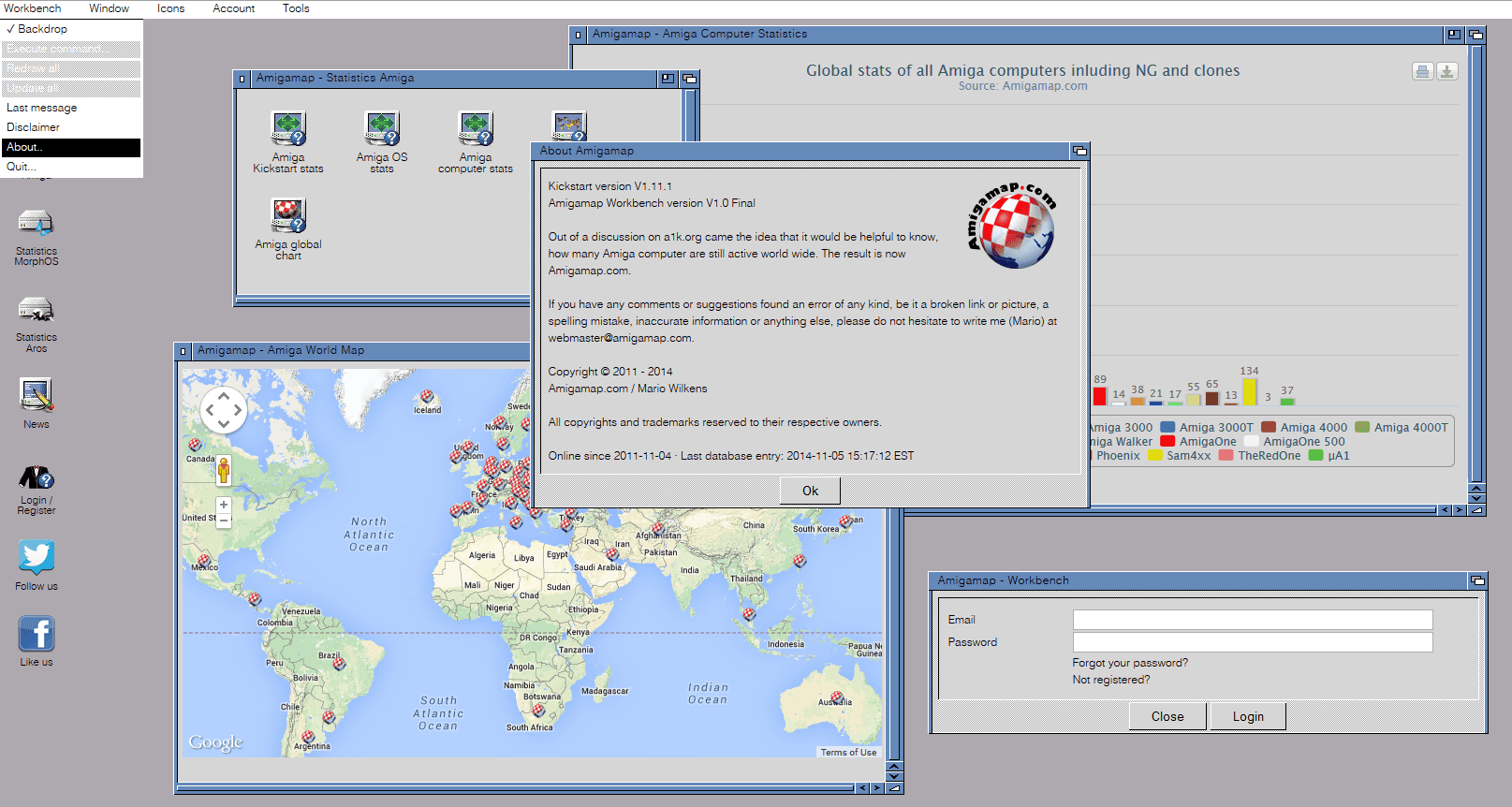

That site is a good reference, but if it's up to date ?

Thanks for sharing.
 
Where are those C128?
In France, the C128 is quite uncommon, avec the C128D even more. That's why my C128D is in my exotic computers cabinet.
 
Where are those C128?
In France, the C128 is quite uncommon, avec the C128D even more. That's why my C128D is in my exotic computers cabinet.
Most C128s were sold in North America, specifically the United States of course. In April 1988, there were 1.5 million C128 users in the United States alone. Worldwide sales reached the 2 million mark in August 1988. That allows the assumption that more than 3 out of 4 C128s were sold to US customers. By 1990, around 285,000 had been sold in West Germany. I don't think many C128s were sold in France, maybe one tenth of those sold in West Germany. Is your C128 a SECAM model?
 
Have you seen all the C128 prototypes/versions? He shows them in the Alternate Universe video. Really cool to see "new" stuff I never saw before from the times past. But sales numbers are quite surprising...potentially more 128s than ALL Amiga maybe true.
C128 numbers is an Internet misunderstanding, number taken for sales repports that combines C64 and C128 for the C128 years. Actual c128 numbers are much less, probably less than 1 million all together. Been done research about this. I believe C64 was cheaper, more common and also consequently out sold c128 the entire c128 life span. C128 was dropped, c64 not.
 
Last edited:
Nice video by the 8-Bit-Guy. Commodore experimented with a lot of designs, but they knew the C128 would be their last 8-bit machine and, consequently, put most of their energy into the Amiga. When evaluating Amiga sales, one shouldn't forget that for two years, the Amiga existed only in the form of the very expensive A1000 model. Only in 1987 did Commodore bring out the much cheaper A500. Only then did the Amiga get a boost in sales numbers. By then, the Amiga's technological advantage over the IBM PC architecture had already begun to diminish though. By the late 1980s, the Amiga line could no longer beat out a standard IBM compatible in terms of graphics performance.
8 bit computers: cbm released c64gs in 1990? C128d-cs in 1986? PC-1 in 1988 (xt clone 8 bit), and also developed C65 to prototype stage around 90-91.
 
The C64 GS is still only a C64 in a different shape and not a newly developed machine. The PC-1 was an Intel 8088 16-bit machine (although certainly a borderline case). The C65 was the largely unofficial side project of a small group of Commodore engineers who stubbornly yet unsuccessfully tried to gain management's support. That's why the C65 never saw the light of day as a consumer product. The C128D-CR was not a new 8-bit architecture but only a revised C128D.
 
Back
Top Bottom