Interest for a C64c (250469) PLA replacement?

  • Thread starter Thread starter Deleted member 14264
  • Start date Start date
  • Replies Replies 48
  • Views Views 13991
Both of the chips you mention are now out of production so I would only be able to buy surplus chips from eBay or elsewhere.
Often, the surplus CPLDs and FPGAs components sold on eBay are rebranded. For example, the XC9536XL I have found on eBay are all rated for 5ns but they also happen to have a very smooth surface because they are actually 10 ns chips on which the surface was sanded and rebranded. You can even see the typeface and logo are smaller than the real chips.
I could buy about 50000 of those chips right now for probably $5-$8 each. Yes they are bigger, but that might be the only way to go.
As far as counterfeit etc, I've purchased several hundred ICs from this company and everything works fine. I bought almost all of the parts from them to build a GBA1000 and it is working fine. They have a return policy also so if anything is found to not work you can return it for a refund or exchange, although in 10 years of buying from them I have not found any dodgy chips yet. The company is utsource and parts for the kipper2k GBA1000 build + PicassoII + 68060 turbo board were also bought from them by "Tuxbar81". This company is very serious about supplying quality parts in small or large quantities.
If you do some research I'm sure you can find a chip that will do the job. It seems like you are just making up excuses why it can't be done, when you should be positive about it since it is a win-win situation.... you recover your investment in time many times over by selling 1000's of chips and C64 owners get chips that are getting harder and harder to find. As far as I can see there are no reasons to not do it. If a 6526 is re-made, I'm sure everyone who owns a C64 would buy several of them (the 6526 related comments above also back that up) and that's a guarantee of a successful project.
As I said above, please think seriously about making a replacement 6526. The entire Commodore community will thank you :-)
UT source is totally blacklisted for me. Back in 2011, when the M27C512-90B6 went out of production (the only really good PROM to use as a PLA substitute) I was suddenly left with no good inexpensive solution for PLA replacement. In 2015, I saw UTSource was offering them so I ordered 2. They turned out to be rebranded Winbond W27C512-45Z which generate a ton of glitches when used as PLA subs. This was discussed on Lemon64 along with a similar problem from Atmel AT27C512 PROMs.

Other people have ordered XC9536 as well as XC9536XL from this supplier and every single one of them were rebranded ICs. Original ICs are easy to distinguish as they have a slightly coarse surface and the text is etched on them. Now I buy my ICs strictly from Digikey.

UTSource is also known for having sold large quantities of ICs as 'RoHS compliant' yet they were really rebranded old ICs which all contained lead. Selling this in Europe can get you enormous fines and even get you in jail. No thanks for me.

As for the size, what good is it to make a CIA which won't even fit inside your C64/C128 because it's twice as large as the original IC ?

It seems you don't pay attention to many critical details and then label me as 'making excuses'.

Added edit:
The only adequate 'single' CPLD I can see for a substitute CIA is the XC95288XL of which the smallest package id the TQFP-144 which is 20x20mm (pins extend 24 mm wide) and it cost 18.40$US per unit.

Add to that, the price of other components for voltage regulation, the pin headers and the PCB as well as workmanship and you end up with an oversized module which would be very expensive.
 
Last edited by a moderator:
took time and read whole topic: quite interesting discussion, may i add my 2c about CIA's?

Was in need of two ic's this year, after quick search stumbled on this Ebay auction:

https://www.ebay.com/itm/1pcs-6526A-Manu-MOS-DIP-40/271679366570

have bought 4x CIA's, these arrived quickly..but..none of them worked!!!!
i am sure, these can't be original, as print on the chips say's: 43 week of 1934 wich is totally bullshit, and makes no sense
contacted the seller, he told me that there are some empty/not programmed chips in the batch present, these are "forgotten" to program..
My questions are:
1. how is this possible?
2. How they can reproduce MOS technology?
3. Maybe these are cpld's in a DIP form factor?

have also found cheap 8501 CPU's for C16, have bought 10x of them, however one week later seller came up with a message that these chips are bad quality, and cancelled my purchase...
Last drop was Xilinx XC9572XL i've bought from trusted chinese seller on Ebay.. Not one from 10x is working, so Eslapion is totally right, from now on Digi-Key only, better safe than sorry...
 
have bought 4x CIA's, these arrived quickly..but..none of them worked!!!!
i am sure, these can't be original, as print on the chips say's: 43 week of 1934 wich is totally bullshit, and makes no sense
contacted the seller, he told me that there are some empty/not programmed chips in the batch present, these are "forgotten" to program..
My questions are:
1. how is this possible?
2. How they can reproduce MOS technology?
3. Maybe these are cpld's in a DIP form factor?
I was starting to ask myself if this thread had reached a point where I start to post oscilloscope screen captures. I assure you I can.

Here's my answers to your questions:
1. It's not
2. They can't. They probably have a ton of faulty ICs or C64 boards lying somewhere and they just recycle the ICs. Maybe they confuse stuff too - I have seen fake 6526 that were actually rebranded 8250 (not 8520) but they worked real fine in an old PC serial card!!
3. The power pins wouldn't match and there would be IO mismatch too.

have also found cheap 8501 CPU's for C16, have bought 10x of them, however one week later seller came up with a message that these chips are bad quality, and cancelled my purchase...
Last drop was Xilinx XC9572XL i've bought from trusted chinese seller on Ebay.. Not one from 10x is working, so Eslapion is totally right, from now on Digi-Key only, better safe than sorry...
Last year there was a very active thread about MOS 6581 (SID) chips that were possibly counterfeit/rebranded chips. Many of them did work but their output characteristics indicated they were more than likely early versions of the SID taken from old, defective C64.
 
Last edited by a moderator:
Thank You, eslapion, for taking time to answer
Sorry for this offtopic, i just wanted to point on CIA and current replacements..

i know and totally agree, however, that seller, i have mentioned before, has sold 349 chips already, and only two or three persons claimed these are fakes, so i assume most of them are working, cause if not - they need to refund, and it's bad busines..

About short board PLA..
have repaired about 40 - 50x C64 till now. maybe i am lucky, but none of them has bad/broken 251715-01 PLA, so i think demand of these chips will be very limited, however i will be very happy to see improoved SID replacement with mouse/paddle support (as swinSID is good, but not perfect replacement) and swinSID Ultimate is just too expensive in my opinion
 
i know and totally agree, however, that seller, i have mentioned before, has sold 349 chips already, and only two or three persons claimed these are fakes, so i assume most of them are working, cause if not - they need to refund, and it's bad busines..
The problem with UTSource is that fake/counterfeit/rebranded ICs sold by them do work most of the time.

Example: If you buy an ST M27C512-90B6 from them, they will work perfectly fine when used as a 64kx8 PROM. However, the surge in demand for this specific IC is because the genuine ICs have a very low slew rate (or long rise/fall time signaling) and this makes perfect for use a PLA replacements in various Commodore computers. This low slew rate acts as a filter to glitches. So the ones you get from UTSource still work great when used as a memory chip for either kernal replacement or ROM replacement in a 1571 but they generate subtle but very real technical issues as a PLA replacement. These become obvious with cartridges such as Fastload or Super Zaxxon (the cartridge, NOT the disk version).

Other example:
I bought a couple of XC9536XL from them to check them out because they were considerably cheaper than their counterpart sold on Digikey. They all worked but they all had smooth slick surface which indicates what was originally etched on them was changed so what I suspect is they were originally rated for 10 ns and rebranded as 5ns because the 10ns versions available on eBay turn out to be more expensive than genuine ones sold by Digikey. It's also possible the units from UTSource were old 'pre-RoHS' ICs and were rebranded because they are now sold as RoHS compliant. The problem is, they do work just fine.

Concerning SID replacements, I suggest you check this out: http://www.fpgasid.de/

Sorry for this offtopic, i just wanted to point on CIA and current replacements..
Don't be sorry. You've raised an extremely important point and I'm glad you did.
 
Last edited by a moderator:
UTSource don't stock Ic's, they source them from other sellers. If they don't work or are unacceptable they have a refund or replacement policy.
As far as ROHS, no government worker in customs or wherever is going to pull apart ICs and test for lead. That's hilarious! LOL!!
ok well I won't try to convince you further that a replacement 6526 is more important than any other C64 chip, since you've obviously made up your mind that its a waste of time and effort.
I suppose now we wait for someone else to comes along (probably from forum64.de) and make a FPGA6526. If a FPGA SID can be done,then a FPGA6526 is definitely possible. If size is an issue the final PCB can have 2 or 3 PCBs stacked together and be near enough the same size and about twice the height which is perfectly fine.
Anyway, I'm sure someone will figure it out and recover their investment and sell many thousands of them. I won't post again about this here or even monitor this thread. there's no point, this is obviously the wrong place for that kind of product development.
 
Last edited:
UTSource don't stock Ic's, they source them from other sellers. If they don't work or are unacceptable they have a refund or replacement policy.
Good luck proving a product they sold you is problematic. Especially with the PLA example given above...

As far as ROHS, no government worker in customs or wherever is going to pull apart ICs and test for lead. That's hilarious! LOL!!
Well...
Producers who place non-compliant products on the EU market risk facing severe penalties that include fines, impounded goods, loss of the right to sell into the 25 EU Member States and related loss of market share, and adverse press and media coverage. Any country that can prove a product does not comply can levy fines against the vendor.

From: http://apitech.com/product-classes/why-should-i-care-about-rohs-and-lead-free-initiatives

No thanks for me...

ok well I won't try to convince you further that a replacement 6526 is more important than any other C64 chip, since you've obviously made up your mind that its a waste of time and effort.
I suppose now we wait for someone else to comes along (probably from forum64.de) and make a FPGA6526. If a FPGA SID can be done,then a FPGA6526 is definitely possible. If size is an issue the final PCB can have 2 or 3 PCBs stacked together and be near enough the same size and about twice the height which is perfectly fine.
Anyway, I'm sure someone will figure it out and recover their investment and sell many thousands of them. I won't post again about this here or even monitor this thread. there's no point, this is obviously the wrong place for that kind of product development.
How exactly does having 2 or 3 PCBs stacked allows me to put a 20mm wide chip on a 14 mm footprint ??

FPGA SID can be done because the SID is not required for the correct operation of the C64 at power-up...

If you can redo the mainboard of a C64 and have the CIAs any size or format you like (64 Ultimate and C64 Reloaded Mk1 and MK2) then of course you can create your own CIAs.

To use your own words, the entire Commodore community will not thank me if I sell toxic junk or replacement modules you can't fit in the equipment they were intended for.
 
Last edited by a moderator:
giving it one last shot for the Commodore community.... This is heading in the wrong direction. Everyone with a C64 wants to see a solution to the 6526 problem. They also want to see a new VIC-II and 6510 as well but that's another story. The bottom line is if nothing is done eventually ALL the custom chips in real C64's will die and that will be the end of the old C64. No one wants to see that happen.
I find it difficult to believe with today's technology that it's impossible to make a replacement 6526, especially with a relatively simple IO chip.
How about using a micro-controller? The SwinSID nano is an amazing product using just an Atmel ATMega88PA and a few other small SMD parts, all in the same footprint as the real SID. You have almost double the space of the SwinSID nano to play with if using an ATMega88PA or one of the other Atmel MCUs and in theory you can mount parts on both sides of the PCB so that allows even more board real estate. The trick is to just find some parts that fit the purpose and fit the board size. I think the Atmel MCU range is a good starting point and most of today's home-developed electronics are Atmel MCU-based.
 
Last edited:
giving it one last shot for the Commodore community.... This is heading in the wrong direction. Everyone with a C64 wants to see a solution to the 6526 problem. They also want to see a new VIC-II and 6510 as well but that's another story. The bottom line is if nothing is done eventually ALL the custom chips in real C64's will die and that will be the end of the old C64. No one wants to see that happen.
I find it difficult to believe with today's technology that it's impossible to make a replacement 6526, especially with a relatively simple IO chip.
The fact it's not possible to make a CIA drop-in replacement at a reasonable price right now doesn't it's not possible to make a CIA replacement (at all).

Right now, the price is too high and the physical format is not compatible but it IS possible to do it. Also here is not the right thread to discuss it. This thread is about a PLA replacement for board 250469.

How about using a micro-controller? The SwinSID nano is an amazing product using just an Atmel ATMega88PA and a few other small SMD parts, all in the same footprint as the real SID. You have almost double the space of the SwinSID nano to play with if using an ATMega88PA or one of the other Atmel MCUs and in theory you can mount parts on both sides of the PCB so that allows even more board real estate. The trick is to just find some parts that fit the purpose and fit the board size. I think the Atmel MCU range is a good starting point and most of today's home-developed electronics are Atmel MCU-based.
I don't think it's possible to use a uC to do it because the CIA requires a very fast real-time response.

Only 10 or 15 years ago it would not have been possible to make things like TOLB or GandALF and now it is. It's only a matter of time before new chips allow us to do much more for a lower price with a smaller footprint.

BTW, populating a PCB on both sides doesn't do much to help you when the CPLD you need is more than 20x20mm in size. You can't 'fold' the IC to be split across 2 different surfaces...

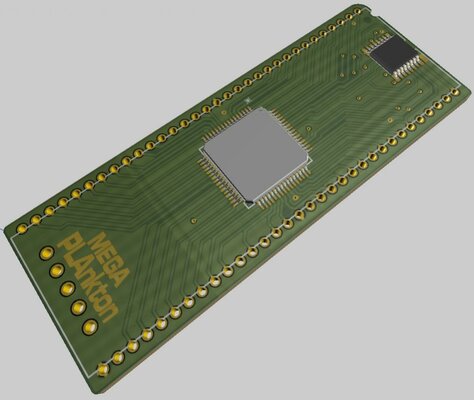
Both PLAnkton and GandALF have parts on both sides and so will this:
MP_6_top_3D_green.jpg
 
well as I said, if it's bigger, mount it on a riser board. that way it still fits in the socket and the larger chip can sit above on the top board.
can't find a pic of an example, but this is the general idea....
http://modtronix.com/images/detailed/1/sbc66ec_pt02tc_backL.jpg
obviously this is big and ugly, and the 6526 would be cleaner, smaller and using 2 smaller fine-pitched plug-in connectors at both ends.
Or...
On most C64's, the 6526's are placed together in one area, so make a dual 6526 that can plug into both sockets. a dual 6526 will definitely fit in the same space because the board will be designed to spread across both sockets. again using a riser board. problem solved.
for the type with the 6526 in a different place by itself (i.e. PCB 250469), the board can be wider by a few mm and still fit just fine so a single board with riser can be used. the trick is mount the plug-in connectors at the ends so the middle section of the riser board can be wider than the DIP socket.

as for not being able to use a mcu, that is not correct. there are super fast chips available. maybe not the Atmel Mega88PA, but definitely there are plenty of others. Think Vampire.....
 
Last edited:
well as I said, if it's bigger, mount it on a riser board. that way it still fits in the socket and the larger chip can sit above on the top board.
can't find a pic of an example, but this is the general idea....
http://modtronix.com/images/detailed/1/sbc66ec_pt02tc_backL.jpg
obviously this is big and ugly, and the 6526 would be cleaner, smaller and using 2 smaller fine-pitched plug-in connectors at both ends.
Or...
On most C64's, the 6526's are placed together in one area, so make a dual 6526 that can plug into both sockets. a dual 6526 will definitely fit in the same space because the board will be designed to spread across both sockets. again using a riser board. problem solved.
for the type with the 6526 in a different place by itself (i.e. PCB 250469), the board can be wider by a few mm and still fit just fine so a single board with riser can be used. the trick is mount the plug-in connectors at the ends so the middle section of the riser board can be wider than the DIP socket.
The CIA is not only used in the C64 and C64c. It is also used in the C128, C128D, the 1571 disk drive and the 1581. I would really like to see a suggestion which shows a couple of 3D graphics for a module with a riser board which fits into all these devices.

as for not being able to use a mcu, that is not correct. there are super fast chips available. maybe not the Atmel Mega88PA, but definitely there are plenty of others. Think Vampire.....
In the C64 and C64c, the CIA2 at DD00-DDFF controls the address lines !VA14 and !VA14 destined to the VIC-II memory map. When changes are applied to registers controlling ports PA0 and PA1, the output must reflect the changes within only a few hundred nanoseconds. This is a very far cry from emulating a SID which operates at audio speeds, it's nearly 100 times faster.

I don't know of any uC which can do something like that. I think you make this comment because you truly don't understand the requirements.

Disk accelerators like JiffyDOS, Super Snapshot or the burst mode of the C128/C128D are less demanding timingwise but they nonetheless have response speeds which far exceeds what any low level uC emulation can do. I would add that ZoomFloppy can communicate with these modes specifically because the software it runs is not running a low level emulation of a specific IC. It's running a code solely dedicated to communicating with a drive and compiled so the uC is using it's built-in capabilities the best way possible with no consideration for other aspects or the real time behavioral response of other ports.

BTW,PLAnkton is based on a CPLD because the response timing must be accurate within about 10ns. PLAnkton is more accurate than that but it's not absolutely required.
 
Last edited by a moderator:
I just had an e-mail exchange with David Viens, a very good programmer and co-owner of Plogue Art et Technologie. https://www.plogue.com/company/about/

Here is his opinion on the matter.

eslapion: I am facing a user on Amibay who seems convinced making a CIA as software on a microcontroller is possible, as for SwinSID. The necessary response speed appears considerably greater. What is your opinion ?

DavidV: I am not yet a great specialist in interfacing hardware/software but I tend to side with you for a CIA. Responding in time to external requests with an ARM can take at least 12 cycles (with an external IRQ on a pin, for example).

So playing the bus 'marshaling' for the VIC-II represents a hard real-time constraint. It would be necessary to examine the exact required timing and the wiggle room in reaction time but nothing is instantaneous with a CPU acting on external signals, you have to code intelligently and make sure IRQs are answered at the highest priority and can't be bumped.

SwinSID does not emulate the audio output with 1MHz accuracy IIRC, it cheats and it aliases a lot.

eslapion: Presently, an FPGA cannot be used because lines !VA14 and !VA15 must be operationnal right at power up and it takes some time to load it's configuration from flash or other memory.

DavidV: So it's dead (for the uC solution) because an ARM takes it's time to boot up as it has to tune 3 or 4 PLLs.
 
Last edited by a moderator:
despite what people on the net say, the C64 will boot fine without either CIA (and yes I did check this on real hardware). obviously the keyboard and ports etc wont work but it doesn't need to be there at power-on. anyway, the solution is just hold the C64 in reset for a few seconds while the FPGA etc configures itself. instead of trying to refute everything I say and make me look like the bad guy, you may want to look into it deeper and try to make it happen. this is a half-a-million dollar idea (the million dollar idea is a VIC-II replacement) and you may be one of a handful of people that could actually make it happen (this is a compliment in case you missed it), although based on your responses it's more likely to be one of the other people in that handful.
 
Last edited:
despite what people on the net say, the C64 will boot fine without either CIA (and yes I did check this on real hardware). obviously the keyboard and ports etc wont work but it doesn't need to be there at power-on. anyway, the solution is just hold the C64 in reset for a few seconds while the FPGA etc configures itself. instead of trying to refute everything I say and make me look like the bad guy, you may want to look into it deeper and try to make it happen. this is a half-a-million dollar idea (the million dollar idea is a VIC-II replacement) and you may be one of a handful of people that could actually make it happen (this is a compliment in case you missed it), although based on your responses it's more likely to be one of the other people in that handful.
If you remove the CIAs of a C64, yes it will boot up fine (I'm not so sure you can say the same of a C128 ) but the register settings given by the kernal to perform keyboard scanning and IEC access correctly will be missed and when the 'replacement' CIAs become functional, all sorts of functions related to the keyboard, disk drive access and datasette functions will have problems. Once more, you assume because you only look at the surface of things.

If you have a FastLoad or Super Snapshot cartridge (or equivalent provided through a 1541 Ultimate cart), the C64 will skip the memory test and send these register settings much earlier during the power up process.

Well, you seem to be very qualified about exactly what can and what cannot be done using presently available technology. Why don't you make a CIA replacement and I'll be happy to buy one.

For now, I consider you simply try to put pressure on me to do something unrealistic. I can assure you if it could be done using the approach you suggest, it would already exist.
 
Last edited by a moderator:
If the people at Commodore had thought like you, nothing would have been done because of immense hurdles that seemed impossible in the late 70's and early 80's.

Obviously you can't hot-plug the CIA after bootup, that's clearly not going to work. You are obviously frustrated and have glossed over and missed the important part. You simply hold the C64 in reset using the FPGA/MCU. The CIA has reset on pin 34 so a replacement CIA has access to the master reset signal and can hold reset low for as long as it needs to while the FPGA/MCU sets itself up, thus stopping the C64 from booting up. The replacement chip would obviously need it's own reset circuit for the initial boot since the master reset won't be connected to the FPGA, but that can be done easily using one tiny SMD IC (PST575). If the C64 does try to boot first, you ignore it, set up the FPGA then pull reset low for 1/4 second then the C64 resets like normal and the FPGA is then running. While in reset the C64 is not running code so it doesn't matter what you do while holding reset low. After you release reset and it goes high (after the FPGA/MCU is running) everything is normal as if the C64 was just powered on and the C64 will see the working replacement 6526 as well as all other chips.
This exact same thing is done by some other user-developed hardware for game consoles and I helped to develop that idea for that hardware (auto reset after ARM+FPGA set-up) which is being sold now.

I'm not putting pressure on you. You are not seeing the importance of this. You said yourself you are looking for a project but the project you suggest is mostly not wanted (clearly, from the above responses). I'm simply pointing out that the CIA is a very worthwhile project to invest development time in rather than some other obscure chip that won't sell in large quantities, and in the process you will financially recover all of your time and effort, which is clearly important to you. The CIA is also one of the achievable chips to replace because it is less complex than the other needed chips such as VIC or 6510.

Besides, this *has* already been done (6510+VIC-II+CIA+PLA+everything else). The Commodore DTV is a masterpiece and does everything with 2 small 5mm ICs under epoxy blobs. Probably the only person who has enough experience and info is Jeri Ellsworth. If you are serious about making replacement C64 chips, I suggest you contact her and get some technical advise. I'm sure she will be more than happy to help preserve the C64.

Anyway I will stop now. If you don't 'get it' then I give up.
In this case, to everyone concerned, please note when your C64 dies just nail the coffin shut, there's nothing you can do when the world's supply of C64 custom chips die.
 
Last edited:
If the people at Commodore had thought like you, nothing would have been done because of immense hurdles that seemed impossible in the late 70's and early 80's.
Commodore and MOS before did what they did because they could invest millions of dollars. I'm sorry to say this but Commodore 8 bit computers are a niche market today.

Obviously you can't hot-plug the CIA after bootup, that's clearly not going to work. You are obviously frustrated and have glossed over and missed the important part. You simply hold the C64 in reset using the FPGA/MCU. The CIA has reset on pin 34 so a replacement CIA has access to the master reset signal and can hold reset low for as long as it needs to while the FPGA/MCU sets itself up, thus stopping the C64 from booting up. The replacement chip would obviously need it's own reset circuit for the initial boot since the master reset won't be connected to the FPGA, but that can be done easily using one tiny SMD IC (PST575). If the C64 does try to boot first, you ignore it, set up the FPGA then pull reset low for 1/4 second then the C64 resets like normal and the FPGA is then running. While in reset the C64 is not running code so it doesn't matter what you do while holding reset low. After you release reset and it goes high (after the FPGA/MCU is running) everything is normal as if the C64 was just powered on and the C64 will see the working replacement 6526 as well as all other chips.
This exact same thing is done by some other user-developed hardware for game consoles and I helped to develop that idea for that hardware (auto reset after ARM+FPGA set-up) which is being sold now.
I missed nothing. There is absolutely no question of 'hot plugging' anything in the answer I gave you previously. If you have a replacement CIA which becomes functional after the CPU starts then it runs a real risk of not listening to accesses by the CPU which are required to configure the registers for proper operation.

If you have half a dozen replacement components, each adding their specific extension to the reset period then you could end up with a device which takes an incredibly long time to start because of some sort of reset wars.

The 1541 Ultimate can use the trick you mention above because the C64/C128 is designed so that a cart port based device can trigger or stretch the normal reset duration. The C64, C128, 1571, 1581 and Amiga 500, 1000, 2000, 3000 are not designed to have a reset triggered by one of the CIAs. I can only imagine the mess it would cause with Amiga computers.

I'm not putting pressure on you. You are not seeing the importance of this. You said yourself you are looking for a project but the project you suggest is mostly not wanted (clearly, from the above responses). I'm simply pointing out that the CIA is a very worthwhile project to invest development time in rather than some other obscure chip that won't sell in large quantities, and in the process you will financially recover all of your time and effort, which is clearly important to you. The CIA is also one of the achievable chips to replace because it is less complex than the other needed chips such as VIC or 6510.
If I didn't see the important then why is it I wasted nearly 700$ of my money and a few hundred hours of my time trying to make a CIA replacement 18 months ago?

You are not seeing the technical hurdles to do it right. In previous posts, you even suggested I use obsoleted components because you don't seem to understand the difference between getting parts off eBay and getting currently produced components from authorized distributors. Selling large volumes of electronic devices which contain components with lead or cadmium can get you arrested and sent to jail.

Besides, this *has* already been done (6510+VIC-II+CIA+PLA+everything else). The Commodore DTV is a masterpiece and does everything with 2 small 5mm ICs under epoxy blobs. Probably the only person who has enough experience and info is Jeri Ellsworth. If you are serious about making replacement C64 chips, I suggest you contact her and get some technical advise. I'm sure she will be more than happy to help preserve the C64.
Making the DTV required convincing investors to put forward the huge sums of money to make about half a million DTVs and getting the distribution chain in place so these found their way to giant consumer outlets. An ASIC was made for the DTV and this costs enormous amounts of money.

BTW, because of time and financial constaint, the DTV was released before the people who created it considered it was ready and there are a number of bugs in it. When you get big financial backers, sometimes they don't care about the technical aspects and can put pressure to do detrimental stuff.

As for your suggestion to contact 'Jeri Ellsworth', she is very much unreachable considering what her career has become. Why don't you contact her and get her to PM me here ? I answer all my PMs and e-mails.

In any case, the problem remains the same. Since I can't finance the production of millions of replacement CIAs, I have to use programmable logic. Right now, FPGAs take too much time to start-up, CPLDs are too expensive and too large, ASICs can only be made in huge quantities to get a reasonable price.

Anyway I will stop now. If you don't 'get it' then I give up.
In this case, to everyone concerned, please note when your C64 dies just nail the coffin shut, there's nothing you can do when the world's supply of C64 custom chips die.
I kindly and respectfully ask you to stop placating me with magical thinking.

I know perfectly well if I make a CIA substitute I would likely sell a lot more than PLAnkton but a CIA requires more than 200 macrocells. GandALF which was a very complicated project which doesn't sell well at all requires 50.

At what price do you think I could sell a CIA substitute ?
 
Last edited by a moderator:
The funny thing about people who have preconceived ideas about what can and cannot be done using current technology is that not only they assume certain things which cannot be done could be done, they also do the opposite.

I can't count the times I was told TOLB would never work because it signals at 0-3.3V and PLAnkton should have pull-up resistors on output. So many people don't know the correct logic signaling level in Commodore 6502 and 68k based computers is really TTL levels, not 5V CMOS levels. These machines are, in fact, compatible with 0-2.5V signaling.
 
Oh yeah, just don't bother trying to contact the knowledgeable people because it's guaranteed they won't help or will ignore you. Again, wrong direction. It's a shame you are not open enough to look outside the box and take ideas from the community.
Seriously dude, having the bullish attitude you have just makes it harder to solve the issue.
There are people on ebay selling 6526's (likely untested/dead) for between $10 - $70 each. Even at $5 each it is wasted money because it is 35+ years old and will die the same way as all the others. Buying an existing 6526 is only a bandaid solution to a serious problem that won't go away.
For a new IC with a long lifespan, I'm sure people will not complain about prices of a new 6526 replacement IC that lasts at least another 30+ years.

As for the chip in the DTV, nope, it's just a 208 pin Atmel FPGA. Common as dirt.

You might just be looking in the wrong place or looking at the wrong technology.
One possibility is this... http://ww1.microchip.com/downloads/en/DeviceDoc/40001825B.pdf
In a QFP44 it fits the size, has enough I/O ports, built in oscillator, power-on-reset, etc etc.
The QFN44 is even smaller and still easy to solder.
That is possibly not even the best type of IC in their range for this purpose, it's just something I found in research that has good I/O support and is currently in production. Or use one of the smaller versions with less ports but use 2 IC's if more features are required.
Another option is this one but is an older IC (although still available in large quantities)....
http://ww1.microchip.com/downloads/en/DeviceDoc/30292D.pdf

More importantly, the big IC companies have marketing people who are there to find the IC that fits the requirements of a customer and all you need to do is give them your spec and they will try to find something in their range that fits. An IC from the 80's has a pretty low/simple spec.
Do yourself a favor and ask the big manufacturers for assistance in finding the right IC for the specification that fits the 6526.
I'm sure one of them (Atmel/Altera/Microchip/Xilinx etc) will have something suitable but the sheer quantity of ICs from them makes it near impossible to find it for the average person. Until you ask the manufacturers to help you have not exhausted the hardware options.
That chip I linked above is pretty close in specification....
 
Last edited:
Oh yeah, just don't bother trying to contact the knowledgeable people because it's guaranteed they won't help or will ignore you. Again, wrong direction. It's a shame you are not open enough to look outside the box and take ideas from the community.
Seriously dude, having the bullish attitude you have just makes it harder to solve the issue.
...
In most of your previous posts, all you did is try to pressure me into doing things that I know are dead end. I can afford to be bullish because unlike you, I took the time and care to investigate in every minute details.

I may seem bullish to you but believe me you do seem to me like someone with a pushy upstart attitude who doesn't have a clue what he's talking about.

If you think it can be done then just do it...

Added edit:
The 2 links to PIC uCs you provided are only able to churn out up to 32MHz. It takes a huge lot more speed than that to fatihfully reproduce the functions of a CIA, especially the high speed serial port which is used by Zoomfloppy and Nibread/Nibwrite.

Maybe, just maybe, a Teensy board like this could do it: https://www.digikey.ca/product-detail/en/sparkfun-electronics/DEV-14056/1568-1464-ND/6569368
I suggest you look at the price tag...
 
Last edited by a moderator:
That's funny. The whole C64 could run on that board. You are over-complicating the 6526. Regardless, that board is still ~30 cheaper than the FPGASID and a cost-reduced version minus the microSD slot and other not-needed components would reduce it further.
Anyway, I'm sure you have not sought help from the manufacturers so that's still an opportunity to solve the problem.
 
Last edited:
Back
Top Bottom