Is there anyone on here that can repair welding inverters?

  • Thread starter Thread starter Merlin
  • Start date Start date
  • Replies Replies 19
  • Views Views 404

Merlin

Ministry of Retr0bright and Street Judge
VIP
Joined
Nov 24, 2007
Posts
15,602
Country
UK
Region
Manchester
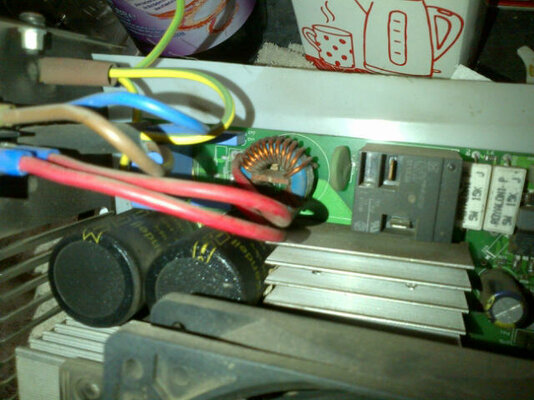
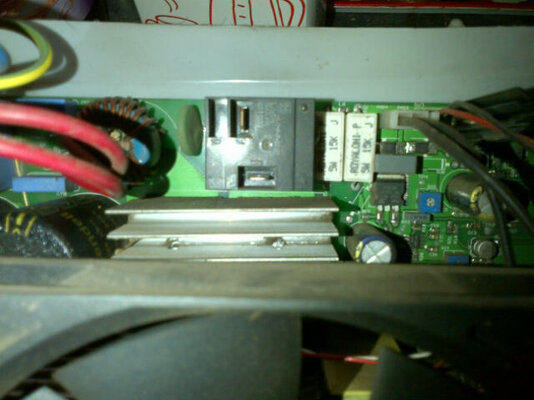
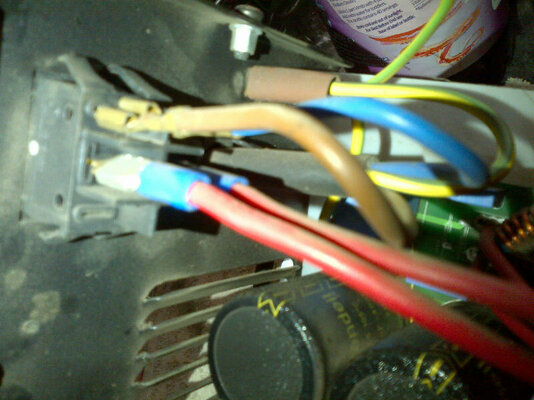
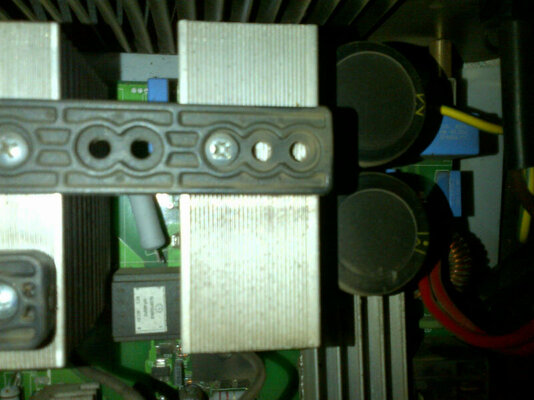
I have a couple of small Arc-TIG welding inverters that are in need of repair. I'm not that clued up on these things, but I know that dangerous voltages and current lurk inside for the unwary. Is there anyone on here whose brain I can pick about repairing these machines?

One is a Clarke AT150 Arc-Tig, the other is a Turkish make, a Kilmak Fantom 165. The Clarke is only putting out about 5 volts DC at the moment on the output side, but the internal cooling fan is running. The Kilmak is putting out about 28 volts DC, but the fan isn't working and the temperature warning LED is always on. They both work after a fashion, but they both need to be repaired.

Help, anyone?
 
Hi Merlin,
do you have schematics for these?

Bryce.
 
I'm afraid not Bryce and I can't find them on the Net. They certainly aren't available from the manufacturers.
 
Ok. Can you take and post a decent photo of the PCBs?

Bryce.
 
these will be the opposite to eht voltages?,something along the lines of 25 volts dc at the anode at 150 amps or there abouts on the output.
i suppose that will depend on the wire used for welding.
 
Last edited:
This is a stick Arc welder that can also be converted to TIG, Roy.

cache_500_1__i_32203411_RRB.jpg


I've taken the board out of the Kilmak one, so I'll take some pictures tomorrow. There's a whole row of FETs on big heat sinks on one side, I'll try and read the part numbers too.

Machine Spec:

Input Voltage: 220-240V AC, 50Hz
Current Range: 15 - 165A
Open Circuit Voltage: 65 VDC
Welding current 35%: 150A
Welding current 60% - 100%: 120 - 90A
 
Last edited:
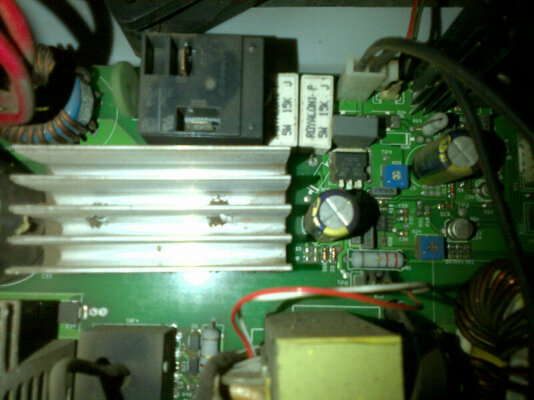
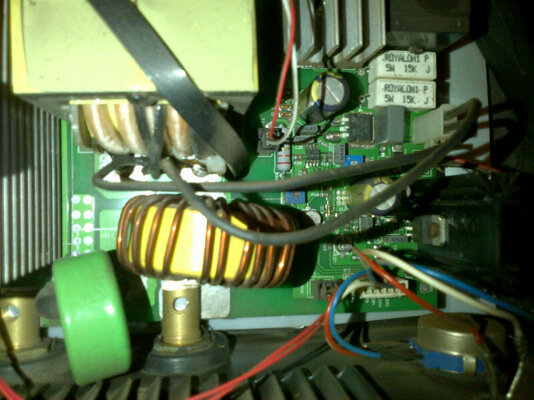
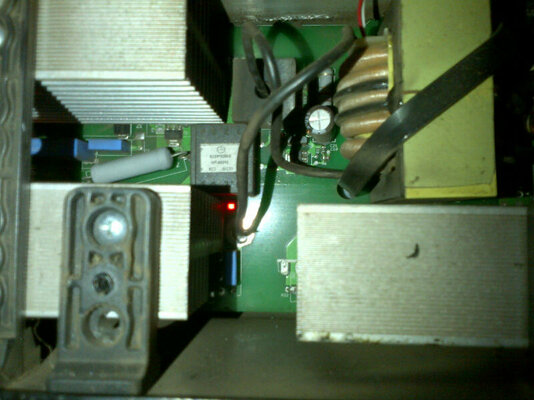
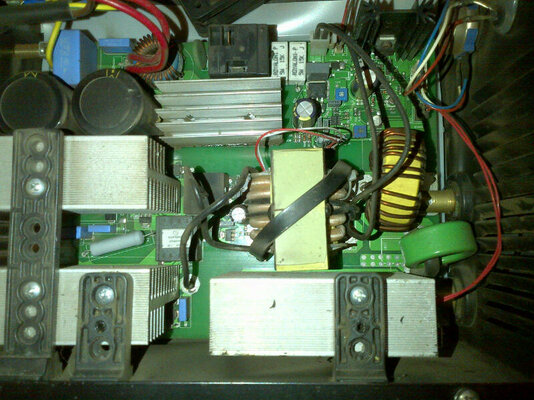
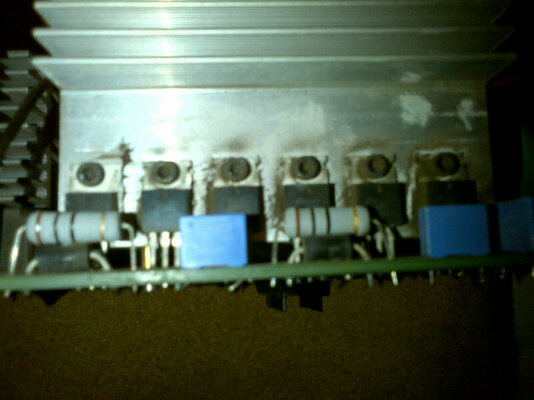
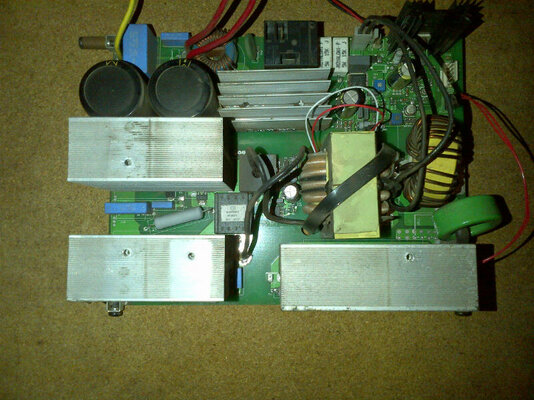
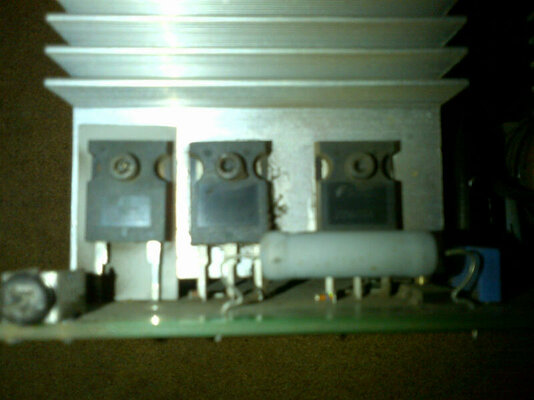
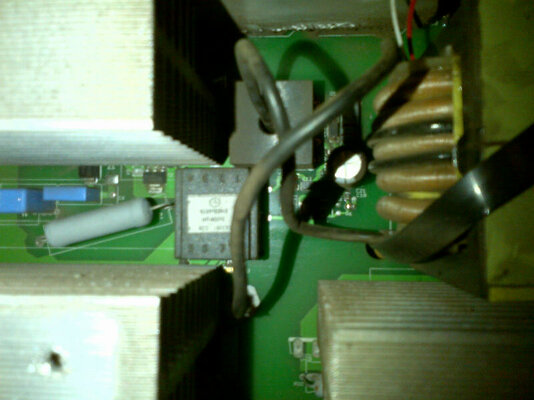
OK, here's where it gets picture heavy, for Bryce and Justin's benefit. Here are some gratuitous nekkid shots of the board from the Kilmak machine, as this was the easiest to remove.
Manchester-20150206-00304_zpsd5cf4d46.jpgManchester-20150206-00305_zps1c2ce9c0.jpgManchester-20150206-00306_zpsce6fb6bc.jpgManchester-20150206-00310_zps0cfee584.jpgManchester-20150206-00309_zpsba11270f.jpgManchester-20150206-00308_zpse1280899.jpgManchester-20150206-00311_zps2c3d9468.jpgManchester-20150206-00307_zps51762998.jpgManchester-20150207-00317_zps3dffbd7b.jpgManchester-20150207-00312_zps305e101c.jpg

The header to the top right of the main board picture is where the voltage select pot and the power/ temp overload LEDs connect.
 
Last edited:
Manchester-20150207-00315_zpsd5eddf1c.jpgManchester-20150207-00313_zps2f3e49bc.jpg

Now, this is what I've found out by examining the board and it's components. The two heat sinks that are together both have 1 x STTH3006 High Voltage Rectifier and 2 x 20N60A4 High Power Switching MOSFETs on them, they are identical.

The single heat sink has a bank of 6 x MBR20200CT High Voltage Schottky Rectifiers. There are also LM317T adjustable regulator and an LM317D2 Voltage Regulator.

I've also found an LM393M Dual Differential Comparator that is located near the LM317T and another LED, that probably should be working but isn't at the moment.

The board layout does appear to be similar to several Chinese-built welder inverter boards but it's not identical to any of the ones I've seen from searching.

Does any of this help, in locating likely suspects for the failed components?
 
Last edited:
i dont think pictures of the board will help merlin.

did you say the fan packed up on this one? that might be a hint as to where the problem is.

can you test the diodes and other components?
 
Last edited:
The fan is in the same area of the board as the LM317T, the LM393M and the LED, Roy. The Fan has been soldered onto the board header, so it may not be the original one and might provide a clue as to why this machine died, if the pins were shorted as they were being soldered. If I was to put money on where the fault is, I'd start here.

- - - Updated - - -

None of the diodes look damaged, Roy. At the moment, to change most of those chips identified above would give me change of £15-20 I reckon, but I'd rather have more of an idea of why it failed before I start changing out chips on a wholesale basis.
 
thinking about it logically,the fan was probably there for airflow over the heatsinks(probably controlled on the board somewhere) if the fan failed while in operation it may be possible the fets and/or diodes overheated and died.
that would be where i would be looking first.along with any power resistors.

of course im guessing here because its really hard to diagnose a problem from photos as you can understand.but alot of the parts can be tested out of circuit with a multimeter.

as for them looking ok,lots of parts fail and leave no evidence of failure just by looking at it trust me it might not be that easy.
 
Last edited:
I know, Roy, but this is something that I would like to work through until it's fixed. There are two large wire-wound resistors that do get warm when power is applied to the board, so I reckon they are OK. I'm a bit reluctant to start poking around with multimeter probes with some of the voltages that could be present on the board - safety first! The fan does run with 12v applied to it via a power supply, so the fault lies with whatever should be feeding 12v to the fan.
 
i didnt mean testing the components while it was on merlin,i meant while it was off.
a lot of the components can be tested that way with a multimeter set to diode test.

try to trace the fan back through the circuit,at a guess it probably goes back the adjustable regulator and what controls that before it.

like i said,its really hard to diagnose a problem from a picture.

there might be more to this than meets the eye merlin thats why its important to check all the parts for failure,i dont think these would last long with no airflow.
 
At a guess you should be expecting roughly 65-80v dc open circuit voltage depending on manufacture ( the higher voltage make it easier to run cellulosic electrodes ), the primary rectifier should take mains and rectify it, maybe to some where around 400v (I'm used to working more on 3 phase stuff I'm afraid) it should then get chopped back to a higher frequency ac , probably by the Mosfet's. Then transformed to nearer the output voltage, then rectified back to dc. The control circuitry with differ between manufacturers.

You can go though it component by component but it will take time I'm afraid, The primary rectifier is a good place to start as this takes a lot of abuse from dirty mains if the filters aren't up to scratch which does tend to happen on the cheaper unit's, then it's on to the mosfets and then the secondary rectifier. You can check the reference voltage across the pot and make sure it's varying and both leg's, but it's really hard to try and guess with so little info. Unfortunately most inverter manufactures treat they're drawings as top secret so unless you can find a friendly distributer getting info might be hard.

Sorry I've not been much help .... at least these won't suffer with software issues like most of the new one's :roll:.

P.S. you could also try contacting these chaps http://www.technicalarc.co.uk/ have a look at the catalogue on the site they do PCB repairs and they're normally quite helpful.
 
Last edited:
I need some help identifying two components.

One is marked TA-316100 on the side and is a two-pin black ceramic package, approx. 20mm square x 10mm height with a hole in the centre. It's labelled TRF4 on the PCB. There are no other markings on the package.

The other is marked ULUS C28 3x500uH SM0204570 (or possibly SM6204570) and is an 8-pin black ceramic package with pins numbers embossed into the top. The package is 20mm x 18mm x 10mm height, but the top of the part is 'stepped' in by about 1.5mm on two sides, parallel to pins 1 and 8 (the pin numbering runs in a circle, 1 to 8 anti-clockwise). There is also a logo, possibly an arrowhead pointing rightwards inside a circle. There is no discernible marking on the PCB to indicate what this is.

Any ideas as to what these might be, based on these descriptions?
 
I think it's fixed. I replaced all of the Schottky diodes, the LM317 and found a resistor that had died . The markings on the resistor had been vaporised, but a member on another forum who speaks Turkish rang them and got the details.

One 2R2, 7 Watt wirewound resistor later and it has coughed into life! I'll try some test welds later this week but for now, I'm just happy that it's powered up, the temperature warning goes out and the fan seems to work as it should.
smile.gif
 
Last edited:
After some test welding today, I can confirm that it's fully working - not bad for an outlay of only £20 plus parts. :mrgreen:

I bought two non-working inverter welders for £20 and I can now turn my attention to the other one, a Clarke AT150 Arc-TIG unit. I can also buy a TIG torch if I want to now, so that I can TIG weld non-ferrous alloys with the use of an Argon cylinder.
 
Back
Top Bottom