@Nikodem
thats very interesting... well other than HP/Compaq, I am unaware of any proprietary based 72 Pin SIMM's.... thats not to say that there are none out there, its just I haven't seen them.
Now, lets talk refresh sizes..... but before we do that we need to talk a little about the matrix
No no.... not the film.... its the memory modules layout...... now imagine if you will the stick of ram you have in your hand (yes pick one up and look at it) is essentially a spread sheet.... like Excel.... it has an X number of CELLS and a Y number of CELLS.... each CELL will have a number of bits....
so.... now you have that in your mind you can envision three distinc matrix shapes -
Wide (horizontal rectangle... with more X Cells than Y Cells)
Narrow (vertical rectangle... with more Y Cells than X Cells)
Square ( an identical number of X and Y Cells )
now, at this point I need to point out that some controllers will only take a certain matrix.... either Square, Narrow or Wide..... some controllers are clever and work out what you have - but I doubt that on most Amiga Hardware lol
Refresh Sizes
now imagine a 2Mx8 DRAM chip, lets say this has 2000 rows (Y) , 1000 columns (X), and 8 bits per column -- a total capacity of - yes you guesed it 2MB or 16Mbit.
As you know DRAM "dynamic" RAM memory must be refreshed, hundreds of times each second in order to retain data. DRAM memory is designed around tiny capacitors that store electrical charges. These charges gradually lose their stored charges if they are not refreshed or energized.
I should also mention for completeness that the process of reading data from the memory array drains these charges, because of this the memory cells areprecharged before reading.
So simply put; A refresh is infact the process of recharging the cells in a memory chip and these cells are refreshed one row at a time with a usual one row per refresh cycle.
Refresh Rate
Refresh rate refers to the total number of rows that it takes to refresh the entire DRAM array for example - 2000 (2K) or 4000 (4K) rows.
Refresh Cycle
Refresh cycle refers to the time it takes to refresh a row or, anyoingly confused with the time it takes to refresh the entire DRAM array.
Sadly because of this while RAM Refresh can be accomplished in many different ways it is also one of the reasons it can be a confusing.
A little more on Refresh Rate
Now, a Refresh rate is determined by the total number of rows that have to be refreshed on a memory chip. because of this memory chips are designed for a particular type of refresh - i.e chips using 4K refresh will have about 4000 rows, which means that it will take about 4000 cycles to refresh the entire array.
This obviously differes with chips using a 2K refresh as they will have about 2000 rows, and chips with 1K refresh will have about 1000 rows.
but this is not dependent of the SIMM memory size - DRAM capacity is rows x columns x width.
So we can say that a 4Mx4 chip is 4 Megabits deep and 4 bits wide for a total of 16Mb (or 2MB). Lets assume for the moment that this chip used a 4K refresh, it will be organized into 4000 rows x 1000 columns x 4 bits per column this is a total capacitty of 16Mb (2MB).
However If this chip uses 2K refresh, it will be internally organized into 2000 rows x 2000 columns x 4 bits per column with a total of 16Mb (2MB) again, the capacity is the same, yet the organization and refresh are quite different.
There are a few DRAM fresh schemes the most common are 1K, 2K and 4K... now some Amiga memory controllers wont support 4K refresh, I am sure that Apollo's struggle with 4K refresh modes and prefer a 2K (Square Matrix) refresh
I hope that ramble helps.



 .
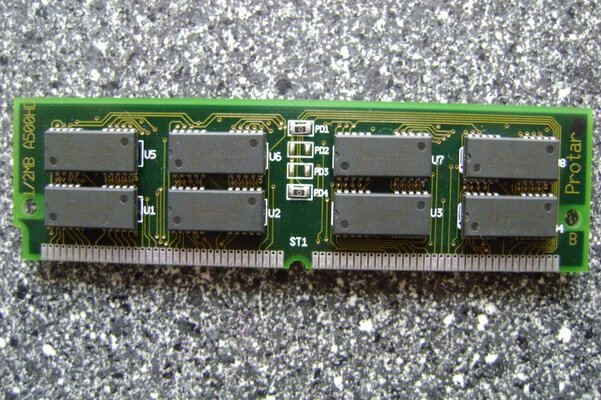
.
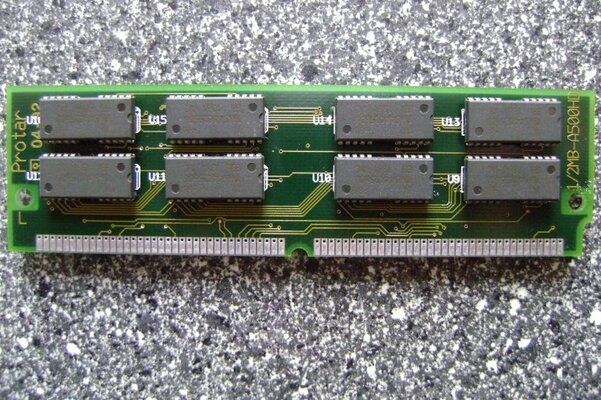
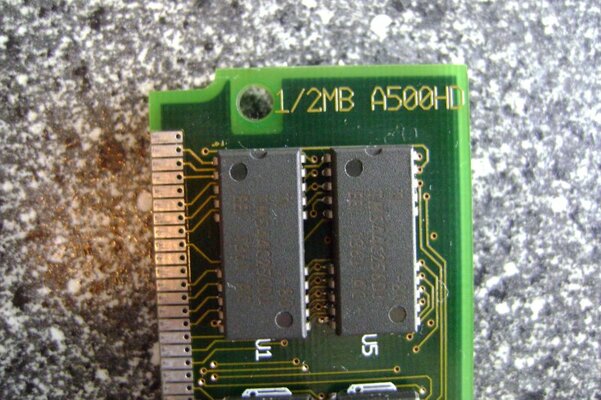
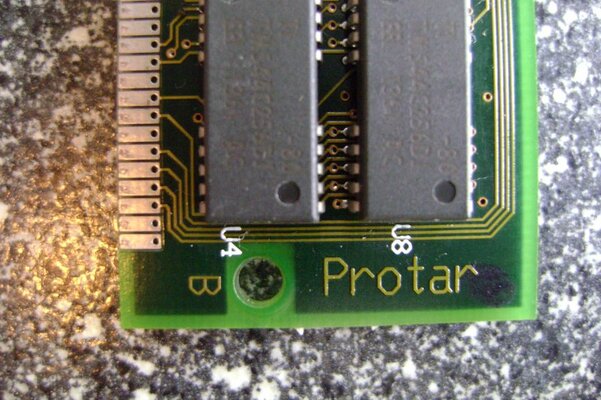

 .
. The Protar Ram module
