Retr0bright on it's own is not a permanent solution - here's why...

  • Thread starter Thread starter Merlin
  • Start date Start date
  • Replies Replies 78
  • Views Views 101399
My Amiga 500+ was looking like new when I got it. I used it occasionally but then it was stored for years boxed up under my bed. There's also a radiator right next to the long side of the bed. When I pulled the amiga out of storage for inspection and some games, it turned out that it has yellowed! I guess heat from the radiator helped speed up the process.

Anyway, just another first hand proof that even things kept in the dark can go yellow :)
 
Since i don't want paint my consoles i'm thinking about a vacuum machine to prevent the oxygen interaction. I know that isn't properly an "invisible" treatment but i would prefer it to spray the lacquer. Do you think it's a wasting of time? :)
 
Time spent on an Amiga is never a waste of time. However if you vacuum seal it, how the hell do you use it?
 
I never talked that i'm wasting time on my machines, i have part of them that i use everyday and their yellowing doesn't bother me. There is also a part of them that i expose in my collection and that i want to avoid (as much as i can) the yellowing.
 
Ahh you mean some for use, some for your own private museum. I can understand that, I do a similar thing myself. But do you have the same problem as me: Do you occasionally remember the "moral message" embedded in Toy Story 2, and realise that you too are the villain of the picture?
:-o
 
Hi
I'm part way treating my Plastic 128D this weekend, I'm already worried about the process reverting.
I'm thinking if it's a matter of treating/removing the bromine. would multiple treatment's eventually stop the reverse process
would the bromine just run out ?
I have some autoglym car polish with UV protection. would that help, without having to spray it.
 
I'm wondering if temperature can also aid in yellowing? My Dreamcast was nice and white before I boxed it away a few months ago when moving house. I unpacked it recently and it has yellowed quite a bit in such a short space of time with no exposure to light. The storage room was a bit cold though and the console itself was wrapped in bubble wrap inside the box. Can't think what else could have caused it? The removable modem stayed perfectly white though!
 
Last edited:
Some computer/console cases, keys or plastic parts may contain different amount of bromine or were fabricated using not the very same ABS material etc. The spacebar of certain keyboards (especially Amiga 4000 keyboards or the SX-64 keyboard) - compared to the rest of the keys - show different kinds of yellowing, for example.
 
Last edited:
ABS plastic is a lattice and a polymer - no two batches would ever be the same as it's like DNA. This is why some parts go brown quicker than others and Nintendo machines are really bad for this. Master batching plastics is not an exact science and you can't tailor the process to make the exact same thing every time.
 
I'm wondering if temperature can also aid in yellowing? My Dreamcast was nice and white before I boxed it away a few months ago when moving house. I unpacked it recently and it has yellowed quite a bit in such a short space of time with no exposure to light. The storage room was a bit cold though and the console itself was wrapped in bubble wrap inside the box. Can't think what else could have caused it? The removable modem stayed perfectly white though!

Was the room damp or any moisture in the air?

I have found in my experience that damp and moisture can also contribute to yellowing. I had a few consoles and computers stored away many years ago in a storage room that would get quite damp in the winter months.
 
No dampness or moisture, just colder as the central heating wasn't left on it that room (it was a spare unused bedroom). I don't like seeing adverts for electronic items that can be seen stored in a damp loft, shed or garage... Everything of mine is kept safe and dry :)
 
The answer is quite simple. Once the parts have been treated, you should coat the parts in a coat of clear, satin finish acrylic lacquer. This has the effect of cutting off the oxygen supply to the fire retardant and will prevent further yellowing.

Won't this lacquer in turn degrade with time and become a problem of its own? Surely, like everything, it's not meant to last forever.
I'm wondering if temperature can also aid in yellowing?
I thought it was already determined that yes, temperature does affect the process.
 
Today I saw an A1200 for sale which has the key caps from A to L slightly yellowed. All other key caps and the case looks like new.
How the flame retardant, UV light and oxygen affected only these 6-7 key caps? 🤔
 
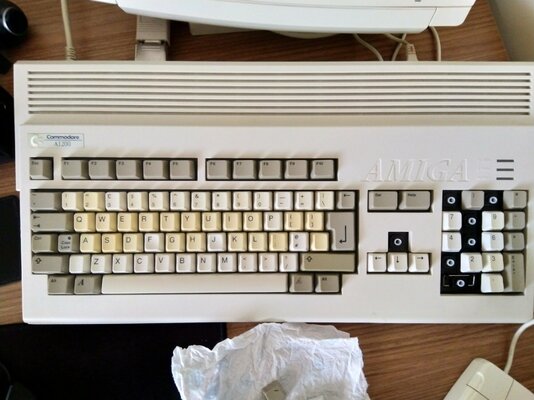
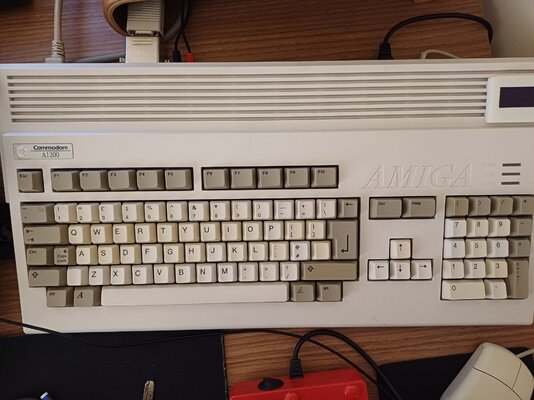
My A1200 is like that. I treated the keys with hydrogen peroxide 3% since it is impossible to find liquid HP > 3% here. The result was exactly as the second photo since 3% + sun did its best but was not perfect. I also applied a UV protector spray. The photo before is from 2020. The photo after is from today. It was EXACTLY the same after I retrobrighted in 2020. Didn't get yellow more than that.


IMG_20200206_083603.jpg
20241003_172715.jpg
 
My A1200 is like that. I treated the keys with hydrogen peroxide 3% since it is impossible to find liquid HP > 3% here. The result was exactly as the second photo since 3% + sun did its best but was not perfect. I also applied a UV protector spray. The photo before is from 2020. The photo after is from today. It was EXACTLY the same after I retrobrighted in 2020. Didn't get yellow more than that.


View attachment 2501964
View attachment 2501963
Just in case, because you are from Greece, i can supply you with H2O2 up to 35% but 12% i guess is enough.
Also, why do you need it in liquid form? Cream is exactly the same and for this purpose and its texture helps a lot!
I am not into retrobrighting and will not be. Just guessing because i handle a lot of chemicals from time to time.
Experts in retrobrighting may give some advice here.
 
Liquid can provide smoother and uniform result. Cream can do the "marble effect", especially when dealing with cases and bits from cases. You need to check often and spread the cream under the plastic foil in case it is concentrated. Not sure about 35%, 12% liquid is something I am interested in.
 
I don't think that stabilizers, conditioning agents or emulsifiers can affect the result but if you have tried that and you've seen differences, probably you know more.
You'll have a PM during the day for the 12%.
 
A fantastic analysis of retrobright! Includes a systematic approach to understanding the chemical process.

 
Back
Top Bottom