Retrocomputing with TV PHILIPS 15PFL4122

  • Thread starter Thread starter Xanxi
  • Start date Start date
  • Replies Replies 9
  • Views Views 171

Xanxi

Well-known member
Donator
AmiBayer
Joined
Jun 10, 2010
Posts
3,010
Country
France
Region
Paris
Hi.

Anyone using a PHILIPS 15PFL4122 TV?

It seems like the perfect device for retrocomputing as it has multiple video inputs including RGB SCART, VGA, HDMI, composite, component, SVideo and (being a TV) even RF.

I am currently testing it with my A600 on composite, SCART and RGB-HDMI and unfortunately picture is between awful to midly acceptable.
It is a 4/3 1024*768 LCD. At least i have a nice full scren overscan with RGB-HDMI when setting up this res.

I intend to use it with some of my exotic non Amiga stuff, probably MSX2 on SCART, Apple IIGS on VGA or HDMI, Sega Dreamcast on VGA or HDMI, C128D on composite, Sega Saturn on SVideo, and possibly something else on component.

It was quite cheap on the second hand market, as opposed to what could be the best solution (Checkmate monitor).

Any experience or insight welcome.

1762615257486.webp
 
I haven't used it but have three LCD TVs from this era (first generation flat TVs , which scart, svideo, composite etc) from Toshiba, Samsung, LG and while acceptable they all have numerous limitations that argue against using them for long. The list includes: 1. Low resolutions that don't scale well 2. Faded or otherwise unnatural colours 3. Minor defects in the sense of burnt pixels 4. Terrible viewing angles 5. Backlight bleed etc.

Later generations flat screen TVs improved enormously on picture quality but started dropping 4:3 ratios and analogue ports. The best solution for me now is to use whatever screen is the best and then use Scart to hdmi adaptors. The old TVs are good for 8bit computers with few colours (c64, spectrum). I do love the colours of the CPC though and would prefer to use it on a monitor that can do justice to them, preferably CRT too.

Not enough space-time to enjoy all my retro collection!
 
Yes you are right. Yet i have a 19' IIyama monitor (not TV) in 4/3 which is excellent on VGA or HDMI, but there is no more 4/3 and no more SCART. SCART has been dropped in France in 2015 after a decision of former president François Hollande. Why the president should bother about the industry using SCART or not is beyond me but it has been publicy shown that he decided on top of the minister.

Now testing this one with the Apple IIGS. On composite, it shows a lot of the so-called NTSC artifacts and is no good. In SCART from the RGB port, i have waves on the screen, don't know why. On HDMI from Applesqueezer accelerator the picture quality is good but the OSD won't let me modify the aspect unlike with the Amiga.

And unfortunately, it doesn't want VGA from the A600 or the IIGS, probably not supporting 15 KHz on VGA despite being a TV. That's a shame, i have another similar Philips TV with fewer ports which works with 15 KHz VGA.
It can't be the poorman Checkmate monitor.
 
Last edited:
This monitor is so disappointing with the Apple IIGS that i have to do what the Amiga never needed in 25 years, bring back the Commodore 1084 from storage (if it is still working).
My back already hurts.
 
I want to complain also about its cousin, the Philips 15pf5121. This one is also a 15' 4/3 LCD TV, sporting SCART RGB, DVI-I port, composite and SVideo. The DVI-I works with VGA-DVI and HDMI-DVI cable which is nice.
However, this monitor can't sync properly with the Apple IIGS or a Sony HB-F1 MSX2 from the composite or the SCART. Those two are NTSC 60Hz but not by the book so it seems, and this monitor is not tolerant enough so the picture keeps jumping. SCART and composite are ok for the Amiga, and SCART is ok with SEGA SMS or MD though the picture isn't so great, but still better than the other Philips. It helps that this one is slightly newer. With DVI-I, the picture is clean either from VGA or HDMI with Apple IIGS or Amiga, but is not centered and unfortunately it forgets the centering at each power off. And there are slight jailbars visible with VGA and Amiga even with an adapter with anti jailbars.
Another missed opportunity to have a cheap multi inputs retromonitor.

1763974208430.webp
 
Last edited:
Hi there.

After being disappointed with those Philips TV, i have found a new contender with the Neovo X-17AV.
This one is a profesionnal grade 5/4 monitor with VGA, DVI-D, Composite CVBS and S-Video. Unfortunately no SCART.
Gives a way better picture than the others.
Sadly, no 15 KHz on VGA.
Works fine with Amiga 600 in composite and HDMI (RGB2HDMI) and with my japanese Sony MSX2 in composite (no jittery picture like with Philips but blurry nonetheless, the OSD does aknowledge the NTSC signal). I will test later the NTSC composite signal of the Apple IIGS.
Mine misses a proper stand so far but is VESA compatible. It is very heavy, made of glass and aluminum.
Got it for 10 european bucks, so still a bargain.

1768575132726.webp
 
By the looks and connection options I'm guessing it may be close to 20 years old? Flat screens back then had bad viewing angles, limited and uneven brightness, light bleeding, washed colours and backlighting prone to failure. And that was from new, it probably hasn't gotten better over time. How's the picture quality?
 
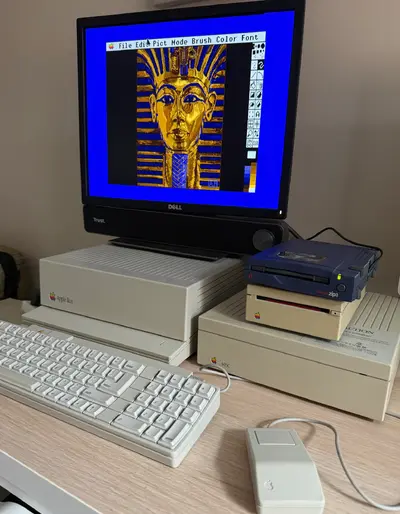
Here is an Apple IIGS using a Macintosh-HD15 adapter on the RGB port and a Dell P1917Sf (the f is important for 15Khz support) monitor, not perfect but surprisingly good. I have had no joy with old LCD TVs, as above they were bad when they came out and have only got worse with age.
 

Attachments

  • IMG_3577.webp
    IMG_3577.webp
    157.3 KB · Views: 2
By the looks and connection options I'm guessing it may be close to 20 years old? Flat screens back then had bad viewing angles, limited and uneven brightness, light bleeding, washed colours and backlighting prone to failure. And that was from new, it probably hasn't gotten better over time. How's the picture quality?

Seems to be around 2004, with rather good latency around 8 ms though. This monitor is aimed at professional CCTV and seems still available for purchase on that market.
Seemed ok to me during my tests except i couldn't really test in front of it because it has no foot so far, it was laying down on the table. Seems to have a bit of lightbleeding on the top indeed but i haven't adjusted the picture with the OSD.
I need to find a VESA foot able to withsand its weight first.
 
Here is an Apple IIGS using a Macintosh-HD15 adapter on the RGB port and a Dell P1917Sf (the f is important for 15Khz support) monitor, not perfect but surprisingly good. I have had no joy with old LCD TVs, as above they were bad when they came out and have only got worse with age.

Nice to see a GS here.
Mine is currently stacked on my A4000 to allow it some permanent desk space, so i have limited options for display and it had to be equiped for the 21th century.
So i'm not using original keyboard and mouse, and no floppy drives either. It is loaded with AppleSqueezer v2 accelerator, CFFA3000 for harddrive and disk images, Uthernet II with Wifi Vonets module inside, LiteSound for stereo sound, and picoPSU to gain some room and power the Wifi module inside. Also have a Mockingboard but this one will leave when i will receive my A2FPGA for HDMI output and Mockingboard emulation. Currently i am using the HDMI out of the AppleSqueezer which is nice but not compatible with some res and some games, or the RGB-VGA adapter but results are not good with my 15 KHz compatible ASUS monitor (i had a better picture with another one but i need to cope with what is on the desk). Very soon, i will be using only the HDMI of the A2FPGA. Also using a Wombat device to share wireless keyboard and mouse with the other computers, and now a GABE to use a wireless XBox gamepad. Only remnant of the past is the Apple 1 MB RAM card which i keep for safety (i have been stuck before when deactivating the RAM of the squeezer, and with 1 MB i can still boot my harddrive image to save the day). Such an amazing computer, however slow.
 
Last edited:
Back
Top Bottom