My 4116 Dram Tester Project.

Status
Not open for further replies.

Itarzanujane

Member
Joined
Apr 1, 2018
Posts
89
Country
Greece
Region
Athens
Hello all.

I am working on a Arduino 4116 dram tester. Still waiting the damn inductors for the final test. If you find it interested, i will release the Gerber's for free.
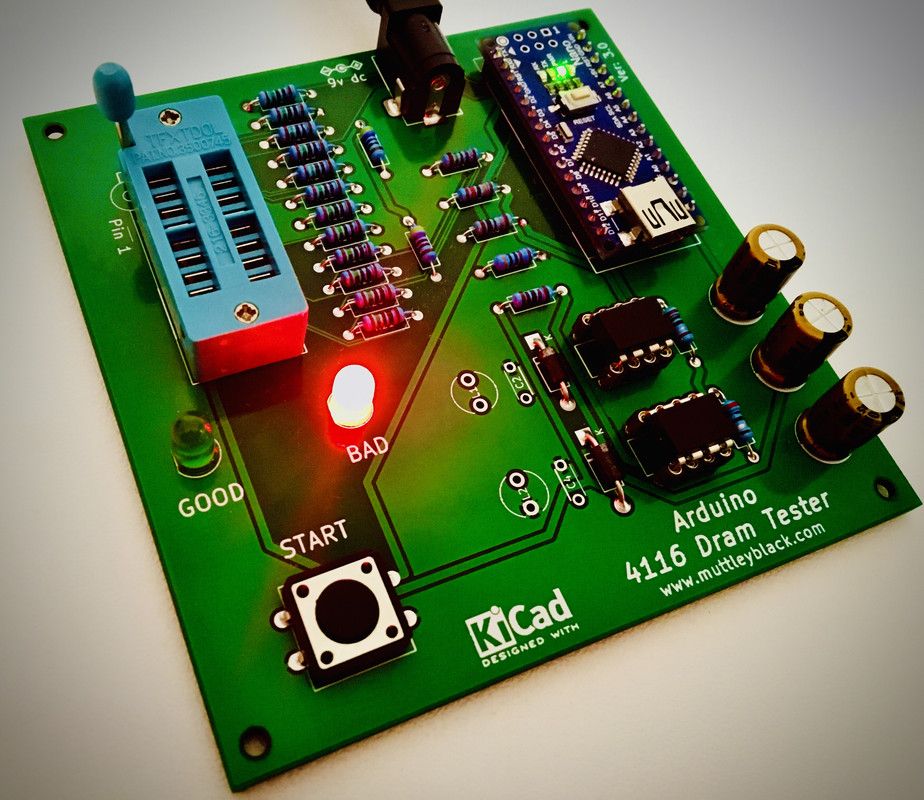
IMG-3473.jpg


Have fun.
 
Last edited:
Looks great, I just built one on breadboard that uses a single 5v (usb) input, -5 & 12v was made using cheap modules. I was looking into adding a LCD display and the possibility of other chips.
 
I recently made one of these on a breadboard too, quite a fun project getting the voltages set up properly.

@Itarzanujane I used an 7805/7812 to achieve the +12 and +5, is that what your resistor banks are for?
 
Last edited:
is that what your resistor banks are for?

Nope. Is for the 4116 (or equivalent) chips. One failure mode is where the silicon becomes degraded or becomes damaged, such that either the +12V or the -5V can leak via internal short circuits out to address, control or data pins.

So rather than directly connecting to the Arduino I/O pins, i use resistors between the Arduino and the DRAM address, control and data pins. This will give the Arduino some protection.


Last edited:
I know of only 2 electronic devices which use 4116 DRAM and these are PET computers and Colecovision consoles.

Since the Colecovision was out in 1982-1983, I'm surprised they even considered using these (then) antiquated DRAMs.

Is there anything else using these type of DRAM IC that is noteworthy?
 
The Sinclair ZX Spectrum uses also the 4116 type of DRAM at its lower 16 kB bank.
 
Last edited:
I have a ZX81 memory expansion that also uses 4116.
 
Interesting device. if I remember correctly, the TRS-80 Model 1 used 4116 in the 16K model and in the Expansion Interface.
 
I believe early model Apple IIs (back when they came with 4/8/16kb) used 116s, but that was 1977/78... though a few must still be floating around...

(my guess would also be that a ton of the arcade machines of the 70s, and very early 80s would have used 116s)

that being said, what I really need is a 464/4256 tester :p
 
Last edited:
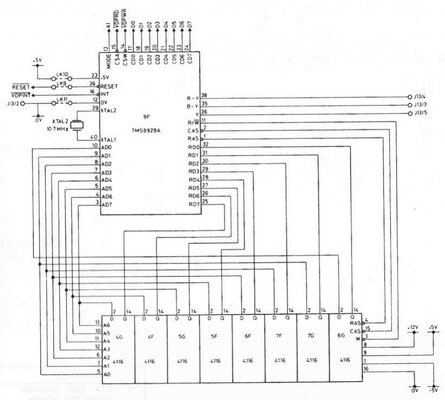
I remember that there was video chips that use own memory areas (also 16kB.....) and all this was used, inside the computer, like as a peripheral (video ram not shared with system ram), I remember the TMS9918/9928 into my old Memotech MTX512, but it could be also in other computers!

https://en.wikipedia.org/wiki/Texas_Instruments_TMS9918


VDP_and_VRAM.jpg
 
Last edited:
https://vimeo.com/454361906


[FONT=&quot]There was some errors in the prototype PCB. I did some emergency cable jumpers to solve the problem. Now it is ready and 100% in working order. Sadly I need to order some new pcb’s for the final test. This tester work also with 5 volts, through the Arduino usb plug. This future make it a bit portable with a power bank.[/FONT]
 
Last edited:
I know of only 2 electronic devices which use 4116 DRAM and these are PET computers and Colecovision consoles.
Is there anything else using these type of DRAM IC that is noteworthy?

I think Apple IIGS?

The Apple IIGS uses 4464.

the Apple IIGS was actually released after the Mac (in Sept. 1986 vs Oct. 1985) and came with 256KB of RAM, 116s are 2KB each... it'd have needed 128 of them... as opposed to 8 464s (and 116s would've likely been way too slow for it's 'fast' (2.8mhz) mode anyways)

it is/was a fantastic machine (I have 3 of them), both a fully compatible Apple II, as well as nearly being a full Mac (runs up to System 6.0.1, which was packaged as GS/OS 4.02 for the IIGS)(the IIGS was also 'crippled' so as not to compete with the actual Mac, it's 2.8MHz CPU is actually capable of operating at 4MHz, and in fact, later versions of the 65C816 CPU could run at 14mhz, but Apple refused to use them (despite a negligible price difference))
 
Last edited:
Status
Not open for further replies.
Back
Top Bottom