
Dear all,
This is my first query, and I hope it hasn't been addressed elsewhere—though I have diligently searched for similar topics.
I own an Amiga 500, PCB revision 6a. For reference, I'm referring to an image posted elsewhere; it is not the actual board in question.
Initially, the floppy drive (original) was recognised, and upon inserting a floppy disk, it commenced reading. However, the motor did not move the head. I embarked on troubleshooting as follows:
I then extracted the floppy drive once more and tested the motor by applying power directly; it moved. Regrettably, I removed the screw of the reading head, likely misaligning it.
Subsequently, I acquired three PC floppy drives and modified them for Amiga 500 compatibility (altering pins, adjusting jumpers, etc.). All three replicated the original's issue: they mounted, the floppy spun, but the head remained immobile.
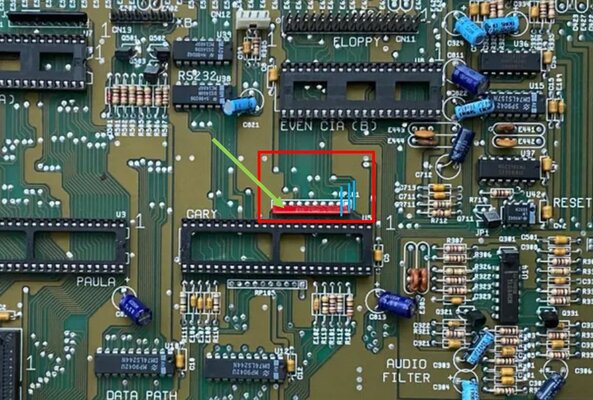
Turning my attention to the board and conducting a microscopic inspection, I discovered corrosion near the resistor array zone, invisible to the naked eye. I decided to desolder the array (indicated by a green arrow), clean the area with isopropyl alcohol, and found three damaged traces, which I repaired (highlighted in light blue in the image).
Q1: Can anyone identify the specific resistor array in question? I intend to replace it but have been unable to find a reference or a purchasing source. Although I procured a 4.7kOhm, 10-pin array from an Amiga webshop, it's black, not red, and I'm uncertain of the original's exact value.
After repairing the traces and testing the Amiga without the resistor array, the issue persisted.
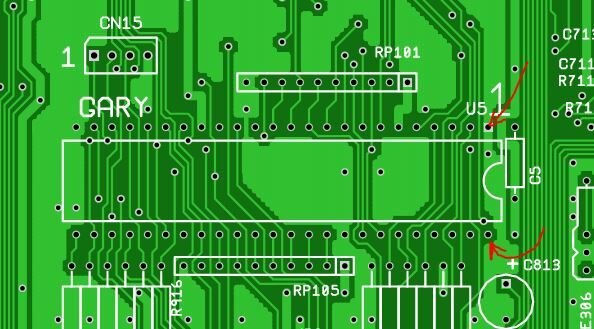
Hence, I examined the GARY switch area for anomalies and checked the traces (having already found three damaged by corrosion). After removing GARY (and discovering a spider's nest underneath), I desoldered the socket for better inspection but found no additional trace damage beyond the nest.
Q2: Is replacing the resistor array a viable solution? Logically, it seems it should function without it, but perhaps I'm overlooking something.
Q3: Are there any further steps I should consider in troubleshooting?
Q4: Should I try to replace the GARY? Is existing a replica from the current days or should I look on e-bay?
Q5: Should I try to replace the CIAs? If Yes, both or just the "even"?
Q6: How often do the chips get damaged? Is it a common issue? As for me is very unliky they became defective
Another I think very important note is that the Amiga operates flawlessly with a Gotek as the floppy drive.
Miscellaneous Questions:
Gennaro
This is my first query, and I hope it hasn't been addressed elsewhere—though I have diligently searched for similar topics.
I own an Amiga 500, PCB revision 6a. For reference, I'm referring to an image posted elsewhere; it is not the actual board in question.
Initially, the floppy drive (original) was recognised, and upon inserting a floppy disk, it commenced reading. However, the motor did not move the head. I embarked on troubleshooting as follows:
- Removed the floppy drive and cleaned the head
- Applied grease to the rod
- Replaced all capacitors
I then extracted the floppy drive once more and tested the motor by applying power directly; it moved. Regrettably, I removed the screw of the reading head, likely misaligning it.
Subsequently, I acquired three PC floppy drives and modified them for Amiga 500 compatibility (altering pins, adjusting jumpers, etc.). All three replicated the original's issue: they mounted, the floppy spun, but the head remained immobile.
Turning my attention to the board and conducting a microscopic inspection, I discovered corrosion near the resistor array zone, invisible to the naked eye. I decided to desolder the array (indicated by a green arrow), clean the area with isopropyl alcohol, and found three damaged traces, which I repaired (highlighted in light blue in the image).
Q1: Can anyone identify the specific resistor array in question? I intend to replace it but have been unable to find a reference or a purchasing source. Although I procured a 4.7kOhm, 10-pin array from an Amiga webshop, it's black, not red, and I'm uncertain of the original's exact value.
After repairing the traces and testing the Amiga without the resistor array, the issue persisted.
Hence, I examined the GARY switch area for anomalies and checked the traces (having already found three damaged by corrosion). After removing GARY (and discovering a spider's nest underneath), I desoldered the socket for better inspection but found no additional trace damage beyond the nest.
Q2: Is replacing the resistor array a viable solution? Logically, it seems it should function without it, but perhaps I'm overlooking something.
Q3: Are there any further steps I should consider in troubleshooting?
Q4: Should I try to replace the GARY? Is existing a replica from the current days or should I look on e-bay?
Q5: Should I try to replace the CIAs? If Yes, both or just the "even"?
Q6: How often do the chips get damaged? Is it a common issue? As for me is very unliky they became defective
Another I think very important note is that the Amiga operates flawlessly with a Gotek as the floppy drive.
Miscellaneous Questions:
- Does anyone know the value of the original red resistor array?
- Where might I find a 48-pin chip socket? The existing socket pins have blackened at the array's position, presumably due to corrosion, and I aim to replace it.
Gennaro


 )
)


