
RAM Tester for Commodore 8-Bit, Amiga & Retro Systems
Featured in Hackaday & Elektor Magazine
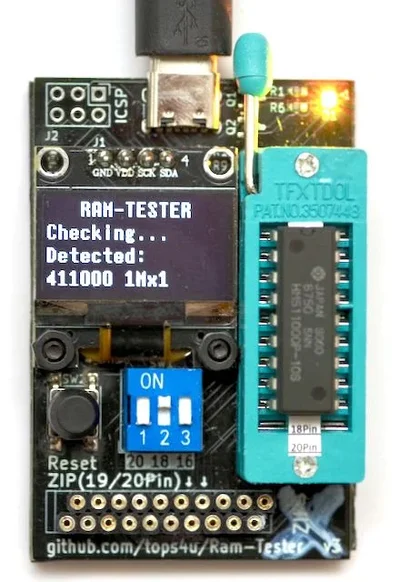
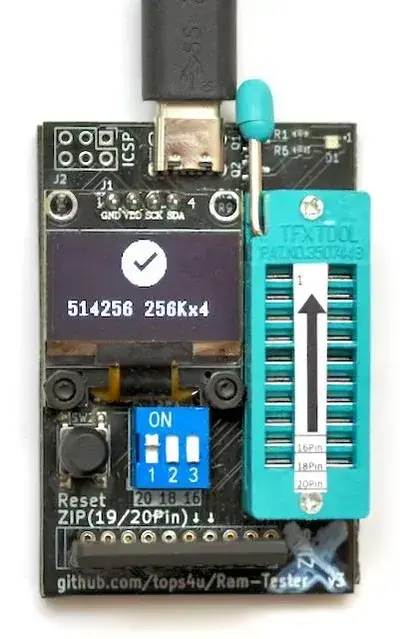
Fast, precise, open-source DRAM tester for classic CBM RAM chips found in C64, C128, Amiga (500/1000/2000/3000/4000), Atari, Apple IIe, ZX Spectrum, BBC Micro and many more vintage systems.
Key Features:
- Tests 20-Pin ZIP RAM (DIP and ZIP packages)
- Verifies Static Column functionality
- Measures actual retention time (2-16ms depending on chip type)
- Complete test in under 15 seconds
- One of the fastest Arduino-based solutions available
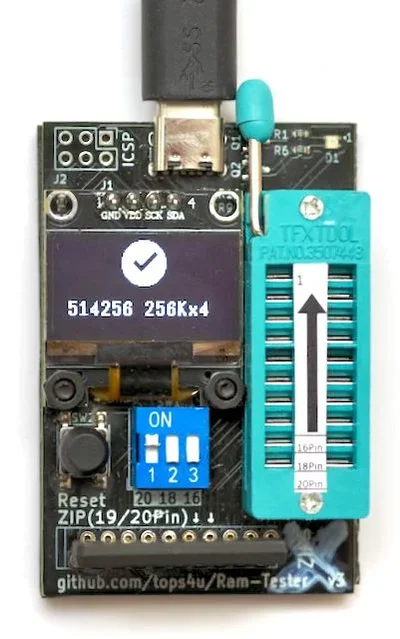
Current V3.4 Hardware (all revisions are software compatible)
Open Source Hardware & Software
This is an open-source project – schematics, PCB files, and firmware are publicly available:
GitHub: https://github.com/tops4u/ram-tester
Build your own or order a partially assembled kit from me.
Two Versions Available:
Kits sold here are the SMD USB-C version with all SMD parts assembled, programmed and tested. You only need to solder the through-hole components (ZIF socket, Display, DIP switches, ZIP sockets).
What Makes This Tester Special
Most Arduino-based DRAM testers need 2+ minutes for a single 41256 RAM and check only basic functions.
This tester completes a comprehensive test in 15 seconds or less including:
- Memory cells with various patterns (each bit tested at least 6 times)
- Crosstalk testing (rows & columns)
- Address lines & decoder verification
- Retention time checks (row-wise, twice with random data)
- Ground shorts detection
- Static Column functionality
- Fast Page Mode functionality
- Row Refresh functionality
- Refresh Counter functionality
Speed Comparison:
Other Arduino testers use slow DigitalWrite commands (4µs per bit = 100µs minimum per cell).
This tester uses direct port commands (62.5ns for 1-4 bits) making it up to 60x faster.
Supported RAM Chips
DIP Package (16/18-Pin in ZIF Socket):
DIP or ZIP Package (20-Pin):
For a complete compatibility list including specific computer systems, see: GitHub Compatibility List
Test Times
All times from reset to completion with display enabled:
Safety & Ease of Use
Protected: Resettable fuse protects the tester if a chip shorts out
Simple Operation:
Demo Video:
Watch the tester in action on the GitHub project page (link above).
Documentation & Resources
Complete documentation available on GitHub:
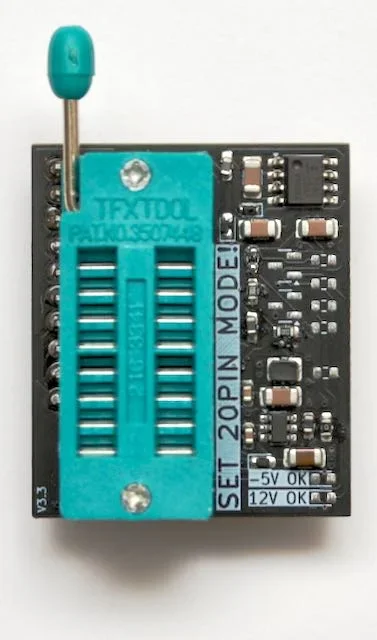
4116 Adapter Board
The 4116/4027 RAM chips require special voltages (+12V, -5V) that the main tester cannot provide. An optional adapter board is available that:
- Generates required voltages safely (current-limited to approx 30mA)
- Includes LED indicators for voltage presence
- Features latch-up protection
- Designed for safety with sensitive 4116 chips
Price & Shipping
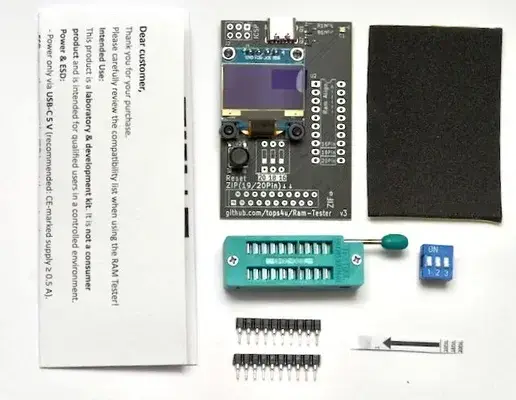
What's Included:
What You Need:
Note: Orders ship from Switzerland. Import duties and/or VAT may apply depending on your country.
Availability
Currently in stock: 10+ RAM Testers / 10+ 4116 Adapter Boards
Important Information
Laboratory / Development Tool – Not a Consumer Product
This RAM Tester is supplied as a kit / development tool:
Devices of this product may be returned to the developer for voluntary recycling. Shipping costs are borne by the sender. No participation in any national WEEE take-back scheme is claimed.
By purchasing, assembling, and using this kit, you confirm that you understand and accept these conditions.
Q&A
Q: Do I need to choose between ZIP and ZIF sockets when ordering?
A: No. Every unit includes both socket types. Only one can be used at a time during testing.
Q: Can this test static column RAM like 514402 or 514258?
A: Yes. Firmware v2.3.0+ tests both types and verifies static column functionality. If static column mode is not detected, it automatically falls back to testing as Fast Page Mode.
Q: What about the 4116 adapter board?
A: The 4116/4027 chips require +12V and -5V supplies. The adapter board generates these voltages safely and includes protection features. It's sold separately and requires the main tester to function.
Q: How does this compare to other testers?
A: Most Arduino-based testers take 2+ minutes per chip and only check basic functions. This tester is 8-12x faster and includes retention time testing, static column verification, and comprehensive address/data line checks.
Community Design
Additional Resources
Feel free to contact me with questions or for bulk orders.
Featured in Hackaday & Elektor Magazine
Fast, precise, open-source DRAM tester for classic CBM RAM chips found in C64, C128, Amiga (500/1000/2000/3000/4000), Atari, Apple IIe, ZX Spectrum, BBC Micro and many more vintage systems.
Key Features:
- Tests 20-Pin ZIP RAM (DIP and ZIP packages)
- Verifies Static Column functionality
- Measures actual retention time (2-16ms depending on chip type)
- Complete test in under 15 seconds
- One of the fastest Arduino-based solutions available
Current V3.4 Hardware (all revisions are software compatible)
Open Source Hardware & Software
This is an open-source project – schematics, PCB files, and firmware are publicly available:
GitHub: https://github.com/tops4u/ram-tester
Build your own or order a partially assembled kit from me.
Two Versions Available:
- Through-Hole Version (Micro USB power – ideal for DIY builders)
- SMD Version (compact, USB-C power)
Kits sold here are the SMD USB-C version with all SMD parts assembled, programmed and tested. You only need to solder the through-hole components (ZIF socket, Display, DIP switches, ZIP sockets).
What Makes This Tester Special
Most Arduino-based DRAM testers need 2+ minutes for a single 41256 RAM and check only basic functions.
This tester completes a comprehensive test in 15 seconds or less including:
- Memory cells with various patterns (each bit tested at least 6 times)
- Crosstalk testing (rows & columns)
- Address lines & decoder verification
- Retention time checks (row-wise, twice with random data)
- Ground shorts detection
- Static Column functionality
- Fast Page Mode functionality
- Row Refresh functionality
- Refresh Counter functionality
Speed Comparison:
Other Arduino testers use slow DigitalWrite commands (4µs per bit = 100µs minimum per cell).
This tester uses direct port commands (62.5ns for 1-4 bits) making it up to 60x faster.
Supported RAM Chips
DIP Package (16/18-Pin in ZIF Socket):
- 4027 (4K x 1) - 2ms retention test (requires adapter board)
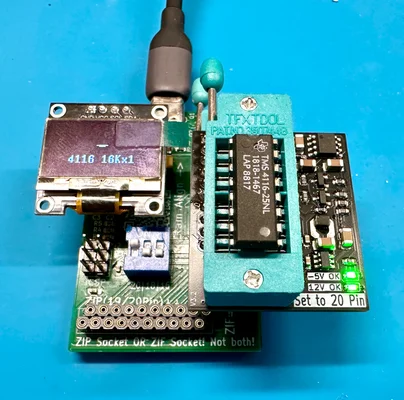
- 4116 (16K x 1) - 2ms retention test (requires adapter board)
- 4816 (16K x 1) - 2ms retention test
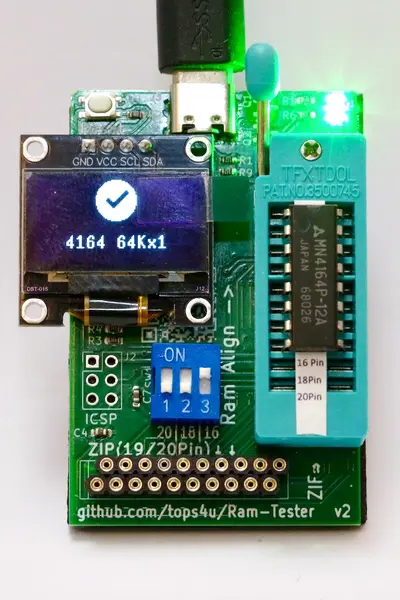
- 4164 (64K x 1) - 4ms retention test
- 41256 (256K x 1) - 4ms retention test
- 4416 (16K x 4) - 4ms retention test
- 4464 (64K x 4) - 4ms retention test
- 411000 (1M x 1) - 8ms retention test
- Preliminary 4532 / 3732 (Half-Good 4164 used in Spektrum)
- Upcomming Nibble Mode for 41257
DIP or ZIP Package (20-Pin):
- 44256 / 514256 / 514258 (256K x 4) - 16ms retention test, Static Column support
- 514400 / 514402 (1M x 4) - 16ms retention test, Static Column support
For a complete compatibility list including specific computer systems, see: GitHub Compatibility List
Test Times
All times from reset to completion with display enabled:
- 4027 / 4116 / 4816: 2.9 seconds
- 4164: 4.6 seconds
- 4416: 3.9 seconds
- 4464: 6.7 seconds
- 41256: 12 seconds
- 514256: 5.9 seconds
- 514258: 6.2 seconds
- 514400 / 514402: 16 seconds
- 411000: 37 seconds
Safety & Ease of Use
Protected: Resettable fuse protects the tester if a chip shorts out
Simple Operation:
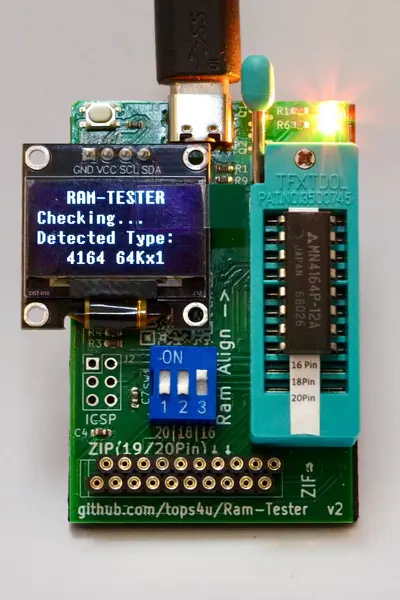
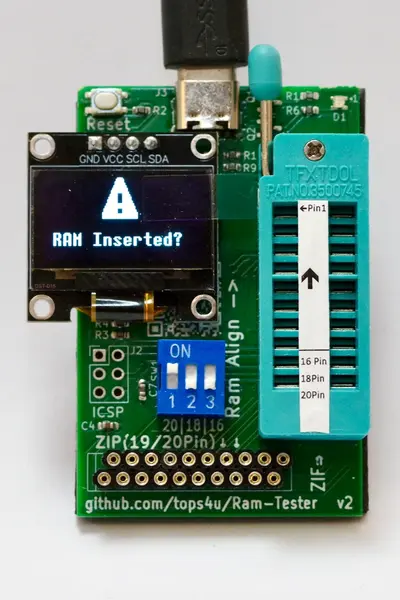
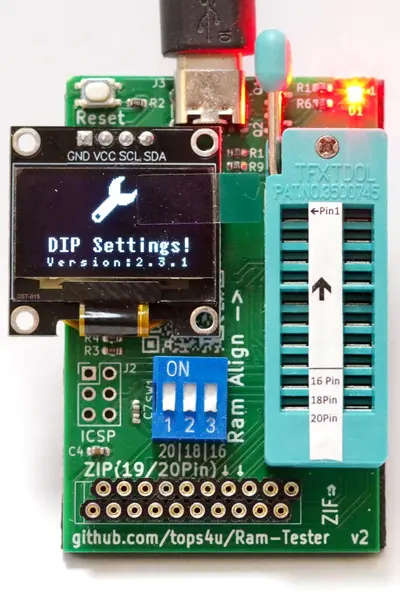
- Select chip type using DIP switches (16/18/20 pins)
- Insert chip into appropriate socket (ZIF or ZIP)
- Connect USB power
- Press reset button
- Read result:
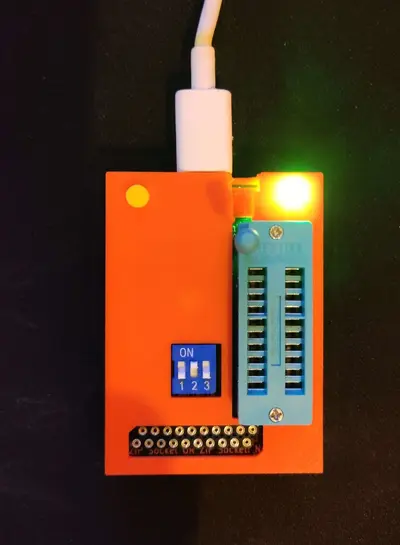
- Yellow LED: Testing in progress
- Green + Yellow flashing: PASS
- Red + Yellow flashing: FAIL
- Display shows detailed results
Demo Video:
Watch the tester in action on the GitHub project page (link above).
Documentation & Resources
Complete documentation available on GitHub:
- Assembly Instructions: GitHub Docs Page
- User Manual
- Schematic & PCB files (KiCad format)
- Firmware source code
- Changelog & updates
4116 Adapter Board
The 4116/4027 RAM chips require special voltages (+12V, -5V) that the main tester cannot provide. An optional adapter board is available that:
- Generates required voltages safely (current-limited to approx 30mA)
- Includes LED indicators for voltage presence
- Features latch-up protection
- Designed for safety with sensitive 4116 chips
Price & Shipping
- RAM Tester Kit: 25 CHF
- 4116 Adapter Board: 10 CHF (requires main tester)
- Shipping:
- Switzerland: 2 CHF
- EU: 4.50 CHF
- Worldwide (except USA): 7.50 CHF
- South America: 14 CHF (registered mail only)
What's Included:
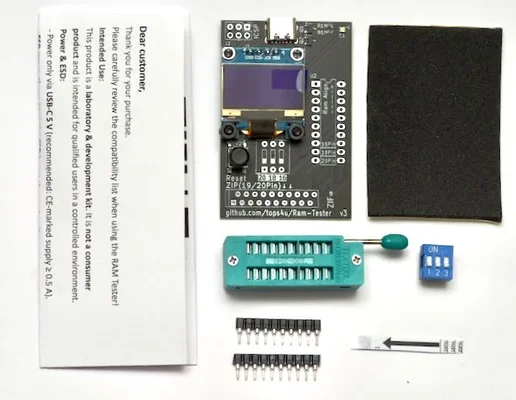
- PCB with all SMD parts pre-assembled
- Programmed and tested ATmega328P microcontroller
- All through-hole components (ZIF socket, OLED display, DIP switches, ZIP sockets)
- Assembly instructions leaflet
- Self-adhesive foam rubber pad for completed PCB
What You Need:
- Soldering iron (50 solder points total, 36 for 4116 adapter)
- USB power supply: 5V 1A with USB-C cable
Note: Orders ship from Switzerland. Import duties and/or VAT may apply depending on your country.
Availability
Currently in stock: 10+ RAM Testers / 10+ 4116 Adapter Boards
Important Information
Laboratory / Development Tool – Not a Consumer Product
This RAM Tester is supplied as a kit / development tool:
- Intended for laboratory and development use only
- Not designed for household or consumer applications
- Requires soldering skills to complete assembly
- Use at your own risk – no liability for damage to equipment, property, or injury
- No warranty – sold as-is after testing
- Not responsible for damage from misuse or faulty chips
Devices of this product may be returned to the developer for voluntary recycling. Shipping costs are borne by the sender. No participation in any national WEEE take-back scheme is claimed.
By purchasing, assembling, and using this kit, you confirm that you understand and accept these conditions.
Q&A
Q: Do I need to choose between ZIP and ZIF sockets when ordering?
A: No. Every unit includes both socket types. Only one can be used at a time during testing.
Q: Can this test static column RAM like 514402 or 514258?
A: Yes. Firmware v2.3.0+ tests both types and verifies static column functionality. If static column mode is not detected, it automatically falls back to testing as Fast Page Mode.
Q: What about the 4116 adapter board?
A: The 4116/4027 chips require +12V and -5V supplies. The adapter board generates these voltages safely and includes protection features. It's sold separately and requires the main tester to function.
Q: How does this compare to other testers?
A: Most Arduino-based testers take 2+ minutes per chip and only check basic functions. This tester is 8-12x faster and includes retention time testing, static column verification, and comprehensive address/data line checks.
Community Design
Additional Resources
- Also available on Tindie: https://www.tindie.com/products/tops4u/ram-tester/
- Also available on eBay: https://www.ebay.ch/itm/136743995188
- DIY at PCBWay: https://www.pcbway.com/project/shareproject/Ram_Tester_ThruHole_Version_93863356.html
Feel free to contact me with questions or for bulk orders.
Attachments
-
 Tester.webp226.4 KB · Views: 47
 -
 Tester2.webp241.8 KB · Views: 34
 -
 Tester1.webp177.9 KB · Views: 36
 -
 Tester3.webp213.4 KB · Views: 40
 -
Case.zip35.6 KB · Views: 25
-
 IMG_3874 2.webp349.9 KB · Views: 14
 -
 IMGP7455.webp26 KB · Views: 10
 -
 IMGP7466.webp47.9 KB · Views: 11
 -
 1767378985049.webp8.5 KB · Views: 5
 -
 1767378985038.webp20.3 KB · Views: 5
 -
 1767378985023.webp27.6 KB · Views: 4
Last edited:


