
You are using an out of date browser. It may not display this or other websites correctly.
You should upgrade or use an alternative browser.
You should upgrade or use an alternative browser.
Retr0bright Support Thread
- Thread starter gazcbm
- Start date
- Replies 1053
- Views 419001


MiliusMesachiel
Member
as we don't have sun in France , I must use UVA lamp 

and what I use for retr0bright

and what I use for retr0bright
Greetings fellow retrobrighteners 
Okay, I've read through the majority of this thread but didn't see any indication of how much surface area would be covered by 550ml of paste the consistency of wallpaper glue. Should it cover 1 square meter of plastic? I'm trying to get a handle on much to mix up for each project. I like dissolving my oxy (T-powder) in warm water prior to introducing it to the peroxide, can the T-powder be stored this way (as a solution) without any detrimental effect?
Okay, I've read through the majority of this thread but didn't see any indication of how much surface area would be covered by 550ml of paste the consistency of wallpaper glue. Should it cover 1 square meter of plastic? I'm trying to get a handle on much to mix up for each project. I like dissolving my oxy (T-powder) in warm water prior to introducing it to the peroxide, can the T-powder be stored this way (as a solution) without any detrimental effect?

roy_bates
Thanks for the timely reply. When you say the entire case, do you mean inside and outside plastic (ie: 75ml for ~480,000 square mm)?
you normally only have to do the outside,the inside doesent really need doing(apart from a good clean).

as ive found the inside of the cases rarely changes colour from original.its a good point of reference.

@ gmaslin
I normally make about 3/4 of a litre, that's about a pint and a half and it's enough to coat an A1200 case top and bottom and treat all of the keys, with some left over to spare.
I estimate the amount required to coat 1 17" CRT monitor all over would be about a litre (2 1/4 pints).
It's not an exact science estimating the amount, but it's close enough.
I normally make about 3/4 of a litre, that's about a pint and a half and it's enough to coat an A1200 case top and bottom and treat all of the keys, with some left over to spare.
I estimate the amount required to coat 1 17" CRT monitor all over would be about a litre (2 1/4 pints).
It's not an exact science estimating the amount, but it's close enough.

edd_jedi
Active member
If you're using BeBlonde, one small bottle doesn't go very far. I needed 2 to do my A4000 fascia and complete keyboard.

From other peoples experience, is this the best I am likely to get my Atari ST? Or can anyone recommend anything else I could try before I spray a clear coat over it?
So far it's had around 3 or 4 applications of Bblonde and while it's still a little off colour if you compare where I've removed the badge to the shell around it, it's at a stage where I think I can live with it.

Thanks in advance.
So far it's had around 3 or 4 applications of Bblonde and while it's still a little off colour if you compare where I've removed the badge to the shell around it, it's at a stage where I think I can live with it.

Thanks in advance.
Does 12% hydrogen peroxide exposure to the eye cause permanent blindness or temporary blindness?
It depends on the exposure time; if we are talking a few seconds, then it may cause the outer conjunctiva of the eye to cloud over as it will have burned the surface. It will look a bit like a cataract or glaucoma in appearance.
If it's on there longer, then the peroxide may penetrate deeper and cause more damage, as H2O2 is very similar to water and the water content of the eye is extremely high, so it can penetrate very easily.
Medical response to this would normally be to irrigate the eye with saline or fresh water for at least 15 to 30 minutes, then apply antibiotic ointment and anaesthetic eye drops to the effected eye, to prevent infection and reduce irritation.
If you are very lucky, this effect will be temporary and steroid eye drops may be able to clear the cloudiness up in time. The worst case is that the eye is scarred and it will be permanent.
This is why we recommend anyone using peroxide based materials wear eye protection.

Does 12% hydrogen peroxide exposure to the eye cause permanent blindness or temporary blindness?
It depends on the exposure time; if we are talking a few seconds, then it may cause the outer conjunctiva of the eye to cloud over as it will have burned the surface. It will look a bit like a cataract or glaucoma in appearance.
If it's on there longer, then the peroxide may penetrate deeper and cause more damage, as H2O2 is very similar to water and the water content of the eye is extremely high, so it can penetrate very easily.
Medical response to this would normally be to irrigate the eye with saline or fresh water for at least 15 to 30 minutes, then apply antibiotic ointment and anaesthetic eye drops to the effected eye, to prevent infection and reduce irritation.
If you are very lucky, this effect will be temporary and steroid eye drops may be able to clear the cloudiness up in time. The worst case is that the eye is scarred and it will be permanent.
This is why we recommend anyone using peroxide based materials wear eye protection.
^^^^ Definitely heed this recommendation.
I had a similar incident once when opening a large tin of acid paint stripper and used a screwdriver to puncture the inner seal of the screw top.
That went straight in my eye although i was rapid enough to get straight to a cold tap and gets loads of water on it while keeping the eye open.
Lucky escape methinks.
This is the damage that 3% hydrogen peroxide can do when it gets into your eye; apparently, these injuries are quite common with contact lens wearers, caused when they accidentally use the wrong solution to clean soft lenses.

There are probably worse images than this out there, but this gets the message across.
There are probably worse images than this out there, but this gets the message across.
Last edited:
Hi Merlin,
I got some clear spray paint from my local DIY store and did the Atari ST shell and it looks like it's gone a shade browner again especially next to the untreated function keys
Any idea what would have happened? Is it a reaction to the Acrylic spray or some trick of the light?


I got some clear spray paint from my local DIY store and did the Atari ST shell and it looks like it's gone a shade browner again especially next to the untreated function keys
Any idea what would have happened? Is it a reaction to the Acrylic spray or some trick of the light?


Last edited:
soeter04
Active member
Hi there,
About to *finally* take my first steps in retrobrighting. :roll:
Wondering if i should go for a mixture of H2O2 (9%), arrowroot and Oxi, or if i should go on a hunt for BBlonde (or similar) cream. I've seen online stores selling 40 vol @ 12%.
My questions:
- the bblonde cream, is that all i'll need (plus uv, obviously) ?
- any difference in result between the cream and homemade gel?
- any other benefits for one of the two? (safer, easier to prepare, quicker...)
- anyone know where to get bblonde in the Netherlands?
- to give me some sense of quantities, for both the bblonde and h2o2 gel, how much would approx be needed (ballpark) for:
a) a very, very, very, very yellowed C64 + some small peripherals
b) an A600 case, pretty yellow
c) some amiga peripherals (lets say a mouse, a brick, and a cd rom enclosure)
Thanks,
Miel
About to *finally* take my first steps in retrobrighting. :roll:
Wondering if i should go for a mixture of H2O2 (9%), arrowroot and Oxi, or if i should go on a hunt for BBlonde (or similar) cream. I've seen online stores selling 40 vol @ 12%.
My questions:
- the bblonde cream, is that all i'll need (plus uv, obviously) ?
- any difference in result between the cream and homemade gel?
- any other benefits for one of the two? (safer, easier to prepare, quicker...)
- anyone know where to get bblonde in the Netherlands?
- to give me some sense of quantities, for both the bblonde and h2o2 gel, how much would approx be needed (ballpark) for:
a) a very, very, very, very yellowed C64 + some small peripherals
b) an A600 case, pretty yellow
c) some amiga peripherals (lets say a mouse, a brick, and a cd rom enclosure)
Thanks,
Miel
@ sir_beaker
The lacquer will tend to make the case look a touch darker as it dries, as it fills in minor imperfections and has a 'prism' effect in evening the colour out. It should certainly get no worse than that from now on.
@ soeter04
- the bblonde cream, is that all i'll need (plus uv, obviously) ?
Yes
- any difference in result between the cream and homemade gel?
The cream is ready to use and I think that the gel is cheaper overall
- any other benefits for one of the two? (safer, easier to prepare, quicker...)
I would say safer, other than that it's similar in performance
- anyone know where to get bblonde in the Netherlands?
Most mainstream pharmacy chains that sell hair dye should have it
- to give me some sense of quantities, for both the bblonde and h2o2 gel, how much would approx be needed (ballpark) for:
a) a very, very, very, very yellowed C64 + some small peripherals
b) an A600 case, pretty yellow
c) some amiga peripherals (lets say a mouse, a brick, and a cd rom enclosure)
If you were making the gel, I'd say make up half a litre. You may need two small bottles of BBlonde, as the C64 may need two treatments.
The lacquer will tend to make the case look a touch darker as it dries, as it fills in minor imperfections and has a 'prism' effect in evening the colour out. It should certainly get no worse than that from now on.
@ soeter04
- the bblonde cream, is that all i'll need (plus uv, obviously) ?
Yes
- any difference in result between the cream and homemade gel?
The cream is ready to use and I think that the gel is cheaper overall
- any other benefits for one of the two? (safer, easier to prepare, quicker...)
I would say safer, other than that it's similar in performance
- anyone know where to get bblonde in the Netherlands?
Most mainstream pharmacy chains that sell hair dye should have it
- to give me some sense of quantities, for both the bblonde and h2o2 gel, how much would approx be needed (ballpark) for:
a) a very, very, very, very yellowed C64 + some small peripherals
b) an A600 case, pretty yellow
c) some amiga peripherals (lets say a mouse, a brick, and a cd rom enclosure)
If you were making the gel, I'd say make up half a litre. You may need two small bottles of BBlonde, as the C64 may need two treatments.
Merlin - would this work on automotive interior plastics from the 1970's - 1980's?
Yes, it should, as fire retardants would also have been required in cars. It may not work on plastics such as lenses, but interior trim plastics should respond to treatment. I have heard good things from the Airstream Forums about this as they have been using it on caravan trim parts, a lot of which were made from ABS.
Most parts made from ABS are embossed with it somewhere; it's become more usual to do this for recycling purposes, but I'm not certain how widespread it was back in the '70s.
I've noticed that none of the oxygen bleach powders I've found for sale locally list TAED as an ingredient, so I started searching for other things that do.
Now I'm not saying the bleach powders don't have it, just that when I buy one, I wanted to make absolutely sure that it does. Also, I've seen a number of complaints that it's difficult to dissolve and mix evenly with the Retr0bright.
So, I found a different product that *does* contain TAED, dissolves fast, comes in small individual packs, and is cheap.
Polident denture cleaner tablets.
I don't see any ingredients that should be any more or less harmful to plastics than Oxy-Clean, and it will leave your parts minty fresh.
Going to try it out with some yellowed keys this weekend and see how it goes.
Now I'm not saying the bleach powders don't have it, just that when I buy one, I wanted to make absolutely sure that it does. Also, I've seen a number of complaints that it's difficult to dissolve and mix evenly with the Retr0bright.
So, I found a different product that *does* contain TAED, dissolves fast, comes in small individual packs, and is cheap.
Polident denture cleaner tablets.
I don't see any ingredients that should be any more or less harmful to plastics than Oxy-Clean, and it will leave your parts minty fresh.
Going to try it out with some yellowed keys this weekend and see how it goes.
Last year I decided to retrobrite my Amiga 1200 as it had become discoloured.
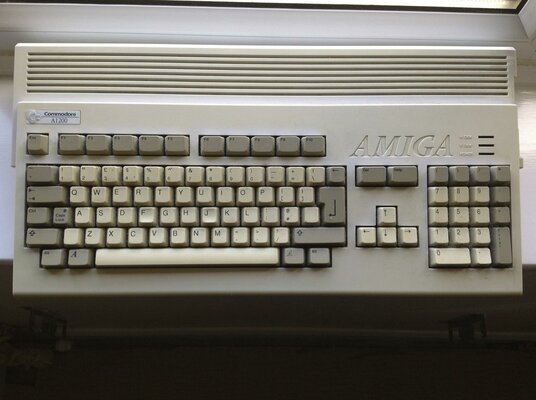
I was pleased with the results on the case, although some of the darker keys had started to bloom, but I could always get a replacement keyboard. This photograph was taken on the 17/09/12, after I had reassembled the Amiga.
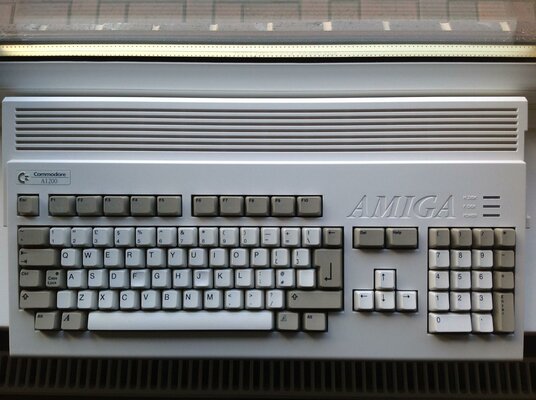
Other than a week, where the Amiga was out, but not in direct sunlight, it has been stored in its original box in the back of a wardrobe, away from any light or heat source. So I was disappointed to see how badly discoloured it had become in just over a year.
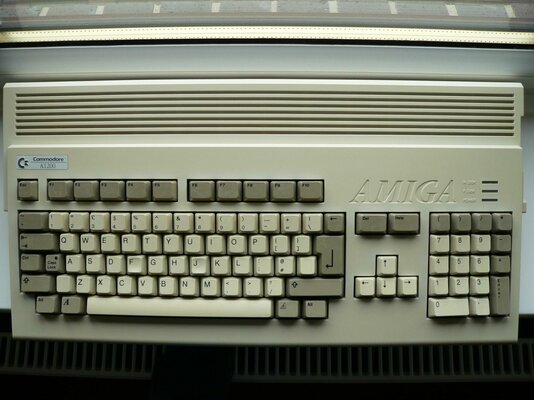
I am considering retrobriting it again, last time I didn't use any lacquer or varnish. Specifically, I'd like to know what type of lacquer or varnish people used and what were the long-term results of it?
Thanks for any help.
I was pleased with the results on the case, although some of the darker keys had started to bloom, but I could always get a replacement keyboard. This photograph was taken on the 17/09/12, after I had reassembled the Amiga.
Other than a week, where the Amiga was out, but not in direct sunlight, it has been stored in its original box in the back of a wardrobe, away from any light or heat source. So I was disappointed to see how badly discoloured it had become in just over a year.
I am considering retrobriting it again, last time I didn't use any lacquer or varnish. Specifically, I'd like to know what type of lacquer or varnish people used and what were the long-term results of it?
Thanks for any help.