Zorro III SATA Controller

  • Thread starter Thread starter JHanna
  • Start date Start date
  • Replies Replies 28
  • Views Views 1878

JHanna

Active member
Joined
Dec 16, 2023
Posts
442
Country
United Kingdom
Region
Northern Ireland
Been having a nightmare these last few weeks researching and trying to find hard disks for my A4000T. SCSI drives are now almost unobtainable unless you fancy paying silly money for a 25 year old drive. Even NOS IDE drives are hard to get. CF adapters are a terrible solution. I honestly can't think of a reason A Zorro III SATA Controller doesn't exist. Preferably with 4 SATA ports, and a ZII mode for those with older machines. Am I missing something here?

Do you think a kickstarter would work if we can get someone to design this for us?

Stephen Leary is the only man I can think for the job, if he'd be up for it. Does anyone know how to get in touch with him?

Thoughts?
 
My two pennies worth .

I have thought about doing this myself , but SATA drives are also becoming obsolete and replaced with M2 solid state drives . Therefore the best option would be to create an M2 NVME controller NOT an SATA controller .

Until they become obsolete , of course .
 
My two pennies worth .

I have thought about doing this myself , but SATA drives are also becoming obsolete and replaced with M2 solid state drives . Therefore the best option would be to create an M2 NVME controller NOT an SATA controller .

Until they become obsolete , of course .
Guy's, this whole thing depends on the IDE to SATA transition chip - when correct chip is chosen - both can be done M.2 & SATA - see advanced version of the Dicke Olga accelerator - it has this implementation and it works flawlessly..

Keep in mind that M.2 has several standards: Serial ATA (NGFF & mSATA) are easy to adapt, but not PCI Express!
 
Oh cool, I hadn't heard of that :) However, isn't it still going to be pretty bottlenecked on IDE in that case?
 
Oh cool, I hadn't heard of that :)
You will be able to see that in Chris Edwards upcoming review of that card. This video is currently viable for Patreons only..
However, isn't it still going to be pretty bottlenecked on IDE in that case?
Well...Not IDE, it'll be Zorro in this case.. 😜
Due to it's design - Zorro2 has data transfer limitation of 3.5MB/s while Zorro3 reaches 6.5MB/s maximum. So You can take any rocket fast transition chip - yet speed limits mentioned above will be absolute maximum on a Zorro card.. Sorry to say that... 😔

Take Freeway Triton USB as example - it would go faster, but unfortunately due to these limitations it can do only 6.5MB/s in Zorro3 mode..

This can only run faster in the situation where IDE, SATA or M.2 is on the same board with CPU, and can do data transfers directly on 32bit bus. In that case it can (and actually does)... 10MB/s - is currently what we have reached on Fat Olga accelerator, and that's 030, might do more with 040 or 060... DMA would support would be ideal - fast data transfers without CPU load... That's what You should know about...


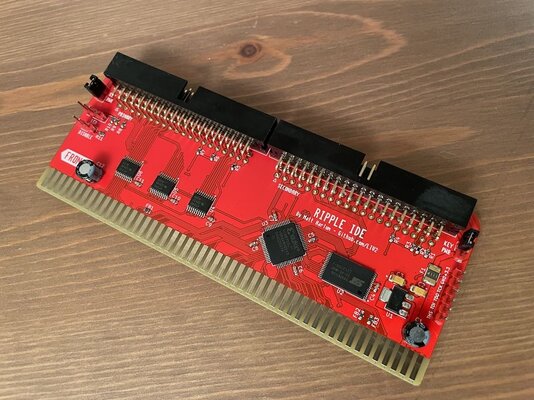
As about a Zorro card: I'm pretty sure that it can be done easily.. I can actually talk to Matt Harlum, maybe he will expand his ripple card and add SATA on it:
RIPPLE.jpg
Regards,

8 Bit Dreams
 
Last edited:
Guy's, this whole thing depends on the IDE to SATA transition chip - when correct chip is chosen - both can be done M.2 & SATA - see advanced version of the Dicke Olga accelerator - it has this implementation and it works flawlessly..
I was thinking to do away with the translator and do a direct to NVME controller ( no SATA involved ) . Will not speed up , but saves the extra steps !

More of a slowed down PCIe to zorro , or cpu bus .
 
Last edited:
My two pennies worth .

I have thought about doing this myself , but SATA drives are also becoming obsolete and replaced with M2 solid state drives . Therefore the best option would be to create an M2 NVME controller NOT an SATA controller .

Until they become obsolete , of course .

I am aware of this argument, but SATA drives are cheap and abundant. They are gonna be here for a long time.
 
How about 1 penny worth of comments?

On my A4000T under OS4.1FE with a Mediator and my CSPPC with SCSI-3 controller, I used to use two SCSI-to-IDE adapters connected to IDE-to-SATA devices to run SATA SSDs -- I achieved 30+ MB/s (commented upon in the Hyperion OS4.1 forums around 2010 - 2016). The mediator allowed the use of a PCI SATA-II card with a SATA drive, too -- although the implementation was poor. These days, on my A4000D I use a 128 GB SSD using an IDE-to- SATA adapter. I may still have the SCSI-to-IDE adapters, and they can be found online. Being used to 3 - 5 MB/s speed, I no longer care as much about data transfer speeds, as restoring, and keeping vintage Amigas alive and kicking.
 
I am aware of this argument, but SATA drives are cheap and abundant. They are gonna be here for a long time.
SATA SSDs are being replaced with NVMe's at an alarming rate; I suspect they will fall out of common use within the next 2 years, becoming a technology left to the sands of time (and climate change).
 
Whatever solution would get good performance on modern-ish storage options is the holy grail here :) I see bdb's 30MB/s and that's what I wish existed on more than just a CSPPC.

But, since the zorro bus isn't fast enough for this, I guess I'm looking in the wrong place. Maybe it makes more sense to try to engage with the people building accelerators :)
 
An accelerator using a 32-bit bus would be able to take advantage of the speed, just remember, we are still dealing with (mostly) 30-year-old hardware here, and even SCSI III is dead with damn hard to find working drives. Having a retro computer will always have its disadvantages when compared to newer ones (that seems pretty stupid of me to say...)
 
It's more about the availability and affordability of huge SATA drives, rather than the speed. For me at least. Zorro III should be fast enough.
 
It's more about the availability and affordability of huge SATA drives, rather than the speed. For me at least. Zorro III should be fast enough.
I thought the same but after using a CSMK3 SCSI I had my mind changed :)

An accelerator using a 32-bit bus would be able to take advantage of the speed, just remember, we are still dealing with (mostly) 30-year-old hardware here, and even SCSI III is dead with damn hard to find working drives. Having a retro computer will always have its disadvantages when compared to newer ones (that seems pretty stupid of me to say...)
Yeah, I think what I am trying to get at here is that there are multiple modern accelerators being built and developed. If someone could make one have an onboard m.2 nvme with similar or better performance to the CSMK3 SCSI, people would really benefit. But this is skewing OT so I'll stop here :P
 
Back
Top Bottom