Modern Amiga PSUs: deeper than a rabbit hole!

  • Thread starter Thread starter fpmpaolo
  • Start date Start date
  • Replies Replies 128
  • Views Views 4854
Amiga PSUs are indeed a rabbit hole! I can see where Jens from iComp is coming from with his disdain for Mean Well and other PSUs (see his YouTube video) - getting a PSU to meet the Amiga's exact specs is hard! The Mean Well RPT range have out-of-spec ripple and also have minimum load requirements on all three rails = +12V, -12V and +5V, and an Amiga is only going to meet the 5V load. The PT-65B has within-spec ripple, but needs a minimum load on the +12V and +5V rails. The Amiga covers the 5V one, but we have to install resistors to get the +12V minimum load. I'm not sure it's worth all this effort when I can buy a CA-PSU from iComp made by someone who actually knows what they are doing. It's fairly expensive, but it really does meet the specs from what I understand.
They're more than a rabbit hole.
I mean: the more you study, the deeper you vanish into the hole.
CA-PSU seems to be the perfect solution for all kinds of Amiga: from the base setup to the most expanded one.
BUT: yes, it's esxpensive. There's another one - the PowerShark but...still expensive: 88GBP.

You can watch its specs in this video

Last but not least. Only a personal opinion, and I hope no-one gets offended but...Jens is a SELLER. Indeed he HAS TO SELL its products so he claims his CA-PSU is the best ever.
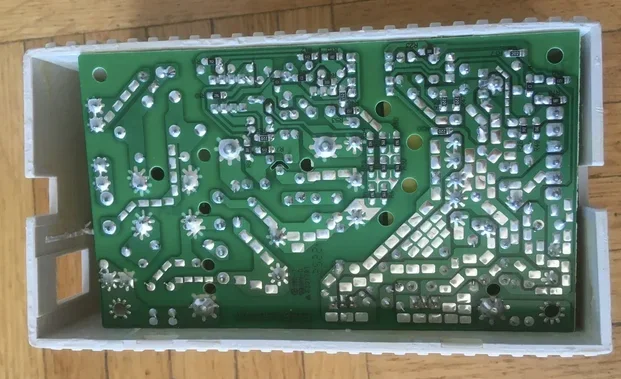
I'd like to dismantle it and see how it's made, MAYBE I'll do that when guarantee time is over.
Unless I don't find someone that has done that.

PS. I have a spare PSU case but it's cut since I wanted to install a Voltage meter...what could I put instead of that meter?
I'd like a display with "AMIGA" written on that but how could I do?
do you have any ideas? If so please lemme know!
 
To all.

I think we’re overthinking this.
Just take a regular RT-65B and leave it as is. What’s the problem? Do you have 4.7V? Then the problem is in your Amiga.
Set it to 5.2V and you’re fine. And if the 12V go up to 12.2V, so what?
Including myself, we’re putting a resistor here, a resistor there, why??
Personally, I’ve never had any problem with the RT-65B, which was plug and play. Except the problem in my head 😎
 
To all.

I think we’re overthinking this.
Just take a regular RT-65B and leave it as is. What’s the problem? Do you have 4.7V? Then the problem is in your Amiga.
Set it to 5.2V and you’re fine. And if the 12V go up to 12.2V, so what?
Including myself, we’re putting a resistor here, a resistor there, why??
Personally, I’ve never had any problem with the RT-65B, which was plug and play. Except the problem in my head 😎
You're probably right! Or are you? And there's the (my) problem - I worry that I'm not giving my Amigas the best chance of longevity, but I don't know if that worry is warranted. Maybe I should just get a Mister and run an "Amiga" that way! :p
 
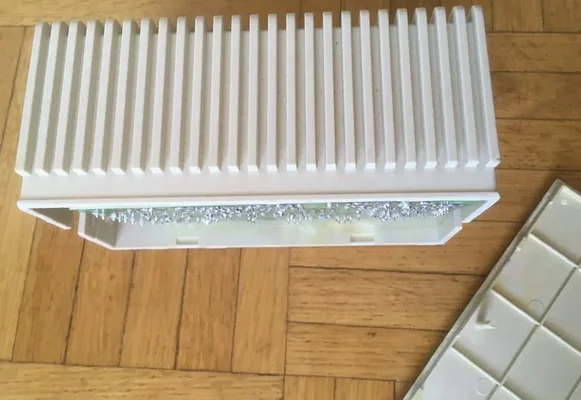
It's these cases I'm going to try to squeeze the PT-65B into. I've only ever got these from UK. 74mm wide internally, ideally I hope it fits on a bit of an angle to clear the 76mm PT-65B spec width. Fun to get that original epoxy block out of these, ain't it? :-) View attachment 2546411
You can trim both sides of the PT-65B and you may make it 1mm narrower in total but don't expect more than that.
Either you'll place it angled or you can trim the case internally another 0.5mm to each side.
I am sure it can be done anyway.
I've made this but it's not fully assembled inside.
20250922_144901.webp
 
My PT-65B landed, and I can confirm that with a slight inside-edge trim of the modern A600/A1200 British 240V PSU and removal of a few in-the-way internal ribs, the 65B will fit internally on a slight angle in my dry-fit trial. At least one spot of the PCB can be filed to allow the base clips to lock in, the other internal clips of the base have to be clipped off on one side of the base before final fit and close-glue.

Verdict: THIS UPGRADE/REPLACEMENT WILL WORK!
 

Attachments

  • Power1.webp
    Power1.webp
    49 KB · Views: 9
  • Power2.webp
    Power2.webp
    32.7 KB · Views: 6
I won't resist. :-) My systems all have something in them from actual spinning disk to accelerators, etc. I think that will provide the required resistance. Too risky?
 
Accelerators and spinning disks will add load to the 5V rail, I believe. If you adjust the PT-65B so that the 5V rail is actually measuring 5V on the Amiga, you'll probably find that the 12V rail is over spec voltage (>13.2V) unless you put a load on the 12V rail too (the minimum load for the PT-65B's 12V rail is 0.2A according to the Mean Well spec sheet). I've no idea if over-volting an Amiga's 12V rail is detrimental or not.
 
Accelerators and spinning disks will add load to the 5V rail, I believe. If you adjust the PT-65B so that the 5V rail is actually measuring 5V on the Amiga, you'll probably find that the 12V rail is over spec voltage (>13.2V) unless you put a load on the 12V rail too (the minimum load for the PT-65B's 12V rail is 0.2A according to the Mean Well spec sheet). I've no idea if over-volting an Amiga's 12V rail is detrimental or not.
In mine, 5v is adjusted to 5.2v and 12v is 12.2v.
On the motherboard I measure 4.96v and 11.96v.
Give me these measurement of yours.
 
Is it too risky not to use resistors? 😂👍
If I was RISCing I would certainly resits. :-)

@GentleBen you and @bdb and others have provided a lot of detailed and useful info here. I think looking back at all the people using ATX power supplies, and the fact that @bdb measured as per below, and the fact that he didn't get anything crazy (I'll check mine too before use) I'll run as-is. Considering the Commodore PSU 12V spec is 10.8V - 13.2V (12V +/- 10%) and the experience people had with these 65Bs...seems like K.I.S.S. is not a terrible approach.

@bdb wrote earlier in the thread...
"I did some testing of the Mean Well PT-65B; stock, it shows the 5 V rails (it sports two) as 5.1 V without load, 4.99 under load with a TF1260. The 12 V rail was 12.7 V but with a load, it was 12.15 V. I added in the Buck DC-DC adapter set for 12 V, without load was 11.8 V and with the load came to 11.35 Volts."
 
Last edited:
In mine, 5v is adjusted to 5.2v and 12v is 12.2v.
On the motherboard I measure 4.96v and 11.96v.
Give me these measurement of yours.
Those numbers are excellent! (y)

I've got two PT-65B PSUs. I've added resistors to one of them to put 0.2A load on the 12V rail.

On my test A600 board (which has SSD, 4MB fast RAM, and 1MB chip RAM expansions), the PSU with resistors shows 4.99V/12.99V at the floppy power connector, which is within spec. The PSU without resistors shows 4.94V/13.76V, which is out of spec, and it's similar to the other PT-65B before I added resistors to it.
 
@GentleBen WOW. That's way more than @bdb. I'm definitely measuring it before I use it.
Yep, the numbers I've seen on the 12V rail are quite high! I'm wondering if my PT-65Bs are defective - even meeting the minimum load requirements, I'm getting 1V over on the 12V rail, which is outside of the voltage tolerance of ±7% (±0.84V) according to the PT-65B spec sheet.

What can get damaged on the 12V rail? The opamp spec says it can handle up to +18V and -18V, so not too worried there. I guess it's peripherals and the floppy drive that could get damaged?

BTW, I bought a CA-PSU last week. The voltages I'm seeing with that are much nicer. They are similar to what @darefail is reporting from their PT-65B. :)
 
Last edited:
@GentleBen, I think the explanation is simple: geography.

You're in the UK, and you're pumping 240V input to the PSU and @bdb and I are here, pumping 117-120V, perhaps this differing input voltage is impacting your output voltage results by a slight margin? Perhaps the concern about the 12V rail is a bigger in the 240V UK zone than here in the 120V zone. It would be interesting to see what 220V Europeans are measuring on it, or what 100V Japan is measuring. Anyone?
 
BTW, I bought a CA-PSU last week. The voltages I'm seeing with that are much nicer. :)
Oh how I would love to disassemble mine and reverse-engineer it.
In a famous video Jens Schonefield says MW PSU are not good.
I would like to see what's inside a CA-PSU.
Ps: when you turn your CA-PSU off, remember to wait some seconds before switching it on again.
 
Perhaps the concern about the 12V rail is a bigger in the 240V UK zone than here in the 120V zone.
This crossed my mind as a possibility. @darefail posted very nice output voltages. They are in Greece I think, and as far as I know, mains voltage there is 230V? I've got a 110V step-down transformer for my Japanese Dreamcast. Maybe I could try feeding that into the PT65-B to see how it affects the output voltage. Or I could just wait for others to post their input vs output voltages. :)
Ps: when you turn your CA-PSU off, remember to wait some seconds before switching it on again.
Yeah, I read that on the iComp website where it says "switching off will start a short timer, ensuring that the next switch-on event can't happen until a few seconds after switching off.". I have a habit of waiting a few seconds between switching off and on, anyway. If I don't, I often see guru meditation on start up.
 
Moreover, investigating DC-DC solutions like PicoPSU could also be another alternative.
Can we investigate these Pico PSUs further? The size is an attractive solution option for many applications. The Alicia 1200 video made me think about this as an option. Anyone using a Pico PSU inside a 1200 for example? These things are a really low cost option too. 180W models are in the $15 range.

EDIT: I guess it doesn't make sense, because you need a decent 12V DC brick externally anyway?
 
Last edited:
I use a MeanWell RT65B for sometime now inside a 3D printed case. It is connected to my A1200 with Blizzard 1230IV (CPU + FPU). Runs just fine. Recently measured with multimeter, it is rock steady.

I use 2 of them but tikered a bit with them and added resistors on 5V and +12V to give it a minimum lkoad spec. Then added a simple filter on the 5V output to pull down the ripple a bit. And looking in my scope it looks better. The problem I had was that the 5V would "dip" if the 12 volt got used to much. Ide it was fine but if I connected a 12V hard drive or alike the 5V dropped down to 4.7 or even lower for a short while. The load resistors made difference and now the 5V never goes below 4.87V when starting up something on the 12 Volt line. With a scope you can try out different caps on the 5V to cut the ripple a bit its mainlu high freq ripple so it works with some tiny ceramics to bring it down.

The main problem is that there is no adjusting "pot" on the 5V only 12V and the 5V "follows" a little if you increese the 12V.

I think it is possible to find a point on the 5V circuit to add a trim pot and up the 5V a little..

Otherwise the CA-PSU is good and not THAT expensive. Building one with meanwell rt65B and a box+ some components cost pretty much the same and is not worth the trouble unless you are inbterested in building stuff like I am.
 
Otherwise the CA-PSU is good and not THAT expensive. Building one with meanwell rt65B and a box+ some components cost pretty much the same and is not worth the trouble unless you are inbterested in building stuff like I am.
Yeah that's my conclusion too, there's just too many things that can go wrong with stock Mean Well supplies (as you demonstraed) as they don't meed the Commodore specs. Even if I had an unexpanded Amiga 500, I still wouldn't use MW and would pay the few bucks extra to get a CA-PSU.

Recently, I also acquired an Amiga 4000 and am now trying to figure out the PSU situation in that world as well. It does seem that there are plenty of off-the-shelf ATX SFX supplies that could do the job but as always, the devil is in the details and there's no CA-PSU for big box Amigas (yet). Also, PicoPSU isn't an option as the 160W model doesn't even meet the Commodore specs for current on the 5V rail.
 
Back
Top Bottom