
You are using an out of date browser. It may not display this or other websites correctly.
You should upgrade or use an alternative browser.
You should upgrade or use an alternative browser.
Closed New board: The VIC-II² - PAL/NTSC switch board for Commodore 64
- Thread starter Starglider
- Start date
- Replies 200
- Views 52316
- Status
- Not open for further replies.

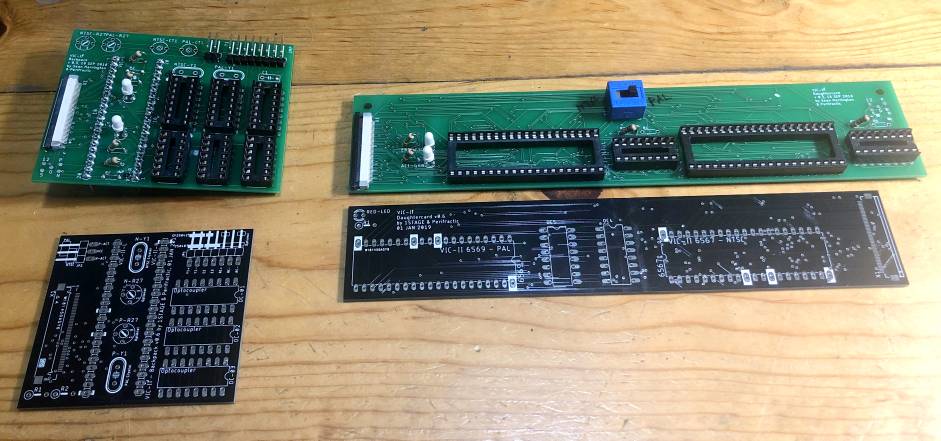
Small update added to initial post: Testing is going steadily. We now have a more compact prototype v2. Still no release date, other that "when it's perfect" [emoji6][emoji973]️
Your friend in retro, Perifractic
Your friend in retro, Perifractic
Last edited:

Please put me down for one assembled board.
Very exciting!
Very exciting!

ToxicToast
New member
re-declaring my interest now that the holidays are behind us! One kit declared.

1stage
New member
UPDATE
UPDATE
Hey, Perifractic has been keeping you all updated, but I apologize that I haven't posted on the details in a while. Here are some salient points on where we're at:
- I've confirmed continuity through cable (50pin 0.5mm pitch FFC "reverse" 300mm long) between the backpack board (sockets into the VIC-II slot) and the daughtercard (holds the two VIC-II chips), so the board design and wiring are tested and confirmed.
- I've built a solder reflow oven to more consistently handle the surface mount parts (FFC connectors) on future revisions, and when we start building kits
- To simplify the problems I was having with the logic switching circuits, I just made the NTSC/PAL a switch that toggles between the two modes, BUT THE C64 MUST BE TURNED OFF BEFORE SWITCHING. We'll figure out how to make this happen logically later.
- I still haven't had an effective test with a VIC-II on the daughtercard. It works when I install a VIC-II in a DIP40 socket I've bodged on top of the backpack, but not when going through the FFC cable to the daughtercard.
- I removed the optocouplers (for now) and hard-switched them by using jumper wires. I don't want to blow the IR LEDs inside the optos while I'm testing, so this is the safest route until I figure out the VIC-II problem.
- I've always assumed that the FFC cable would pick up noise and mess with the signals coming from the motherboard, so I added aluminum foil tape around the cable for some shielding and heavy duty clear packing tape to insulate. This gave me a blank white screen (stable) instead of a wavy, static-filled black screen, so I chalk it up as progress. I may also later use this method (with a laminator and tin foil instead) to create an ad-hoc shielding box for each of the boards.
- The FFC cable seems excessively long, so I've ordered some 100mm, 150mm, and 200mm replacements to test.
Given that, here are my thoughts:
- If the new, shorter cables don't work, I'll need to create a different design of boards that keeps the VIC-IIs VERY close to the socket. In both breadbox and C style cases, this is TOUGH, as the keyboard just barely clears the metal box around the VIC... not much headroom.
- I'm thinking of creating a "step-down" board that brings the two VIC-IIs below the height of the shielding box, but on the 250407 boards it would have to intrude in the area over the ASSY NO.250407 silkscreen at the bottom of the board, and there are four components there (ceramic cap, electrolytic cap, filter, and a terminating resistor), which I would either have to move (could be moved to bottom of the motherboard), or design around. But for the 250425 boards the VIC-II is turned 90 degrees CCW, and if I used the same board, it would also spin 90 degrees CCW and the VIC-IIs would have to fight for space with a couple BIG electrolytic caps. This would mean that I'd need to use the space ABOVE and to the LEFT of the VIC-II slot on the 250425 board for the VIC-IIs (no components there!). But that config wouldn't work in the 250407, because there are about four ICs in the way in the 90 degree CW rotation... so, that would be TWO different boards for each of those two classes of mobos.
Anyway, that's where I'm at right now. Thanks for your words of support and positive feedback!
- Sean
UPDATE
Hey, Perifractic has been keeping you all updated, but I apologize that I haven't posted on the details in a while. Here are some salient points on where we're at:
- I've confirmed continuity through cable (50pin 0.5mm pitch FFC "reverse" 300mm long) between the backpack board (sockets into the VIC-II slot) and the daughtercard (holds the two VIC-II chips), so the board design and wiring are tested and confirmed.
- I've built a solder reflow oven to more consistently handle the surface mount parts (FFC connectors) on future revisions, and when we start building kits
- To simplify the problems I was having with the logic switching circuits, I just made the NTSC/PAL a switch that toggles between the two modes, BUT THE C64 MUST BE TURNED OFF BEFORE SWITCHING. We'll figure out how to make this happen logically later.
- I still haven't had an effective test with a VIC-II on the daughtercard. It works when I install a VIC-II in a DIP40 socket I've bodged on top of the backpack, but not when going through the FFC cable to the daughtercard.
- I removed the optocouplers (for now) and hard-switched them by using jumper wires. I don't want to blow the IR LEDs inside the optos while I'm testing, so this is the safest route until I figure out the VIC-II problem.
- I've always assumed that the FFC cable would pick up noise and mess with the signals coming from the motherboard, so I added aluminum foil tape around the cable for some shielding and heavy duty clear packing tape to insulate. This gave me a blank white screen (stable) instead of a wavy, static-filled black screen, so I chalk it up as progress. I may also later use this method (with a laminator and tin foil instead) to create an ad-hoc shielding box for each of the boards.
- The FFC cable seems excessively long, so I've ordered some 100mm, 150mm, and 200mm replacements to test.
Given that, here are my thoughts:
- If the new, shorter cables don't work, I'll need to create a different design of boards that keeps the VIC-IIs VERY close to the socket. In both breadbox and C style cases, this is TOUGH, as the keyboard just barely clears the metal box around the VIC... not much headroom.
- I'm thinking of creating a "step-down" board that brings the two VIC-IIs below the height of the shielding box, but on the 250407 boards it would have to intrude in the area over the ASSY NO.250407 silkscreen at the bottom of the board, and there are four components there (ceramic cap, electrolytic cap, filter, and a terminating resistor), which I would either have to move (could be moved to bottom of the motherboard), or design around. But for the 250425 boards the VIC-II is turned 90 degrees CCW, and if I used the same board, it would also spin 90 degrees CCW and the VIC-IIs would have to fight for space with a couple BIG electrolytic caps. This would mean that I'd need to use the space ABOVE and to the LEFT of the VIC-II slot on the 250425 board for the VIC-IIs (no components there!). But that config wouldn't work in the 250407, because there are about four ICs in the way in the 90 degree CW rotation... so, that would be TWO different boards for each of those two classes of mobos.
Anyway, that's where I'm at right now. Thanks for your words of support and positive feedback!
- Sean
Last edited:

1stage
New member
Update 21 FEB 2019
Update 21 FEB 2019
Quick update: single board solution kinda worked...
- Optocouplers aren't going to work, unfortunately. Changing to solid state relays.
- System does work when optocouplers are replaces with wire jumpers, but there is some noise in the screen.
- I had to move the big capacitor (next to the VIC-II cage on the 250407 board) to the bottom of the motherboard for now.
- New version will "straddle" the VIC-II slot with the NTSC VIC-II to the left of it and the PAL VIC-II to the right.
- The eight jumpers at the top of the board will be removed and the board will now slot DIRECTLY into posts/headers (haven't decided on male or female yet) on the C64 motherboard.
BUT
- This means that there will be TWO versions of the board: one for 250407 and another for 250425/250466 due to the change in orientation of the VIC-II slot between those two models.
- I still don't know how much headroom I have before I hit the bottom of the keyboard. The VIC-II chips MUST have a heat sink, and there's only so close I can get to the surface of the motherboard without hitting other components.
That's it for now.
- Sean
Update 21 FEB 2019
Quick update: single board solution kinda worked...
- Optocouplers aren't going to work, unfortunately. Changing to solid state relays.
- System does work when optocouplers are replaces with wire jumpers, but there is some noise in the screen.
- I had to move the big capacitor (next to the VIC-II cage on the 250407 board) to the bottom of the motherboard for now.
- New version will "straddle" the VIC-II slot with the NTSC VIC-II to the left of it and the PAL VIC-II to the right.
- The eight jumpers at the top of the board will be removed and the board will now slot DIRECTLY into posts/headers (haven't decided on male or female yet) on the C64 motherboard.
BUT
- This means that there will be TWO versions of the board: one for 250407 and another for 250425/250466 due to the change in orientation of the VIC-II slot between those two models.
- I still don't know how much headroom I have before I hit the bottom of the keyboard. The VIC-II chips MUST have a heat sink, and there's only so close I can get to the surface of the motherboard without hitting other components.
That's it for now.
- Sean
1stage
New member
VIC-II Squared v0.8-M PCBs Due Today
VIC-II Squared v0.8-M PCBs Due Today
Hey, the "manual" version of the VIC-II Squared PCBs are due today. This involves using a manual 10p2t push-on/push-off switch that toggles the ten circuits needed to switch between PAL and NTSC. I'm pretty confident with this version, but hey, I've been surprised/disappointed in the past...
Caveats:
- The system DOES require you turn it off before switching.
- There is currently no way to switch without the case open.
- This board is ONLY for 250407 motherboards.
- Desoldering and removal of components is required (quartz crystal, jumpers, R27 trim resistor), and replacement with header pins (still don't know if they'll be male or female yet).
- Not sure, but the big electrolytic capacitor might still need to be moved to the bottom of the board. I moved it previously for an earlier version that was too big to fit.
I'll post a picture and maybe some video on my Twitter feed (@1stage) as it happens, later tonight, Pacific Time, but I don't want to miss the finale of Masked Singer, so... you know, priorities...
- Sean
VIC-II Squared v0.8-M PCBs Due Today
Hey, the "manual" version of the VIC-II Squared PCBs are due today. This involves using a manual 10p2t push-on/push-off switch that toggles the ten circuits needed to switch between PAL and NTSC. I'm pretty confident with this version, but hey, I've been surprised/disappointed in the past...
Caveats:
- The system DOES require you turn it off before switching.
- There is currently no way to switch without the case open.
- This board is ONLY for 250407 motherboards.
- Desoldering and removal of components is required (quartz crystal, jumpers, R27 trim resistor), and replacement with header pins (still don't know if they'll be male or female yet).
- Not sure, but the big electrolytic capacitor might still need to be moved to the bottom of the board. I moved it previously for an earlier version that was too big to fit.
I'll post a picture and maybe some video on my Twitter feed (@1stage) as it happens, later tonight, Pacific Time, but I don't want to miss the finale of Masked Singer, so... you know, priorities...
- Sean
1stage
New member
Quick update:
- We're testing the final candidate boards. They work but we need to make sure our installation instructions are clear, correct, and concise.
- It is a single-board solution (not two as previously mentioned), but there will be both a 250407 and a 250425/250466 version of the board. This accommodates the different location of the jumpers, crystals, and VIC-II sockets between the two motherboards.
- Doesn't fit in a 64c-style case at this time. Sorry. Not a lot of head room, so breadbin cases only for now.
- Doesn't require a case mod. The switch can be trailed out the RF channel switch hole without interrupting it's function.
- Only switches modes AFTER power is turned off, and you can keep it in whichever "default" mode you want. BUT, you must power off. A soft reset won't do it (latching relays).
More news soon!
- We're testing the final candidate boards. They work but we need to make sure our installation instructions are clear, correct, and concise.
- It is a single-board solution (not two as previously mentioned), but there will be both a 250407 and a 250425/250466 version of the board. This accommodates the different location of the jumpers, crystals, and VIC-II sockets between the two motherboards.
- Doesn't fit in a 64c-style case at this time. Sorry. Not a lot of head room, so breadbin cases only for now.
- Doesn't require a case mod. The switch can be trailed out the RF channel switch hole without interrupting it's function.
- Only switches modes AFTER power is turned off, and you can keep it in whichever "default" mode you want. BUT, you must power off. A soft reset won't do it (latching relays).
More news soon!
Last edited:

How exciting, it's almost ready! Interested in one board, please put me in the list, thanks!
*UPDATE*
I already expressed interest back in September 2018. Haha! Thanks to the past me!
*UPDATE*
I already expressed interest back in September 2018. Haha! Thanks to the past me!
Last edited:
Putting you down for 2 boards [emoji6][emoji6]How exciting, it's almost ready! Interested in one board, please put me in the list, thanks!
*UPDATE*
I already expressed interest back in September 2018. Haha! Thanks to the past me!
Hope it will work on a PAL C64 unit too, to make it switchable to NTSC ?
Thanks for the great effords.
That's the plan! [emoji106][emoji973]️
1stage
New member
Another set of updates:
- Boards have been reworked to fit in either breadbin or 64c-style cases... took some careful shifting of parts closer to the RF box while keeping the analog lines as short as possible
- Both 250407 and 250425/250466 motherboard versions supported (2 different boards)
- Includes Lumafix circuitry, but you can omit those parts if you don't want/need it (saves a few bucks)
- All through-hole soldering components... no SMD...
- Should require desoldering of only 5 or 6 pads/leads on the C64 motherboard... the VIC-II socket is safe!
- Streamlined, simplified instructions
- We switch relays using hook clip leads attached to C64 power switch (to keep it simple), BUT could (hypothetically) be switched from an Arduino with attachment to the reset line
- Boards have been reworked to fit in either breadbin or 64c-style cases... took some careful shifting of parts closer to the RF box while keeping the analog lines as short as possible
- Both 250407 and 250425/250466 motherboard versions supported (2 different boards)
- Includes Lumafix circuitry, but you can omit those parts if you don't want/need it (saves a few bucks)
- All through-hole soldering components... no SMD...
- Should require desoldering of only 5 or 6 pads/leads on the C64 motherboard... the VIC-II socket is safe!
- Streamlined, simplified instructions
- We switch relays using hook clip leads attached to C64 power switch (to keep it simple), BUT could (hypothetically) be switched from an Arduino with attachment to the reset line
- Status
- Not open for further replies.