D
Deleted member 14264
Guest
Hi everyone,
PLAnkton has been a very popular product since it's introduction back in August 2015. More than 3000 units have been sold since, a number which I find stunning after all this time.
Back then, me and co-creator Fredric Blåholtz expected to sell a few hundreds. With lots of luck maybe 1000. We were quite surprised with the demand and the very positive reception.
However, time has passed and a few potential improvements have been noted.
For one thing, a genuine Commodore PLA signals at a voltage between 3.7 and 4.5 volts. Usually hovering around 4.3 volts. PLAnkton feeds the XC9536XL core CPLD at 3.7-3.8 volts and while this is within the requirements to be representative of a good PLA, it is beyond the recommended operating voltage defined by the manufacturer. At the same time, it is somewhat too low when compared to a genuine Commodore PLA.
Also, even when using the low power mode of the XC9536XL and slew rate limiters built into this type of IC, PLAnkton's slew rate signaling remains much higher than a genuine old PLA.
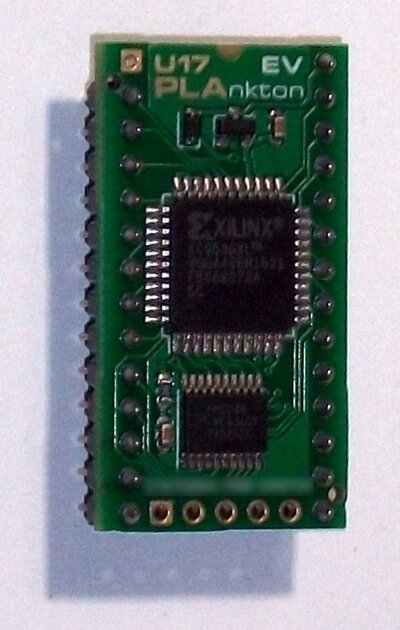
PLAnkton EV resolves these issues by adding a CMOS buffer which will be powered at 4.3V while the CPLD is now powered at 3.3V. The buffer uses legacy CMOS technology which has a low slew rate nearly identical to that of vintage technology PLAs and is powered at a voltage which also allows it to signal a higher voltage, now also nearly identical to that of vintage technology PLAs.
Half a dozen units have already been made and thoroughly tested.
EV means Exact Voltage.
More information and photos to come.
PLAnkton has been a very popular product since it's introduction back in August 2015. More than 3000 units have been sold since, a number which I find stunning after all this time.
Back then, me and co-creator Fredric Blåholtz expected to sell a few hundreds. With lots of luck maybe 1000. We were quite surprised with the demand and the very positive reception.
However, time has passed and a few potential improvements have been noted.
For one thing, a genuine Commodore PLA signals at a voltage between 3.7 and 4.5 volts. Usually hovering around 4.3 volts. PLAnkton feeds the XC9536XL core CPLD at 3.7-3.8 volts and while this is within the requirements to be representative of a good PLA, it is beyond the recommended operating voltage defined by the manufacturer. At the same time, it is somewhat too low when compared to a genuine Commodore PLA.
Also, even when using the low power mode of the XC9536XL and slew rate limiters built into this type of IC, PLAnkton's slew rate signaling remains much higher than a genuine old PLA.
PLAnkton EV resolves these issues by adding a CMOS buffer which will be powered at 4.3V while the CPLD is now powered at 3.3V. The buffer uses legacy CMOS technology which has a low slew rate nearly identical to that of vintage technology PLAs and is powered at a voltage which also allows it to signal a higher voltage, now also nearly identical to that of vintage technology PLAs.
Half a dozen units have already been made and thoroughly tested.
EV means Exact Voltage.
More information and photos to come.
Last edited by a moderator: