Modern Amiga PSUs: deeper than a rabbit hole!

  • Thread starter Thread starter fpmpaolo
  • Start date Start date
  • Replies Replies 128
  • Views Views 4845
AFAIK all ATX supplies do their regulation on the 12V rail, so potential issues would be common with all of them. I'd assume that it's possible to load the 12V rail enough to get stable output on the 5V rail. Some modern ATX supplies (Seasonic) have amazing specifications with minimal ripple. However, I'm not an electrical/electronic engineer, so I can't help with specifics. Maybe post at EAB, there are plenty of knowledgeable people there (e.g. Daedalus) that could help.

My question would be, why go this route when there are simpler alternatives? Spend the 70-80 euros to buy a CA-PSU or recap an older Commodore PSU with solid polymer caps.
 
Last edited:
Jens has told me a couple of years ago that IComp is working on a modern PSU for big boxes, so hopefully he will come up with a solution for the 12V regulation.
 
My question would be, why go this route when there are simpler alternatives? Spend the 70-80 euros to buy a CA-PSU or recap an older Commodore PSU with solid polymer caps.

You're right, i might be reconsidering my old bunches of Commodore PSU.
However, problem is that they usually lacked the power for advanced setup and are of course quite yellowed, not of the best effect at the side of a clean looking A1200.net case.
 
You're right, i might be reconsidering my old bunches of Commodore PSU.
However, problem is that they usually lacked the power for advanced setup and are of course quite yellowed, not of the best effect at the side of a clean looking A1200.net case.
Personally, I'm amazed that nobody else other than Jens has come up with another widely-available pre-packaged DC-DC solution (which the CA-PSU is). That kinda shows you the real level of electronics expertise in the community: Mostly grifters / people looking to make a quick buck with minimal effort.

There's Powershark which I very much want to see become widely available (though I have some reservations as Jens has offered to perform extensive testing on it and they turned him down, but also it's now been delayed for months, maybe they're fixing faults?)

Then there's PicoPSU but that still requires some electronics skills and work to put it together into a complete supply.

DC-DC seems to me the most promising route for the future. It's compact, and according to Jens, cross-regulation issues either disappear or are very simple to solve and one doesn't have to worry about the expensive testing and certifications for mains-powered electronics.
 
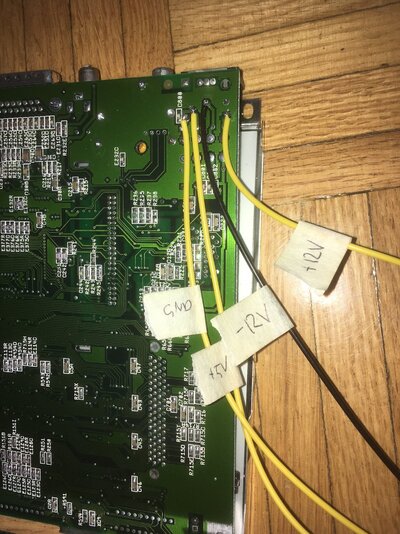
Well @atomontage, I think cost is becoming a factor in this hobby. It seems like something of quality and value should be possible in this space, and yet it is fleeting. I also respect the quality of products Jens delivers, but take the cost, add the hefty UPS shipping charge to North America (not his fault) add customs/brokerage/duties (not his fault) and you have one heck of a motivation to use an ATX power supply. Look at what I've resorted to in a build or two? :)
 

Attachments

  • IMG_6495.JPG
    IMG_6495.JPG
    653.1 KB · Views: 24
Last edited:
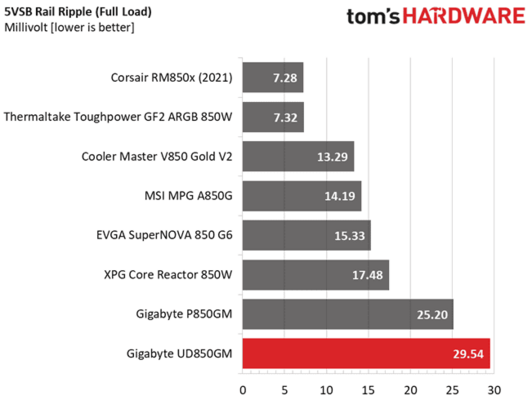
@atomontage ....maybe this ripple problem on ATX is not that bad? Tom's Hardware notes that the spec limit is 50mV on 5V, which would meet Commodore's needs.


The ripple limits, according to the ATX specification, are 120mV for the +12V and -12V rails, and 50mV for the remaining rails (5V, 3.3V, and 5VSB). Nonetheless, in modern PSUs, we expect to find a much lower ripple. It should be just a small fraction in high-end platforms with quality components and the proper amount of filtering capacitors. Below, you will find a schematic that analyzes a ripple waveform.
 

Attachments

  • 5VRippleTest.png
    5VRippleTest.png
    15.2 KB · Views: 13
Modern ATX supplies don't usually have a ripple problem (that was mostly referring to the MeanWell supplies) just a regulation problem (with the Amiga) as their main rail is typically 12V and not 5V.
 
Last edited:
@atomontage, that's good to hear. I'm a bit relieved, was worried there about my Amiga.

By the way, 50mV ripple Commodore specification is only for 5V, correct? And 12V ripple at 120mV is OK on Amiga? Is there a spec/requirement for 12V as well? Again, really appreciate your knowledge and detailed feedback.

This power supply problem has got to be solvable somehow. I wish I had the engineering knowledge on this and here is a little example why. Like many of us, Amiga are not my only sickness. I also enjoy a bit of retro audio. I have this Technics CD player, SL-XP7. This thing is weird because it needs a proprietary power supply of -6V DC and +6V DC. These power supplies for this CD payer are rare and when they come up, are expensive. But recently a car accessory for this thing came my way and it takes in 12V DC only, and converts it to the necessary -6V DV and +6V DC for this CD player. Now I look at this thing and wonder if such a conversion would be possible for Amiga form a single higher amperage 12V PS to give us the 5A 5V, 1A 12V and the low amperage -12V. Of course...what of the ripple in that case? :)
 
@atomontage, that's good to hear. I'm a bit relieved, was worried there about my Amiga.

By the way, 50mV ripple Commodore specification is only for 5V, correct? And 12V ripple at 120mV is OK on Amiga? Is there a spec/requirement for 12V as well? Again, really appreciate your knowledge and detailed feedback.

That's right. The spec is here (taken from Jen's slides, I'll also add it to my original comment as a reference), so you can see on page 3 they specify ripple for all voltages at full load (that's another point that folks who just measure ripple with an oscilloscope under minimal load are missing).

This power supply problem has got to be solvable somehow.

I think it's a combination of the market being small, potential issues being hidden short-term / easily manifesting only with modern add-ons (e.g. using 3.3V regulators and CPLDs) and of course lots of grifting and profiteering. It is a simple problem to solve, especially if one goes the DC-DC route and adds a simple compensation circuit like CA-PSU did.
 
Last edited:
None of them admit that they're simply taking a dirt-cheap off-the-shelf MeanWell supply that doesn't even meet the Commodore specifications and wrap it in a plastic case with cables whilst charging 3-4 times the price. Besides the ludicrous margins, there's zero engineering here.
Well, we Amiga fans seem to be a little emotional I think. It's OK, we can admit it. I've found myself wondering why. Bridgeboards are a perfect example, often fetching obscene amounts when a Pentium SBC is here for fraction of the cost, with VGA and other goodness onboard already. Big deal...SBC needs an external switcher for keyboard and video, which by the way so does a bridgeboard if you use a VGA card behind it. Funny example about Amiga premium I came across recently is the 16-bit ISA 36pin slot. I wanted 2 for my 2000 as many of us do. Searched it up, and result with "AMIGA" in it cost 50% more for just one (1!) vs 5-pack without "AMIGA" in it. And the "AMIGA" listing has sold plenty of units too.

What does this tell us? A power supply that would output the needed voltages and amperages, with simple "AMIGA" added in description can indeed command 3-4 times the price. :) Or...ATX?

And so people start feeling this...

 
Last edited:
That's right. The spec is here (taken from Jen's slides, I'll also add it to my original comment as a reference), so you can see on page 3 they specify ripple for all voltages at full load (that's another point that folks who just measure ripple with an oscilloscope under minimal load are missing).
So for 5V it is 50mV and for 12V it is 120mV, which is ATX spec. This all makes me sleep better knowing all those ATX users are not harming their Amiga. :-) Thank you for this spec sheet link as well. This is a very informative thread for newbies thanks to you @atomontage.
 
So for 5V it is 50mV and for 12V it is 120mV, which is ATX spec. This all makes me sleep better knowing all those ATX users are not harming their Amiga. :) Thank you for this spec sheet link as well. This is a very informative thread for newbies thanks to you @atomontage.
The potential problem with an ATX PSU is that the Amiga won't normally be loading the 12V rail. And modern ATX PSUs do all their regulation (even for 5V) on that 12V rail. So in a typical Amiga setup, the 5V output could be very unstable and lead to damage. If you do use a modern ATX PSU, you need to ensure you're loading the 12V appropriately, which can vary depending on the specific ATX PSU you're using and its rated power.

From Ian Stedman's guide to ATX PSUs here (look at the "minimum loads" section):

ATX power supply minimum loads

It is worth noting that modern, high current ATX power supplies, have minimum load requirements. If you do not
provide the minimum load on each power rail, the voltage outputs may be outside of the specification. Trying to locate
actual minimum loading data was not easy, what the author did manage to locate is below.

So going the ATX route is not simple especially with modern supplies that almost exclusively focus on 12V. And again you can't simply measure the output of an ATX PSU one time with a multimeter and call it a day. What matters is the dynamic behavior of the PSU with varying loads.
 
Last edited:
So going the ATX route is not simple especially with modern supplies that almost exclusively focus on 12V. And again you can't simply measure the output of an ATX PSU one time with a multimeter and call it a day. What matters is the dynamic behavior of the PSU with varying loads.
Lovely! Thank you. So 350w or less for big box and smaller 150w for wedges, which the 1U I tend to use are not much more than. I often will have full size optical drive or hard drive in those setups as well. I guess the only way to verify 5V voltage is to measure. Would one be looking for more before power on? Or a spike after? Or voltage after it is turned on? Do you know where the problem can be identified, if present?
 
I'm not an expert in this field so I don't feel comfortable speculating on specifics, I don't want to mislead anyone. I'm simply presenting what I've discovered with references that others can use to validate the information.

As a wild guess that nobody should take seriously I'd say that trying to model dynamic behavior of any complex system is not easy. If I absolutely had to use an ATX PSU I'd follow what Ian Stedman writes and try to find the definitive specifications for minimum load for the ATX PSU I'd be actually using and ensure that I'm presenting that minimum load to the PSU. But as he writes, that may not be so easy. I choose to bypass the problem completely by not using modern ATX power supplies.
 
How important is it to be within ripple specifications as specified by C= ?

I mean, Apollo cards has a bad reputation and certain users (or a certain enginer if you get what I mean) say they are shit, but my Apollo 1260 has been working fine for years in my A1200. If I had been waiting for an 060 card being released by IC then I would have wasted 17 years of premium Amiga use which I have enjoyed with my Apollo 1260 that I have finally retired for a TF1260 after 17 years!

What I am trying to say, it is quite easy to obsess over these things which in reality might not really be that important, just look at all the happy Meanwell users who has no problem.
 
@cv643d - no doubt, you make a valid point. I actually started to even question the need for some upgrades. How nice is it to still have a 68000 in a 2000 and be able to fall back? Or boot into 1.3? 20MB or 40MB Hard Drive limit? There is something pure about that. And it's quite an affordable approach. But you're right...key is to use them and enjoy them. I think that's where having too many is an issue.
 
How important is it to be within ripple specifications as specified by C= ?

I mean, Apollo cards has a bad reputation and certain users (or a certain enginer if you get what I mean) say they are shit, but my Apollo 1260 has been working fine for years in my A1200. If I had been waiting for an 060 card being released by IC then I would have wasted 17 years of premium Amiga use which I have enjoyed with my Apollo 1260 that I have finally retired for a TF1260 after 17 years!

What I am trying to say, it is quite easy to obsess over these things which in reality might not really be that important, just look at all the happy Meanwell users who has no problem.

If you're mostly using old hardware then it probably doesn't matter much. But if you're using modern hardware addons with 3.3V ICs and CPLDs that can be very sensitive to unstable voltages then it's all about your risk threshold. Personally given the amount of money at stake I choose not to risk it.
 
In reading this posting, I have some questions that perhaps could be answered:

The original post asks about external Amiga PSUs, I believe, but switches to ATX power supplies, are folks suggesting using them for the A500, A600 and A1200?

The 12 V lines (+/-) that drives the RS232 transceiver and the sound are said to need a DC-DC converter for the RT-65B, is this required for a better sounding output, or better serial port transmission?

The Amiga specs listed for a 50 mV ripple on the 5 V line recommended are for the A500, A500+ and A600, is this implied to also be for the A1200?
On follow up, the PT-65B is spec'd by Mean Well to have a 50 mV ripple, is there some other reason that no one uses or discusses this PSU?
Does the PT-65B not have specifications applicable to the discussed Amigas? Does it require a DC-DC converter?

What are the implications for ripple and lack of a DC-DC converter for the 12 V (+/-) lines on the A500 and the A1200? Is there a reference to this that I can use to be better informed on this subject?

Ian Stedman, who's repaired several of my Amigas, lists information mostly about PSUs and big-box adapters, but doesn't say much about the wedge Amigas, except for their line voltages, Amps and needed Amps under load; does he discuss this ripple effect, need for DC-DC converters and such in another place than that referenced?

Thank you to those willing to help me out here 😊
 
@bdb - First, remember, I'm no expert on the subject of electronics so I'll take my punches from you who know for my lack of circuit design knowledge, but I'll give a few points a shot for answers.

It is my fault ATX is mentioned perhaps. Of course we're all familiar with ATX from big box Amiga applications, but what gave me confidence to use it on wedges is the Checkmate1500 - new one, not classic one. It was using SFX format ATX power supply for 500 and 1200. At that point I thought...why not? Makes sense. Let's go. I have not had issues with that application of otherwise. I have two enclosures of 240V PSUs left, and I'm thinking of putting these smaller form factor 1U ATX in them eventually. May have to cut or remove their metal covers and put them in there at an angle, but it appears doable to end up with a world wide PSU with plenty of wattage to spare and OEM Commodore looks.

The 50mb ripple 5V and 120mV ripple on the Commodore PDF (link provided by @atomontage - thank you) matches spec on ATX power supplies, as per link I provided. Modern ATX don't exceed the Commodore specs on ripple. There is a valid and real issue of loads on certain PSes, and it seems that lower wattage solves these concerns potentially, or if you have an optical/HDD devices connected, that will help.

500 vs 1200 spec concerns, I'm guessing there aren't any because we've come across many recommendations suggesting 500 power supply be used with expanded 1200 for better wattage, for example. I'm thinking the spec is therefore fully compatible.

Other questions...I have no answers to. :)
 
I've built one A500 in a CheckMate case and several A1200s in CheckMate cases, all using an SFX PSU, but the post began with appropriate external supplies consistent with the A500 and perhaps the A1200. Again, I return to the PT-65B as having a 50 mV ripple on the 5 V line and being unsuitable, and whether an absolute 12 V (+/-) for the sound and RS232 transceiver is necessary, requiring a Buck's converter.

I was attempting to learn about the accuracies needed for the A1200 12 V supply. I don't use the RT-65B for other reasons, but I wish to know more about this issue.
 
Back
Top Bottom