I'd settle for a rerelease of the SX32pro's, or just an IDE adaptor and A1200 expansion inside the CD32 would be nice so I could plug in a nice '060 board to it
Will never happen though![]()
That would be awesome. My CD32 is crying for such an upgrade.
I'd settle for a rerelease of the SX32pro's, or just an IDE adaptor and A1200 expansion inside the CD32 would be nice so I could plug in a nice '060 board to it
Will never happen though![]()
maybe because the 060 and ppc cards would be too expensive to develop?
cant imagine them going for less than say 3-400 a pop.(060 no ppc)

maybe because the 060 and ppc cards would be too expensive to develop?
cant imagine them going for less than say 3-400 a pop.(060 no ppc)
little history
060 and ppc wouldn't be alot you wouldn't use old hardware they would use new tec not hard to find tec no longer in prodoction
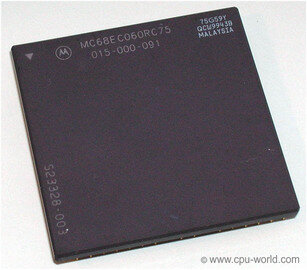
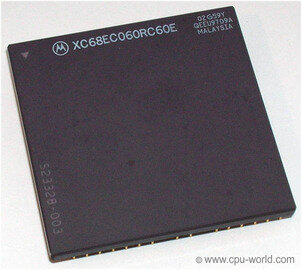
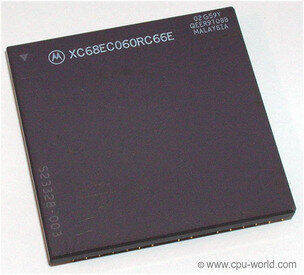
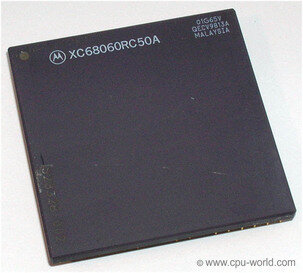
Motorola 68060 (MC68060) is the fourth and the last generation of 680x0 line of 32-bit microprocessors. The 68060 has two 4-stage pipelines, separate 8KB instruction and data caches, two Paged Memory Management Units - one for instructions and another for data, and two integer execution units. Like its predecessor MC68040, the 68060 integrates Floating-Point Unit compatible with Motorola 68881 / 68882 co-processors. The FPU provides hardware support only for most common floating-point instructions and data types. All unsupported instructions and data types are emulated in software.
Supervisor mode of the Motorola 68060 CPU differs from the 68040 due to changes in exception processing. User mode of the Motorola 68060 is object-compatible with MC68040, assuming that the CPU uses special software to simulate a few instructions that were present in 68040 CPU and are missing in MC68060.
The Motorola 68060 is much faster than its predecessor, mainly due to higher clock speed, superscalar design, larger instruction and data caches and branch prediction. Under the best conditions the 68060 can execute one integer instruction and one Floating-Point instruction per clock cycle, or up to 2 integer instructions and one branch instruction per clock cycle. Not all integer instructions can be executed simultaneously. Also, the CPU cannot execute the instructions out of order.
The 68060 CPU uses lower voltage - 3.3 Volt as opposed to 5 Volt for 68040. Lower core voltage directly translates into lower CPU power requirements. For example, 68060 66 MHz dissipates as much power as 68040 33 MHz. In addition to lower voltage the 68060 includes other power-saving features, such as powering down individual chip units when they are not in use, and ability to stop the clock while saving the contents of CPU registers.
Motorola also manufactured two low-cost versions of the 68060 microprocessor:
- 68LC060 (MC68LC060) was a low-cost version without integrated FPU
- 68EC060 (MC68EC060) was an embedded version without integrated FPU and MMU units.

my new baby is a mac mini triple boot tigger,morphos,commodore os
I can understand Tiger and MorphOS, but Commodore OS? Have they "made" a distro for ppc machines, or is it just skins and stuff plugged-in to a regular Linux ppc distro?
Hell why not an ARM acceleratorThey run nice and cool and are way fast enough to emulate 060 code. It'd be a task sure but think how fast you could get a miggy running, lol
Seriously, though, is there a 68K -> ARM JIT compiler yet? Because a non-JIT emulation wouldn't offer much improvement speedwise.
And i'm not sure what your on about, bridging the gap, by sticking a x86 CPU on a Amiga accelerator? You do realise that no software written for current x86 systems would run on it, and no software written for it, would run on current x86 systems. The only benefit you'd get is that you could run wine, (and similar environments) and have the x86 CPU run x86 software as if on a x86 system. In which case your better of using the x86 system to start with. It's going to be faster, more reliable, and most likely, a lot cheaper.
OS4.x and possible future OS5 or whatever, if people can pay 2000 large on an X1000, why not port it to x86 and have it run on either an Amiga with bridge board or a normal x86 system.
Amiga OS needs to come off those special processors and join the mainstream.
FPGA is an idea if only for RoHS to be compliant, but I still like it to be a 71E41J MC68060 if possible, I know that will work if it as stable as a Blizzard 1260 or Cyberstorm MKIII.
And i'm not sure what your on about, bridging the gap, by sticking a x86 CPU on a Amiga accelerator? You do realise that no software written for current x86 systems would run on it, and no software written for it, would run on current x86 systems. The only benefit you'd get is that you could run wine, (and similar environments) and have the x86 CPU run x86 software as if on a x86 system. In which case your better of using the x86 system to start with. It's going to be faster, more reliable, and most likely, a lot cheaper.
who has the rights to them now?etc
basicly everyone would have to ask themselves a few questions about the hardware to start with.
can a amiga use sdram?
can a 040/060 be interfaced with sdram?
can an 060 be ran on an amiga at 100mhz?(even on the old hardware as proof of concept)
up until recently these where thought impossible for all sorts of reasons.(just making a point here)
....Amiga OS needs to come off those special processors and join the mainstream.
who has the rights to them now?etc
No one.
basicly everyone would have to ask themselves a few questions about the hardware to start with.
Let's go:
Yes, but the design is tricky, at best. SDRAM have higher raise and fall edges (signal-wise) and the interface must be pass through a very fast PGA. I've check the schematics while researching a DIY 030 accelerator for the A600, a few years ago. The (free) available code is for the 68k replacement CPU: the Coldfire.
See above.
can an 060 be ran on an amiga at 100mhz?(even on the old hardware as proof of concept)
Yes and no.
The 060 CPU can. Memory and memory interface are not faster enough to cope with this clock speed.
up until recently these where thought impossible for all sorts of reasons.(just making a point here)
The 100MHz was already reached (see Stan/Stachu efforts on this very site).
I couldn't found the thread with my poor search skills, but I'm sure they are in this very forum.
Stan use to sell lots of upgraded Blizzard PPC & Apollo 1260@80MHz here, so you might ask him directly.