Modern Amiga PSUs: deeper than a rabbit hole!

  • Thread starter Thread starter fpmpaolo
  • Start date Start date
  • Replies Replies 128
  • Views Views 4854
Again, I return to the PT-65B as having a 50 mV ripple on the 5 V line and being unsuitable, and whether an absolute 12 V (+/-) for the sound and RS232 transceiver is necessary, requiring a Buck's converter.

I was attempting to learn about the accuracies needed for the A1200 12 V supply. I don't use the RT-65B for other reasons, but I wish to know more about this issue.

I wasn't familiar with the PT-65B (as opposed to the RT-65B which is commonly used) so looking at the numbers it seems that the ripple is within Commodore spec. If it also has an output potensiometer to adjust voltage to compensate for cable/connector drop then it's probably not a bad solution. I did some googling and Daedalus over at EAB speaks positively about it. I'll keep using the CA-PSU myself as it comes with a feedback circuit for dynamic voltage compensation, has warranty and liability insurance etc.
 
Thank you for the feedback. I am still unfamiliar with why a power supply like the PT-65B's use is suboptimal and going to cause issues. It is said by Mean Well to be of Medical Grade (that I assume means it meets ANSI IEC60601-1 and 60601-1-2 standards for electrical and electromagnetic requirements). An online commentator (Reddit) has argued that it would cause severe damage to an Amiga A1200, but I am finding on investigation no evidence of this.

Hence, I am trying to find more information about using it versus other options.
 
I've built one A500 in a CheckMate case and several A1200s in CheckMate cases, all using an SFX PSU, but the post began with appropriate external supplies consistent with the A500 and perhaps the A1200. Again, I return to the PT-65B as having a 50 mV ripple on the 5 V line and being unsuitable, and whether an absolute 12 V (+/-) for the sound and RS232 transceiver is necessary, requiring a Buck's converter.

I was attempting to learn about the accuracies needed for the A1200 12 V supply. I don't use the RT-65B for other reasons, but I wish to know more about this issue.
If the CheckMate builds exhibit no issues, is that not sufficient confirmation that such power supplies are a valid option to the others you list? Did you happen to experience any issues with the SFX ATXs in those builds?
 
If the CheckMate builds exhibit no issues, is that not sufficient confirmation that such power supplies are a valid option to the others you list? Did you happen to experience any issues with the SFX ATXs in those builds?
Well I think they are fine, but the CheckMate cases get pricey for all of my A1200s I own.
 
Indeed @bdb, and I have only one Checkmate 1500 for this very reason. However, when the new 1500 came out many of us jumped on board and put our 500s and 1200 in there with an ATX power supply in SFX form factor, usually in that sub-350watt size, which is ideal apparently to avoid issues with the load @atomontage validly brought to our attention.

So while this was certainly not the intent of the Checkmate 1500, all those users using ATX with their wedge motherboards and usually upgraded setups gave me confidence to find an ATX solution out there for cost efficiency reasons. I don't quite like any of the external power supply looks outside of the original Commodore bricks, because they belong. And as many noted, economics of those PSU can become a hurdle. Since I could find enough 1U PSUs and some spares locally for all my wedges for less than the price of a dedicated external PSU, I decided that I'll go this way. Hence sharing my idea of 1U ATX PSU for standard desktop wedges application. Although, I've also stuck those motherboards in some interesting places that make use of such PSU logical. I'm about to finish putting a 1200 Mobo where no 1200 Mobo has gone before! But I also use them in place of the Commodore bricks now as well and pick them up often for a price of large McDonald's fries at local used computer stores that are still around.
 
What issues with the load are you referring to? Do you mean the 12 V line that drives the audio and RS232 Transceiver? Since these require so little in the way of amperage, do they pose a serious issue with damage to the other ICs? Or does the ripple and Amperage affect the sound and serial transmission?
 
Last edited:
What issues with the load are you referring to?
To the issues highlighted and shared with us by @atomontage. On Page 2, @atomontage noted:

From Ian Stedman's guide to ATX PSUs here (look at the "minimum loads" section):

On that page Ian Stedman notes under ATX section that to avoid load issues (explained on that page) do this:

You would be better suited using a 350W power supply or lower, they have more realistic minimum loads, which are met by the Amiga. For the ‘wedge’ Amigas, use a 150W or lower supply.
 
Isn't Ian referring to the big box Amigas?
For the ‘wedge’ Amigas, use a 150W or lower supply.

Looks like for all Amiga applications, but as per the info I pulled from his site, he separates the details to give a blanket recommendation for big box and wedges. There are plenty of 90W, 110W etc. 1U power supplies that I got that fit within this recommendation.
 
Can you explain why?
I think maybe you could read his (Ian's) page first? The one @atomontage provides under the "here" word is a link to it. He explains it in detail. Cheers. He's just making sure the load issue is addressed for users using ATX. Very useful and helpful info and work done by Ian, and I appreciate @atomontage sharing it with us.
 
Jens CA PSU powers his device with a wall wart power supply which can't approximate a 150 W ATX PSU.
 
I've read Ian's and Jen's pages in length and others, but neither recommend an ATX PSU for a wedge Amiga.
 
Jens CA PSU powers his device with a wall wart power supply which can't approximate a 150 W ATX PSU.
Yes, it's a lovely PSU, about that there is no argument. For those of us in North America it lands at your door at $1 USD per watt after shipping and duties (Not his fault!). On the other hand, I'm quite certain I can locate about a dozen FSP090, FSP100 and FSP150 1U ATXs and have change for lunch.

I've read Ian's and Jen's pages in length and others, but neither recommend an ATX PSU for a wedge Amiga.
This could be due to some of the slight complexities, like this 150 watt recommendation for wedges by Ian, which I happen to be following by total fluke of choosing these 1U power supplies I found and chose simply due to size and price. However back to Checkmate 1500 - how many people are running 150 watt SFX in there? I'm not. Mine if memory serves me right is 400 watt. And I'm sure many people put large wattage SFX ATX in their Checkmate 1500 and their wedge motherboards are just fine. So, is that 150 watt ATX wedge limit recommendation by Ian necessary or just from overabundance of caution? You hear of anyone blowing up their 1200s or 500s with their SFX ATX PSU? I haven't. Also, I don't think Ian recommends to not use ATX PSUs with wedge. Ian's page is designed for the purpose and his recommendation appears to be, use 150watt or smaller ATX for wedge to avoid any potential load related issues.
 
Last edited:
Then you should sleep well at night knowing your Amiga's are safe.
I have not had issues with ATX applications. Is it more risky to have old original PSUs in big box or wedge Amiga or use a newer ATX? And if so many people are using ATX without issues, why can't I? ...and so I have. Just my choice that I shared, but I'm clearly not the only one powering Amiga wedges with ATX. Every Checkmate 1500 is doing it, and how many is that? About 500 people backed the Kickstarter alone. I bought my case after. I've heard of no issues or problems.

And you know...really anything could happen, anytime. Hence, I sleep well knowing I better get good sleep in case I get to wake up tomorrow to live another day...don't want to be groggy and tired because my Amiga is getting juice from an ATX PSU. :)
 
Last edited:
I will continue to search for information on the smaller power supplies that function in a closer approximation to the original specifications as originally laid out by Commodore for their wedge style computers.
 
@bdb The possible issue with modern ATX supplies is that they use the 12V rail as the main rail for voltage regulation. This means that if there's not appropriate load on that 12V rail (which will almost always be the case with an Amiga) then all bets are off regarding voltage output, and it can be unstable to varying degrees. In a lot of these modern ATX supplies, this will also affect the 5V rail. So essentially, if you don't present enough artificial load to the 12V rail of these PSUs to exceed their minimum load requirements (read what Ian Stedman has to say about that), then you could be getting wildly varying voltages out of the PSU which can damage an Amiga.

Some older ATX supplies use the 5V rail for regulation and I believe those would be appropriate (but don't blindly trust what I say).
Even older AT supplies are also appropriate and should not suffer from regulation problems.

Regarding wattage, there's no way you'll need more than the 60W the CA-PSU offers for compact desktop Amigas (including an A1200 expanded "to the gills").
For tower Amigas and A4000, 60W may not be enough depending on number of expansions but I'm speculating.

So TL;DR ripple should not be an issue with ATX/AT supplies, but voltage regulation could be.
 
I will continue to search/research the topic, as the original specifications must allow other safe options other than those discussed here. It seems folks have made their decisions and settled on their own solutions quoting Ian and Jens as the only viable ones. Can this really be all there is to the solution?
 
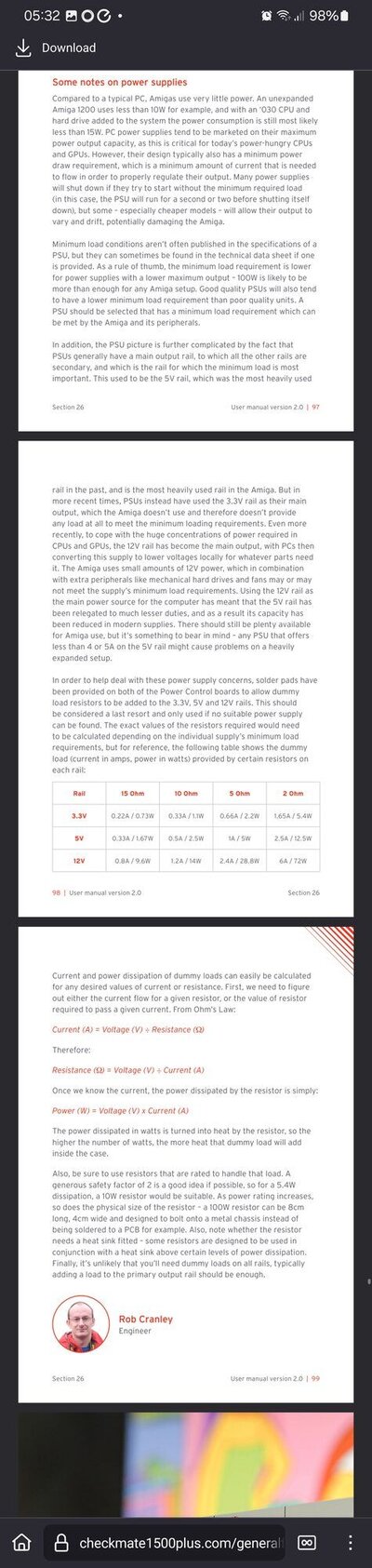
In the Checkmate 1500 Plus manual there's a separate chapter discussing how to add dummy loads of the PSU isn't behaving.

The chapter is called "Some notes on power supplies", and is found on page 97.
 

Attachments

  • Screenshot_20250422_053226_Firefox.jpg
    Screenshot_20250422_053226_Firefox.jpg
    168.6 KB · Views: 21
Back
Top Bottom