
Thats so odd. I dont know what i'm doing differently.
which pi are you using please, a pi 2/3 /zero /zero w?
probably best to write a floppy on your apple via atdpro (serial card or over audio etc)
It's because you are being cheap as usual and using a Pi Zero lol

You made me laugh Bas!

@danielj:
Nice to hear from you, your project, eh? Excellent! I really must stick my nose in at *. it's been ages.
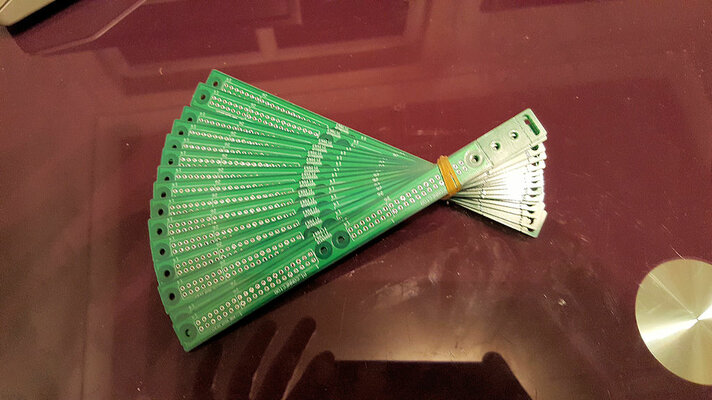
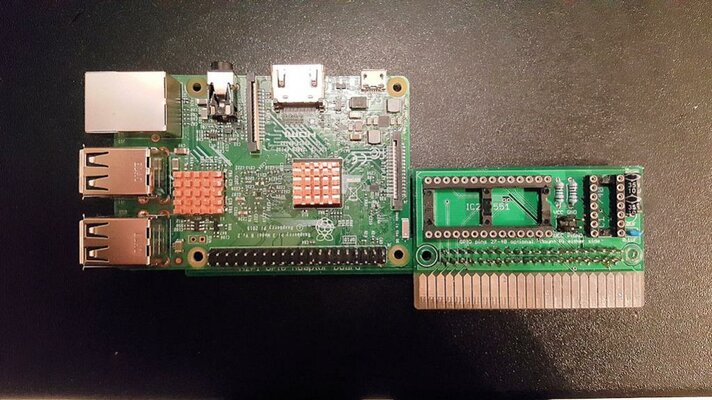
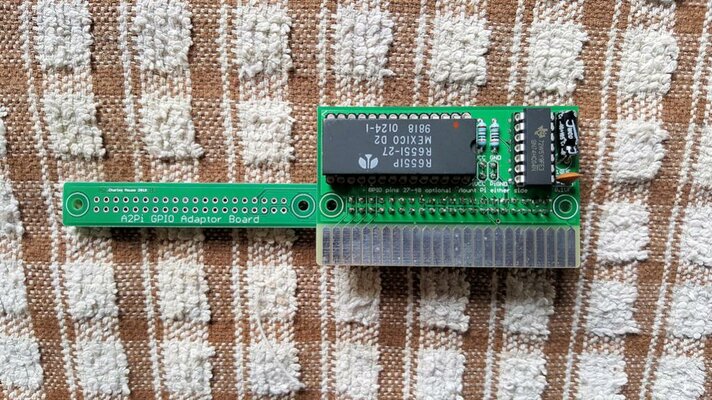
On the A2Pi front I can claim no cleverness at all, the design + software is down to Dave Schmenk, I just grabbed his published specs an rolled my own version of the interface board... I did intend to use something other than a 6551 (a bit old) but in all honesty ran out of talent at that point so just stuck with 'traditional'.
Entirely from memory:
A2Pi uses 5 GPIO lines: 5v & GND, and IN, OUT, CLOCK, for the serial communication with the 6551 (also a couple of resistors for level conversion) It works remarkably well with an absolute minimum of hardware, hat's off to him. If I hadn't run out of talent I was hoping to drive the serial communication faster with with the help of newer hardware, or use more GPIO pins for a parallel connection - one of the many very good things about A2Pi is it auto-magically mounts your physical drives on the Pi and provides virtual drives for the Apple II... the down side is that serial link can be a bit slow when opening a FDD with lots of files or an HDD.
If I can be of any assistance I'd be most pleased, but I suspect you know far more about this stuff than me. If I had my way I'd be happy with a faster connection and if at all possible the client code going in to ROM so a bare Apple II would just work. If you are inclined to add an A2Pi header to your board that would be excellent, TBH the only trick, if going with a 6551, is to be sure you think carefully where you put the header or routing cables to the Pi can be impossible:
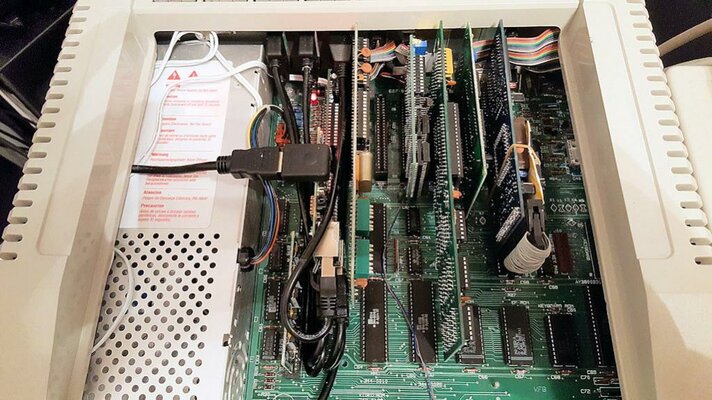
-The official board has the GPIO at the top with the Pi mounted face-down, with just enough room in front of the Apple bus socket to get a HDMI adapter in there.
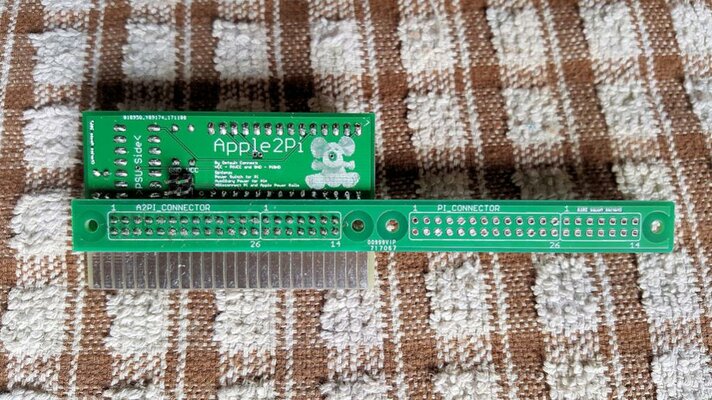
-Mine has the GPIO right next to the Apple bus slot and the Pi mounted the other way up primarily because it meant a smaller / cheaper PCB...further up this thread is a GPIO adapter for my board to mount the Pi further away from other cards. I suspect mounting a Pi on the keyboard end of a Superserial design might be the best plan for space.
PS:
Another option might be to dispense with a traditional Pi completely and instead include a socket for a Pi compute module. I did some preliminary Eagle files for that further up this thread that you would be very welcome to... More complication, and would very likely will push up the price of a finished board quite a bit compared to just including a few GPIO pins... but a Super Serial board with the option to plug in a compute module would be very cool and with all those lines open up a world of further options.
- - - Updated - - -
...
Whats the easiest way to get the startup.txt to a disk image? I see Charlie mentioned Ciderpress, I will download it and play with it. Is that Going the right direction?
THANKS
Glad it's working for someone other than me ;-)
The most helpful thing would be for me to put up a disk image with my changes on it. I've been a bit reluctant to do so because I don't want to go treading on DS's toes flinging about rogue versions of his software...
For now CiderPress is your (very unintuitive) friend. In a nut-shell: Take the v1.6.po image, load up in CiderPress, delete the STARTUP.BAS file, and import my start.txt being sure to inform CiderPress it's a BASIC file.
If you look as what I did to DS's code you can see I wasn't at all tidy - just slammed in a bunch of code to (IMO) pretty-up the screens a bit - absolutely nil added on the functionality front... Having said that, once I get a better hang of AppleSoft BASIC, I'm intending to add the A2CLOUD client to the disk for those who might want it - I added A2CLOUD support in to 'my' version of the A2PiOS with that in mind.
Last edited: