
You are using an out of date browser. It may not display this or other websites correctly.
You should upgrade or use an alternative browser.
You should upgrade or use an alternative browser.
A2Pi
- Thread starter Charlie
- Start date
- Replies 151
- Views 31230


protek
"Takai desu ne." -"Jinsei da."
I'll probably put a CF adapter card into it. Do the 40-pin CF adapters get their power straight from the IDE pins? A cheaper option might be an IDE to SD card adapter, though. At least the SD cards are cheaper.
Edit: Got an 40-pin IDE to SD card adapter from the other bay. Need to make a power cable for it.
Edit: Got an 40-pin IDE to SD card adapter from the other bay. Need to make a power cable for it.
Last edited:

I've kept an eye on their site for years and ordered one a couple weeks ago!
3, that's not a bad ratio
i think the cf adaptors that work on amiga pull 5v from the standard pins. When mine arrives I'll try that and a sd /ide adaptor as well and will share if / which works.
Does anyone know- on an apple Ii with ide, if you load a program, do you reset the entire machine to exit the program or does control reset(?) exit and leave you back in prodos and able to cat, load another program without rebooting from cold??
3, that's not a bad ratio
i think the cf adaptors that work on amiga pull 5v from the standard pins. When mine arrives I'll try that and a sd /ide adaptor as well and will share if / which works.
Does anyone know- on an apple Ii with ide, if you load a program, do you reset the entire machine to exit the program or does control reset(?) exit and leave you back in prodos and able to cat, load another program without rebooting from cold??
protek
"Takai desu ne." -"Jinsei da."
The user manual says they've been using an SD card ina SD CF adapter which in turn has been stuck into a CF IDE adapter.
The adapter I ordered had a 40 pin connector and a floppy/molex power connector. I bought a simple molex to floppy/molex Y splitter cable. I can stick the female molex into the adapter and the floppy connector to the Classic IDE.
Have to create an SD card with ciderpress.
The adapter I ordered had a 40 pin connector and a floppy/molex power connector. I bought a simple molex to floppy/molex Y splitter cable. I can stick the female molex into the adapter and the floppy connector to the Classic IDE.
Have to create an SD card with ciderpress.
Last edited:
While surfing I came across:
http://retrorgb.com/rpi240p.html
https://github.com/fenlogic/vga666
...and I thought:
RGB out on the A2Pi board might make an easy and interesting addition, assuming there aren't any GPIO clashes. Is this something others might be interested in?
http://retrorgb.com/rpi240p.html
https://github.com/fenlogic/vga666
...and I thought:
RGB out on the A2Pi board might make an easy and interesting addition, assuming there aren't any GPIO clashes. Is this something others might be interested in?
hello
probably not for me ta, as i'm v happy with the pi zero's composite out, it even copes very well with GS desktop and 80 cols. plus I like a bit of that Woz NTSC colour weirdness (even though its emulated)
probably not for me ta, as i'm v happy with the pi zero's composite out, it even copes very well with GS desktop and 80 cols. plus I like a bit of that Woz NTSC colour weirdness (even though its emulated)
New Run and Version
New Run and Version
Hi all,
I'm doing another run of these boards as the last lot I made are all gone and they seem to be quite popular.
Small but significant update:
I've added a power jumper block to the A2Pi board. By default the idea is it can be jumpered as per the previous board to get all it's power from the Apple II bus, but now the Pi's power rails can be fully separated from the computer's supply. I did take every precaution to make the jumper settings on the board as obvious as possible as getting them wrong will cause a short, escapes Magic Smoke, flames, FUBAR, etc...
Why?
The A2Pi's electronics are, as before, wired to the Apple II. But this addition gives the option to either add an independent power switch for the Pi or (in the hope that the software may one day become Pi 3 compatible) allow an auxiliary PSU for the Pi to take the strain off the Apple's power rails - I really wouldn't recommend using the Apple II's bus to power a Pi 3 should this ever become an option.
PDF of latest version attached below.
New Run and Version
Hi all,
I'm doing another run of these boards as the last lot I made are all gone and they seem to be quite popular.
Small but significant update:
I've added a power jumper block to the A2Pi board. By default the idea is it can be jumpered as per the previous board to get all it's power from the Apple II bus, but now the Pi's power rails can be fully separated from the computer's supply. I did take every precaution to make the jumper settings on the board as obvious as possible as getting them wrong will cause a short, escapes Magic Smoke, flames, FUBAR, etc...
Why?
The A2Pi's electronics are, as before, wired to the Apple II. But this addition gives the option to either add an independent power switch for the Pi or (in the hope that the software may one day become Pi 3 compatible) allow an auxiliary PSU for the Pi to take the strain off the Apple's power rails - I really wouldn't recommend using the Apple II's bus to power a Pi 3 should this ever become an option.
PDF of latest version attached below.
Attachments
Last edited:

Much needed upgrade, awesome... 1 for me please
Much needed upgrade, awesome... 1 for me please
Most kind, that will be two boards I need to post to you!

PS
For general info: I sold my spare boards on eBay to help fund ongoing projects and they went rather quickly... hence my seeing a need to do more as there's obviously quite a demand, and why not add a bit of functionality while I'm at it? As before this is hobby for me so boards to AmiBay friends who want one and any remaining will go to help fund further projects.
Some potentially good news:
I just got an eBay message from, I believe, the chap who did the design for the boards sold through Reactive Micro. It seems they are back in production which can only be good news for the Apple II community at large.
Still, that's a professionally supported commercial product that comes with software ready to go while my own board is something cheaper without support as such for people who are happy to get their hands dirty, or indeed take my Eagle Files and do their own thing!
Both boards are based off Dave Schmenk's publicly available circuit and software from his website and github. He along with those behind Raspapple II and anyone I've carelessly forgotten deserve all the credit. All I've done is come up with my own physical design based on Dave's work.
Eagle Files for latest verion below:
Attachments
Last edited:
Latest A2Pi Revision
Latest A2Pi Revision
Well my latest boards came from Seeed today, here's hoping I've not stuffed anything up with the latest addition to the layout.
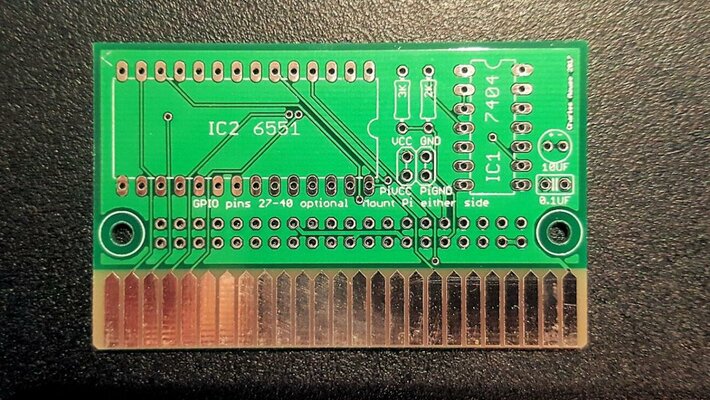
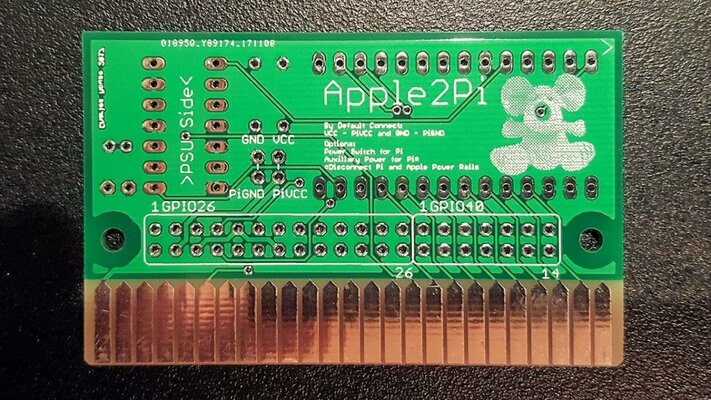
PCB Front and Back
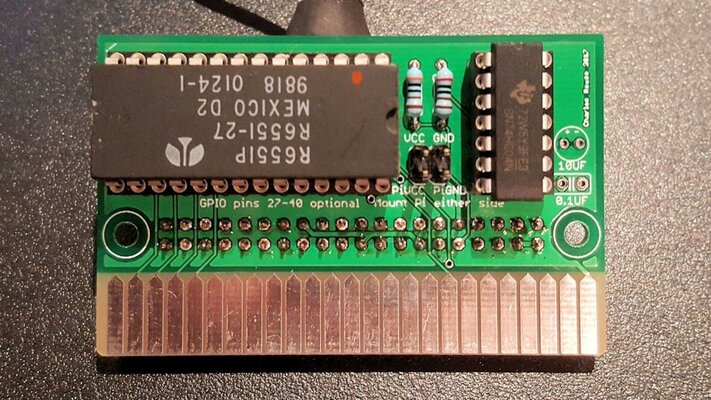
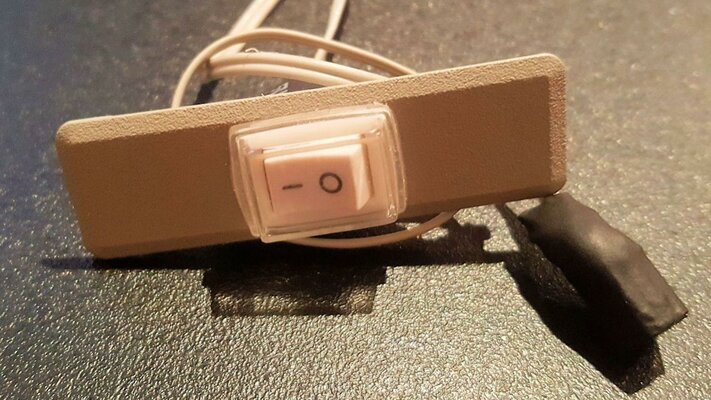
Constructed and Switch
Apart from updating the text so it should now be possible to build an A2Pi with only the PCB to hand by way of instructions the main change was to separate the Pi's power lines from the Apple II by way of a four pin header. Such a useful and simple idea, I wish I'd thought of it sooner. As in the photos above I'm going to use the header for an independent on/off switch but other uses spring to mind...
Time to pull my IIe apart, again, and see if it works - wish me luck!
Latest A2Pi Revision
Well my latest boards came from Seeed today, here's hoping I've not stuffed anything up with the latest addition to the layout.
PCB Front and Back
Constructed and Switch
Time to pull my IIe apart, again, and see if it works - wish me luck!
Last edited:
Very Useful Upgrade my friend. Save having to Pull the A2Pi from the slot if you want to use the machine is Standard Mode..

Thank you
It seems I'm about to find out if my other intention will work - extra power to run a Pi 3... Having pulled my current set up I see I soldered the Pi 2 to my previous A2Pi card. Oops, and having checked my Zero is also soldered to a CoPro adaptor board for my Beeb and I otherwise only have Pi 3's to hand. Double oops!
Oh, well. I'll call it a testing opportunity... I have a feeling Raspapple II won't work with a Pi 3. Hopefully wrong, but if so I hope the pkg files will work with Raspbian.
It seems I'm about to find out if my other intention will work - extra power to run a Pi 3... Having pulled my current set up I see I soldered the Pi 2 to my previous A2Pi card. Oops, and having checked my Zero is also soldered to a CoPro adaptor board for my Beeb and I otherwise only have Pi 3's to hand. Double oops!
Oh, well. I'll call it a testing opportunity... I have a feeling Raspapple II won't work with a Pi 3. Hopefully wrong, but if so I hope the pkg files will work with Raspbian.
Awesome work on this. I’ve been trying to get a pie to work via a super serial card with no luck. I think the A2Pi card is a great route to go. Just need to pick up a card when they go on sale again.
Thanks for sharing.
Thanks for sharing.
Last edited:
Awesome work on this. I’ve been trying to get a pie to work via a super serial card with no luck. I think the A2Pi card is a great route to go. Just need to pick up a card when they go on sale again.
Thanks for sharing.
Hello,
Thanks for your kind comments, there are developments on the A2Pi front, let's get the possibly unhelpful news out of the way first:
The 'official' boards are back in production, and the maker has politely expressed to me he's not that happy I've been making a version myself. The last thing I want to do is tread too heavily on the toes of others supporting the retr0 community so I'm not intending on making further runs of my board for sale, but:
-I have PCB's, of which I will make more if I run out, I even have a spare Pi 2 soldered to a board ready to go as a drop-in-and-go
-I'll keep making my version on a request basis here on AmiBay - pm me
Now on to some hopefully better news:
-I'm working on an A2Pi board that uses a Pi Compute Module, the design is 3/4 done and I'll finish it if there's interest. The idea is basically you get a fully plug 'n play A2Pi solution as a proper Apple II slot board with USB, HDMI, and GPIO if I can be bothered with the latter. Take board, plug in compute module of your choice, plug in to Apple II, hook up USB hub and HDMI and away you go...
-I've updated the A2Pi client a little. Nothing amazing, but my version is IMO a little prettier and more helpful than the official v1.6 A2Pi floppy image. I'll link the replacement STARTUP.BAS in this post, just replace the old one with mine using CiderPress.
-I've also spent a good deal too much time updating the A2Pi v2.4 OS image (oh, how I HATE Linux). I'll also put a copy of the ReadMe for info below and a link to a DropBox page for download if anyone's interested - .7z archive just under 4gb, 16gb microSD card needed for the un-archived image. IMO it's a pretty big / useful update and well worth a try, feedback welcome.
PS
The ReadMe file was written on my Pi under Raspbian (Linux) so, of course, the formatting will be all messed up if you open it in Notepad (sigh). Use a Linux text editor if you must, or I'd recommend Notepad ++ if you're using a functioning OS.
Attachments
Last edited:
Oh, and here's a video of my IIe Platinum doing it's thing:
As an aside: Haley Reinhart - who would have thought a modern pop-singer, especially one who was on American Idol of all things, would have any talent what-so-ever? It's also a pleasant surprise to hear actual musicians on a modern recording!
As an aside: Haley Reinhart - who would have thought a modern pop-singer, especially one who was on American Idol of all things, would have any talent what-so-ever? It's also a pleasant surprise to hear actual musicians on a modern recording!
Last edited:
A step too far..?
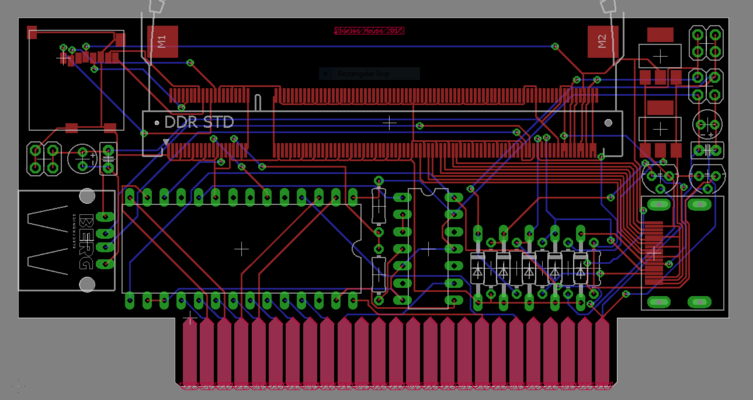
A2Pi for Compute Module
The above is an initial prototype for a Pi Compute Module based A2Pi card. The idea is to have a neater / more flexible / easier to install solution. The A2Pi board carries a microSD card, HDMI port, USB port, the Pi itself, and the A2Pi interface logic.
-Pick a Compute Module of your choice (Pi1 - Pi3 spec)
-Plug said module in to the above card
-Bang the card in to your Apple II and job done...
...well, there's the small matter of a microSD card, and USB hub to add if required
The down sides are:
-Compute Modules are a little more expensive
-The above version of the A2Pi board will be more to produce
-There's only one USB port...
...so a USB hub would be needed. At the end of the day I'm pretty sure standard Pi's hang their USB ports, WiFi, and Ethernet off an on-board USB hub so there shouldn't be a performance hit with the benefit that using an off the shelf hub will be cheaper and more flexible than it being part of the A2Pi board.
What do people think? Is this 'better' or just overcomplicating something that already works fine?
If this is 'better' is the above prototype about right or should it have anything else? eg:
-GPIO headers wouldn't be hard to add but are they needed for this application?
-A boot ROM instead of relying on Floppy /HDD..? (I'd need someone to do the coding!)
-It might be fun to have some kind of composite out / mixing with the Apple II's output for a more 'authentic' experience
A2Pi for Compute Module
-Pick a Compute Module of your choice (Pi1 - Pi3 spec)
-Plug said module in to the above card
-Bang the card in to your Apple II and job done...
...well, there's the small matter of a microSD card, and USB hub to add if required
The down sides are:
-Compute Modules are a little more expensive
-The above version of the A2Pi board will be more to produce
-There's only one USB port...
...so a USB hub would be needed. At the end of the day I'm pretty sure standard Pi's hang their USB ports, WiFi, and Ethernet off an on-board USB hub so there shouldn't be a performance hit with the benefit that using an off the shelf hub will be cheaper and more flexible than it being part of the A2Pi board.
What do people think? Is this 'better' or just overcomplicating something that already works fine?
If this is 'better' is the above prototype about right or should it have anything else? eg:
-GPIO headers wouldn't be hard to add but are they needed for this application?
-A boot ROM instead of relying on Floppy /HDD..? (I'd need someone to do the coding!)
-It might be fun to have some kind of composite out / mixing with the Apple II's output for a more 'authentic' experience
Last edited:
Hi Charlie, very nice work there, I've just watched the video. So you're booting into attract mode, which seems to work really nicely on your setup.
I like you have the matching artwork, is that artwork in the dropbox download?
This is so hard. But what are the reasons for having an a2pi, the requirements .. i think [for me] reason 1) is my a2pi with pi zero works great to emulate 2GS as i have enough usb ports, my usb keyboard actually has 2 more usb ports built in. For that, mine is perfect.
ive never made the virtual drives work and dont need to now i have the apple2sdthingy - and other ide options are now available! so i can only see 2 reasons to do it:
reason 2)_ is if I want to install retropie with attract mode and use the iie keyboard etc. for that a pi 3 is needed*
As I dont like soldering pi 3's or compute modules [making it a permanent arrangement] my ideal would be a set up with headers so the pi3 could be repurposed, so mount either by ribbon or using a longer pcb with the pi3 positioned away from the narrow slot width.
I know you've tried those though.
i know the pi zero cant drive composite and hdmi at the same time, I assume thats the same for pi 3.
usb ports, btw there's a usb hat for pi3 (even has a uart on it.. (??)) and of course that needs access to the GPIO pins
if you want an emergency reset for the pi [very useful in my experience] there's a reset script that also needs access to the gpio pins.
so it comes down to:
an a2pi with soldered on pi zero for 2GS emilation: perfect as is
a pi3 to run retropie really needs a detachable /accessible /aesthetically pleasing board. I'd pay extra to get a bigger board and mount the pi in a better place. its still comprimised by the external psu so maybe not that big a deal.
unless there's a 3rd reason for adding a pi?
*have you tried running the emulators you want to use, on a pi zero w?
I like you have the matching artwork, is that artwork in the dropbox download?
This is so hard. But what are the reasons for having an a2pi, the requirements .. i think [for me] reason 1) is my a2pi with pi zero works great to emulate 2GS as i have enough usb ports, my usb keyboard actually has 2 more usb ports built in. For that, mine is perfect.
ive never made the virtual drives work and dont need to now i have the apple2sdthingy - and other ide options are now available! so i can only see 2 reasons to do it:
reason 2)_ is if I want to install retropie with attract mode and use the iie keyboard etc. for that a pi 3 is needed*
As I dont like soldering pi 3's or compute modules [making it a permanent arrangement] my ideal would be a set up with headers so the pi3 could be repurposed, so mount either by ribbon or using a longer pcb with the pi3 positioned away from the narrow slot width.
I know you've tried those though.
i know the pi zero cant drive composite and hdmi at the same time, I assume thats the same for pi 3.
usb ports, btw there's a usb hat for pi3 (even has a uart on it.. (??)) and of course that needs access to the GPIO pins
if you want an emergency reset for the pi [very useful in my experience] there's a reset script that also needs access to the gpio pins.
so it comes down to:
an a2pi with soldered on pi zero for 2GS emilation: perfect as is
a pi3 to run retropie really needs a detachable /accessible /aesthetically pleasing board. I'd pay extra to get a bigger board and mount the pi in a better place. its still comprimised by the external psu so maybe not that big a deal.
unless there's a 3rd reason for adding a pi?
*have you tried running the emulators you want to use, on a pi zero w?
Last edited:
Hi Iain,
All most helpful feedback, thanks.
The image I put on Dropbox is the very same install I used in the video... well, to keep the download size down there aren't any ROMs included but for the Amstrad version of Lasersquad. For the same reason the image on Dropbox only has the standard skin, not the one in the video.
The Dropbox image should work absolutely fine with any Pi, but I admit I've not tested as yet. The Pi 3 overclocking options I put in the config.txt file are commented out and labelled so it shouldn't fall over with other Pi's.
Yes, a Pi 3 (indeed a Pi 2) is absolutely overkill for A2Pi and GSOS emulation. And a Zero is more than enough to do RetroPie for anything 'below' and PSX /N64, including MAME... For interest I came across someone else who's running a Pi 3 in his IIe without an additional PSU and reports he's having no issues, although his II's PSU has been upgraded. TBH: I'm using a Pi 3 because I like to push these things and I want to make my IIe my daily driver for retro stuff and light 'modern PC' use.
On the hardware front:
What's really required is a neater / more convenient solution using a standard Pi..? That makes sense, I have a habit of packing and miniaturising the boards I make for no better reason than aesthetics... my Mockingbird board is a good example of that. It was Bas who quite rightly suggested a more roomy version with a few more features, and I have to admit the latest version is indeed much, much better for his feedback.
So:
I'm thinking a larger board with connection for standard Pi's, situated on the end of the board so there's more room round the Pi..? Half a mo' I'll do a quick mock-up and see what you think. Another benefit is a larger board would allow for further additions if anything takes your fancy.
Thanks for the feedback.
PS:
I also did an updated A2Pi image without RetroPie if anyone's interested. I didn't upload it simply because the above image filled my Dropbox account.
All most helpful feedback, thanks.
The image I put on Dropbox is the very same install I used in the video... well, to keep the download size down there aren't any ROMs included but for the Amstrad version of Lasersquad. For the same reason the image on Dropbox only has the standard skin, not the one in the video.
The Dropbox image should work absolutely fine with any Pi, but I admit I've not tested as yet. The Pi 3 overclocking options I put in the config.txt file are commented out and labelled so it shouldn't fall over with other Pi's.
Yes, a Pi 3 (indeed a Pi 2) is absolutely overkill for A2Pi and GSOS emulation. And a Zero is more than enough to do RetroPie for anything 'below' and PSX /N64, including MAME... For interest I came across someone else who's running a Pi 3 in his IIe without an additional PSU and reports he's having no issues, although his II's PSU has been upgraded. TBH: I'm using a Pi 3 because I like to push these things and I want to make my IIe my daily driver for retro stuff and light 'modern PC' use.
On the hardware front:
What's really required is a neater / more convenient solution using a standard Pi..? That makes sense, I have a habit of packing and miniaturising the boards I make for no better reason than aesthetics... my Mockingbird board is a good example of that. It was Bas who quite rightly suggested a more roomy version with a few more features, and I have to admit the latest version is indeed much, much better for his feedback.
So:
I'm thinking a larger board with connection for standard Pi's, situated on the end of the board so there's more room round the Pi..? Half a mo' I'll do a quick mock-up and see what you think. Another benefit is a larger board would allow for further additions if anything takes your fancy.
Thanks for the feedback.
PS:
I also did an updated A2Pi image without RetroPie if anyone's interested. I didn't upload it simply because the above image filled my Dropbox account.
Last edited:
and over on stardot, someone is cloning an apple ii superserial, presumably with the all-important rom
http://stardot.org.uk/forums/viewtopic.php?f=45&t=14496&p=194158&hilit=apple#p194158
Re the serial ic on the a2pi card charlie, is it viable the card behave like a) a super serial and b) have a switchable input /output to a mounted pi? 2 functions, 1 slot?
In a Homer-Simpson-designs-his-perfect-car scenario, like this (plus the serial output port)
ps i'll try installing your retropie set up on my pi zero w, over composite.
cheers!
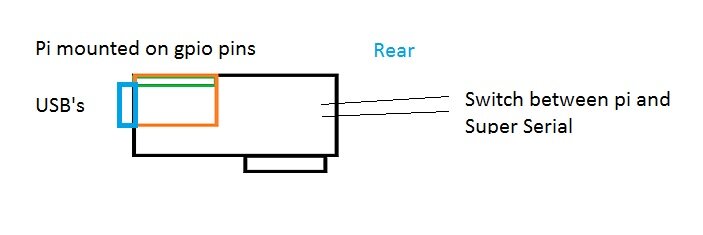
How simple can it be eh
http://stardot.org.uk/forums/viewtopic.php?f=45&t=14496&p=194158&hilit=apple#p194158
Re the serial ic on the a2pi card charlie, is it viable the card behave like a) a super serial and b) have a switchable input /output to a mounted pi? 2 functions, 1 slot?
In a Homer-Simpson-designs-his-perfect-car scenario,
like this (plus the serial output port)ps i'll try installing your retropie set up on my pi zero w, over composite.
cheers!
How simple can it be eh
Last edited:
Ah, now that's interesting...
My understanding is all A2Pi boards are just minimal Superserial cards for the purpose of interfacing the Pi. If one has a Superserial card one doesn't actually need an A2Pi board, wire the relevant GPIO to the Superserial, power for the Pi and job done...
...now, if someone is doing a modern Superserial clone it would indeed be a 'piece of ****' to add a GPIO header for the purpose of attaching a Pi. There may even be enough spare room in the Superserial card's ROM to install the A2Pi client software which would be lovely!
Thoughts:
Is it worth bringing up the whole A2Pi thing over on Stardot? The hard part is doing a new Superserial board, integrating a GPIO header would be a non-issue for the designer - indeed a minimal header with VCC, GND and the required 3 GPIO pins would be enough and take up very little room. The only real 'gotcha' with internal A2Pi solutions is being sure the Pi is mounted low enough so you can plug in an HDMI cable and still get the lid on!
If the designer over on Stardot was interested (and why not for so much extra in exchange for so little extra effort) that would indeed be lovely. If not I'll just wait for the recreated Superserial schematic to be published and do it myself... sadly the latter would mean no added A2Pi boot ROM as I can't code for toffee!
I'm most interested to hear what the reply might be... maybe a link to my video as a quick demo of the kind of thing A2Pi can bring to the party?
In the meantime I came up with this... hack:

A2Pi Adaptor Board
Imagine your Pi of choice is situated at the keyboard end of the current A2Pi board, rather than on top. The above board intended to be snapped in to two sections; the red part would have two GPIO headers, one that fits on the the Pi and the other fits on to the A2Pi board. The small black bit just goes round the back for support. The whole lot then plugged + screwed together for security. One would end up with an A2Pi solution shaped more like a traditional Apple bus card with a lot more room for manoeuvre...
...this solution would remain compatible with any newer Pi (I need to think about the implications for 26 pin GPIO models) and leave the Pi's GPIO potentially accessible for other modules, assuming no clash with the lines A2Pi uses.
Thoughts?
Regards,
Charles.
My understanding is all A2Pi boards are just minimal Superserial cards for the purpose of interfacing the Pi. If one has a Superserial card one doesn't actually need an A2Pi board, wire the relevant GPIO to the Superserial, power for the Pi and job done...
...now, if someone is doing a modern Superserial clone it would indeed be a 'piece of ****' to add a GPIO header for the purpose of attaching a Pi. There may even be enough spare room in the Superserial card's ROM to install the A2Pi client software which would be lovely!
Thoughts:
Is it worth bringing up the whole A2Pi thing over on Stardot? The hard part is doing a new Superserial board, integrating a GPIO header would be a non-issue for the designer - indeed a minimal header with VCC, GND and the required 3 GPIO pins would be enough and take up very little room. The only real 'gotcha' with internal A2Pi solutions is being sure the Pi is mounted low enough so you can plug in an HDMI cable and still get the lid on!
If the designer over on Stardot was interested (and why not for so much extra in exchange for so little extra effort) that would indeed be lovely. If not I'll just wait for the recreated Superserial schematic to be published and do it myself... sadly the latter would mean no added A2Pi boot ROM as I can't code for toffee!
I'm most interested to hear what the reply might be... maybe a link to my video as a quick demo of the kind of thing A2Pi can bring to the party?
In the meantime I came up with this... hack:
A2Pi Adaptor Board
...this solution would remain compatible with any newer Pi (I need to think about the implications for 26 pin GPIO models) and leave the Pi's GPIO potentially accessible for other modules, assuming no clash with the lines A2Pi uses.
Thoughts?
Regards,
Charles.
Last edited:
Similar threads

- Replies
- 54
- Views
- 3K


